Williamstown Voters Pass Waubeeka Hotel Bylaw
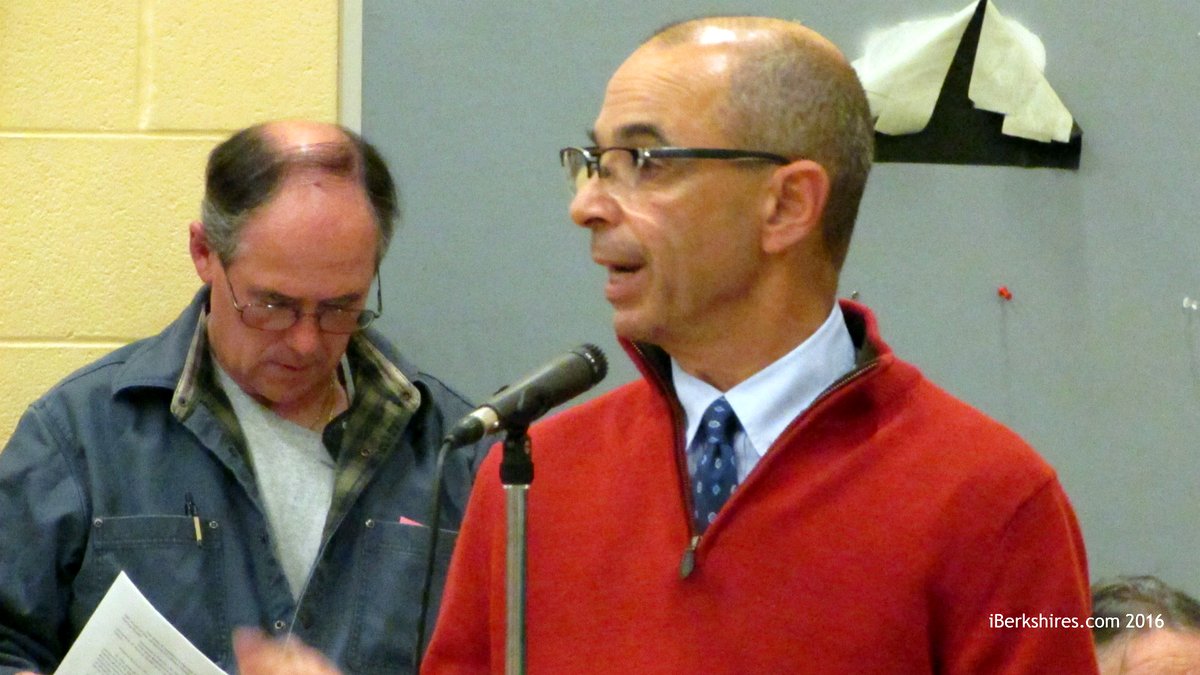
Stanley Parese, the attorney for Waubeeka owner Michael Deep, addresses town meeting.
After a protracted debate that saw a series of amendments and amendments to amendments, the town passed the language preferred by Waubeeka's owner — the so-called "acreage-controlled" amendment that would allow a developer to seek a special permit to build a 120-room hotel and associated buildings in a 10-acre building envelope.
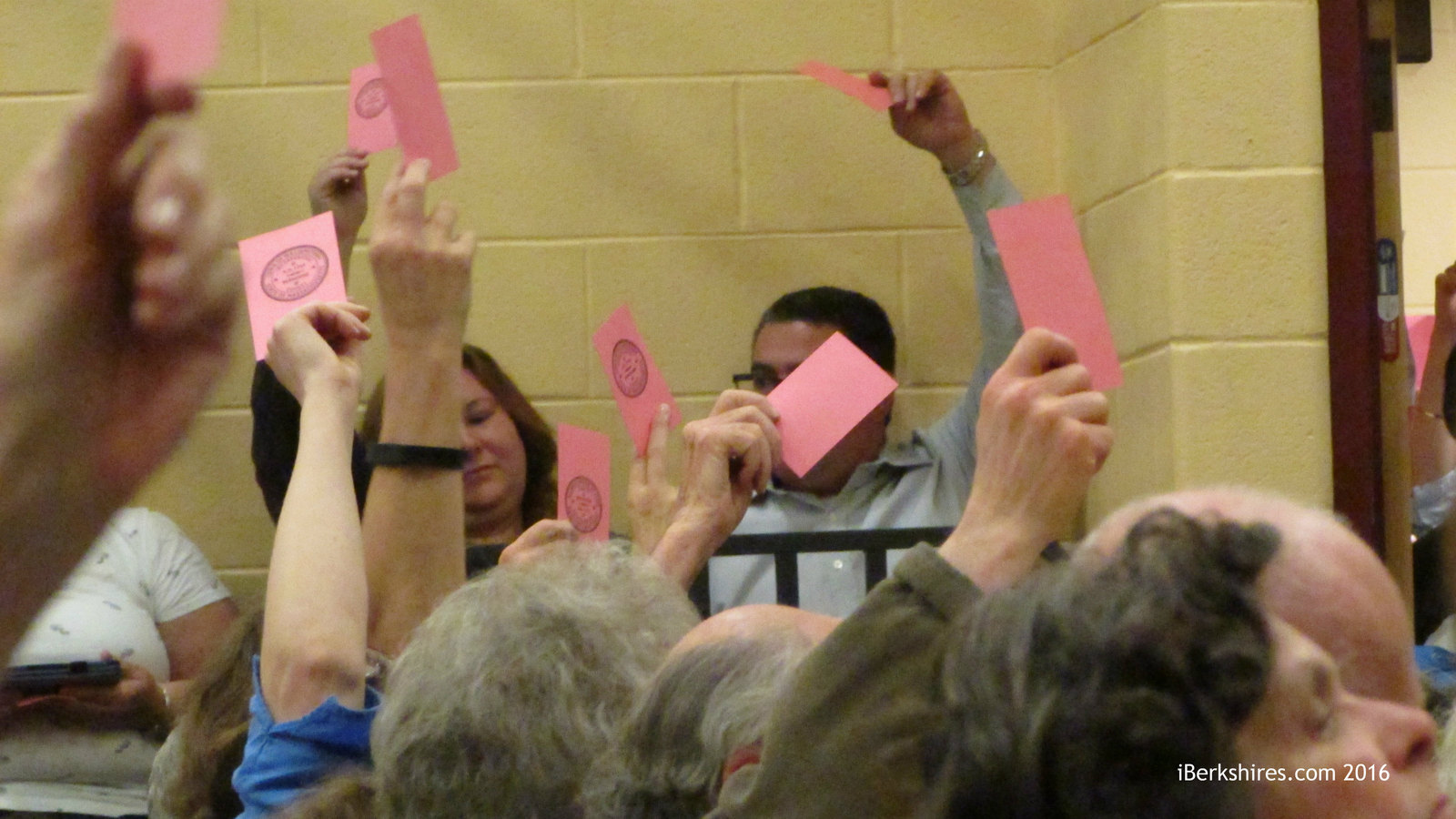
As a zoning change, the article needed a two-thirds "super majority" for passage. The final vote was 418-192 — clearing the two-thirds hurdle by about 10 votes.
"I really do not have a sense of what put the vote over the top," said Stanley Parese, the attorney for Waubeeka owner Michael Deep and the Williamstown resident whose petition put the bylaw on the annual town meeting warrant. "I think it has been said, really throughout the long, long conversation, that everybody at some level wanted this to happen.
"It was just a point of getting it to where everyone could be comfortable. Well, clearly not everybody. In fact, one of those cliches is that indication you have a good outcome is that no one is completely happy."
Parese's acreage amendment went into the annual town meeting as one of two competing amendments to the original citizen's petition he submitted earlier this spring.
Standing opposed to Parese's acreage amendment was the "square footage" amendment, which passed the Planning Board on a 3-2 vote on May 4.
The square footage plan was the first to face a vote, needing just a simple majority to take the place of the original citizen's petition and move on to full consideration by the voters.
It lost, 482-244, meaning that 33 percent of voters in the room were willing to swap out the original text for the Planning Board's version. That sent a clear signal that Parese's amendment — if it went to the floor as drafted — was in for a close vote.
When it came time to debate that acreage amendment, Anne Hogeland, an attorney and recent candidate for the Planning Board, offered a series of amendments that would have made the acreage amendment more like the square footage amendment.
While allowing the use of a building envelope and leaving out the "conservation bonus" feature of the amendment passed by the Planning Board, Hogeland's language: 1. toughened the language governing a conservation restriction on 67 acres of the property; 2. removed a "revocation" clause that would allow a developer to shutter the hotel and return to its current residential zoning status; 3. inserted the phrase "including the golf course" into the "intent" section of the bylaw, and; 4. changed the limiting factor of a hotel from the phrase "120 units" to "120 rooms."
On conservation restrictions, Hogeland objected to language in the acreage amendment that allows uses like geothermal wells and ground-mounted solar arrays in the conserved land.
"Mr. Deep's proposed language has so many exceptions ... that undercut land conservation, which is exactly what a conservation restriction is supposed to accomplish," Hogeland said. "My proposed amendment is to allow a real conservation restriction to occur and for us to be able to preserve the wetlands and watershed as we need to do."
Hogeland's argument for the last point was that the vaguer term, "units," opened the door to the creation of more than 100 suites, which could easily double or triple the size of the final product.
Parese said half of what Hogeland proposed was OK with him.
"In the spirit of compromise, if we can split these motions ... the motion to add language about the golf course, if you want to put that language in there, that's fine," Parese said. "We're trying to save the golf course. If you want to say 'golf course,' great, let's say 'golf course.'
"As to the rooms, fine. We can't build more than that on 10 acres anyway. … As for the rest of it, no. We are not giving the golf course into a permanent CR, and that's the effect of this. This town has very little land on which to develop economic opportunity. This is 200 acres at the intersection of two state highways. This town meeting should not be about saying future generations of residents will not touch that property."
Waubeeka abuttor Sherwood Guernsey, also an attorney, argued passionately that the revocation clause was a mistake.
Guernsey said he reached out to land law expert Mark Bobrowski, a professor at the New England School of Law.
"He's probably written 100 bylaws for various towns," Guernsey said. "His words are 'the [Massachusetts] statute does not provide for revocation of a special permit for any reason.' Surrender after a period of time is a concept foreign to the zoning act. His recommendation was to strike the revocation language.
"If the hotel is not viable ... the owner, like every other businessman in this commonwealth, has options. The option is you sell it or you come back to the town and ask for rezoning at that point. That gives flexibility to the developer.
"But to have it be automatic is not provided in the law."
Hogeland's motion to make those four changes — including striking the revocation clause — passed, 334-311.
That brought Parese back to the microphone to make what he described a "last chance" attempt to reach a compromise.
He moved to do essentially what he suggested before the question was called on Hogeland's amendment: breaking it out into different parts. Parese moved that the voters restore the language on revocation and go back to the original "acreage amendment" text on CRs while keeping Hogeland's wording on the rooms versus units question.
The vote on Parese's amendment to cut Hogeland's amendment in half was 360-260 in Parese's favor, clearing the decks for the final 418-192 vote on the bylaw amendment as a whole.
After the meeting, Parese said the 2-1 margin in that initial vote on the square footage amendment probably was in the back of his mind when he made the final compromise on the rooms versus units question.
"During the meeting, it's all unfolding, real time, very fast," Parese said. "I can't tell you it didn't cross my mind, but I can't tell you this is precisely when and here's what I thought.
"It feels like it's excruciatingly slow, the process, and in many ways it is. ... It was a very, very long conversation, but in the middle of it, it's hard to process as it unfolds.
"To answer your question, I'm sure [the 482-244 vote] was something I was thinking about, but I couldn't tell you precisely what it translated to."
The other hotel-related zoning change on the annual town meeting warrant won approval by a more convincing margin, but it was not without its detractors.
South Street resident Roger Lawrence was the only resident to rise in opposition to a bylaw amendment expanding the Village Business District to include land owned by Williams College where the college plans to build a replacement to the Williams Inn.
Lawrence argued that an inn at that location will create parking and traffic problems in excess of the numbers projected by the college, and that the college, which argues a downtown hotel would bring vitality to Spring Street, is actually a threat to small businesses on the street.
"The institution supporting the hotel is tax exempt," Lawrence argued. "It can easily afford to operate a hotel at a loss. That's how it uses its nonprofit status to unfairly compete."
Lawrence argued that the college already has land where a hotel creates none of the traffic and parking problems he fears at the Spring Street location. He said the school should either renovate the current Williams Inn or rebuild on site at the junctions of Routes 2 and 7.
The bylaw to expand the Village Business District passed by a margin of 224-65 (after many residents left following the Waubeeka votes) — a 78 percent majority.
Tags: commercial zoning, motels, hotels, town meeting 2016, waubeeka, zoning,