Pittsfield 4-Year-Old Attacked By Fox
.jpg)
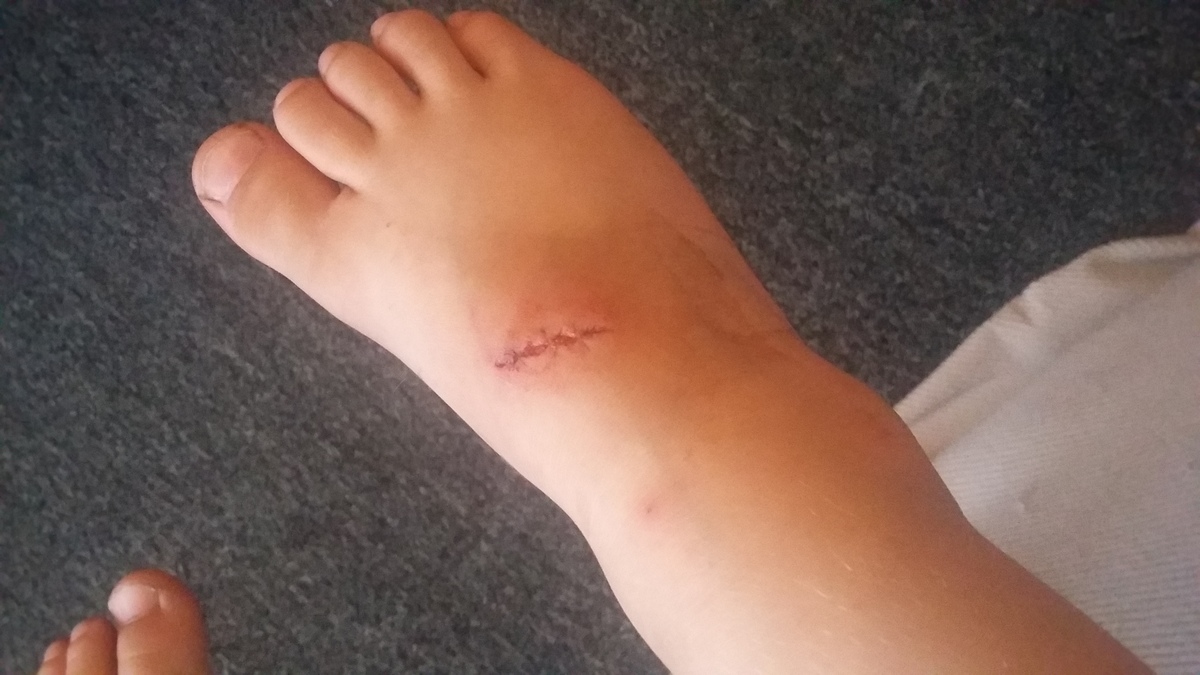
Bradlee O'Keefe gives thumbs up after being treated at
Berkshire Medical Center.
PITTSFIELD, Mass. — Britney O'Keefe stepped outside of her back door on Robbins Avenue on Monday and just had a bad feeling.
Her 4-year-old son, Bradlee, had followed her and she turned to bring him back inside.
Before she could, a fox was in mid-air lunging at the toddler. She grabbed her son and quickly threw him into the house but the fox kept charging.
She slammed the door on the animal and she expected it to run away. It stood up after falling and kept coming, jaws open, exposing teeth.
"He kept trying to push through the door," O'Keefe said. "It just kind of came out of nowhere."
Her husband, Roderick Powell, came running. A roommate quickly grabbed the first thing available — a hammer — to fend off the fox.
O'Keefe heard her son say he was bleeding and ushered him into the living room to find a gash on his foot. It was 5:57 when she called police and two minutes later they were at her door.
"I feel bad. I yelled at the the guy on the phone at the Police Department," O'Keefe said. She remembers drawing a blank when she tried to tell the dispatcher her address.
She could chuckle a bit about it on Thursday despite not being able to sleep soundly since the incident.
While she was on the phone, her husband was hitting fox on the head with the hammer as it tried to push its way through the door. Powell killed the fox and police took care of the remains.
Bradlee was taken by ambulance to Berkshire Medical Center, where he received three stitches on his foot. O'Keefe said Bradlee was a trooper and didn't shed a tear until she did. And even then, the toddler tried to console his mother.
"If I didn't get him when I did, it could have been much worse," O'Keefe said.
On Thursday, she said she was notified that the fox was rabid. Bradlee now has to go back for three weeks worth of shots in case he was infected through the gash on his foot. Despite the ordeal, Bradlee is "back to his normal self" and tells his friends how the fox tried to "eat his foot."
Health Director Gina Armstrong said on Thursday that she has not yet seen the final report on whether the fox was rabid but knew that the child was being treated because of the probability that it was.
"This appears to be an isolated incident," Armstrong said, adding that the department hasn't fielded any other complaints this year.
But she's reminding residents to report any sightings of sick animals.
"We encourage people to make a report to the Police Department if they do observe an animal that appears to be sick," she said.
For O'Keefe, the ordeal has been traumatic. She constantly wakes up at night worried about it. She thinks about all of the children in the neighborhood playing outside and the number of stray cats and pet dogs around the residential area.
"Now I am more concerned with everybody in my neighborhood," O'Keefe said. "I can just think about all of the kids playing outside."
Earlier in the day that Monday, neighborhood children had said they saw the fox but O'Keefe thought it was just a dog or a cat and they were exaggerating. Now she hopes everybody else nearby is aware that there could be rabid animals in the area.
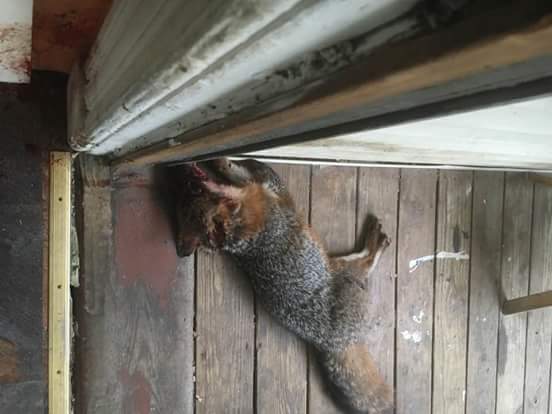
Roderick Powell had to kill the fox that kept trying to push its way through the family's back door.
The fox was young and O'Keefe thinks other animals may have been attacked and are now carrying the disease.
She hopes others will be aware of the possibility because it hasn't happened a lot. The last reported rabid animal in Pittsfield was a skunk last year; recently in North Adams a cat was found to have rabies, which led to a neighborhoodwide rabies clinic.
Five of 34 suspected rabies cases in the Berkshires tested positive in the first half of this year.
Rabies is potentially deadly as it attacks the central nervous system. The disease is spread mostly through raccoons, skunks, bats, and foxes, according to the U.S. Centers for Disease Control and Prevention. The disease causes anxiety and confusion and then progresses to cause hallucinations and delirium.
Once those signs appear, it is "nearly always fatal," according to the CDC. Those attacked need injections of antibodies.
Armstrong said rabid animals are rare despite an outbreak among skunks last year. She said it is "infrequent" that the office has human rabies cases.
Nonetheless, Armstrong encourages residents to take precautions to prevent wildlife from entering properties and to be aware — particularly this time of the year when bat populations tend to find their way from attics and into homes.
"This is the time of year where we see more prevalence in the bat population," she said.
For Bradlee O'Keefe, all signs show that he'll be alright, ending this next three-week period with just a story to tell his preschool classmates on Sept. 1. For his mother, it is an experience she'll never forget.
"It was scary," she said.
Tags: rabies, wild animals,