Clark Art Institute Acquires Emile Bernard Painting
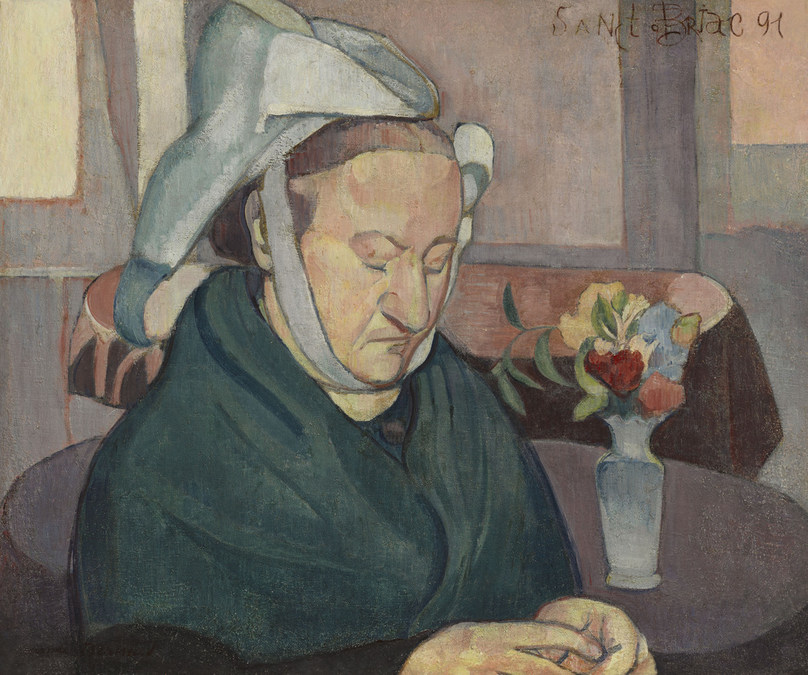
WILLIAMSTOWN, Mass. — The Clark Art Institute has acquired "Portrait of Madame Lemasson (1891)," an oil painting by Émile Bernard (French, 1868–1941).
This is the first painting by Bernard to enter the Clark’s collection and adds depth to the museum's holdings of Post-Impressionist paintings, drawings, and prints. The painting was once owned by noted collector Samuel Josefowitz, who was among the most important 20th-century collectors of the works of Paul Gauguin and of the wider Pont-Aven School.
"Portrait of Madame Lemasson" is currently on view.
"Portrait of Madame Lemasson" was painted during one of Bernard's many trips to Brittany. The sitter is the innkeeper with whom Bernard stayed during his visits to the northern coastal town of Saint-Briac between 1886 and 1892. Madame Lemasson is seated and knitting in front of a table with a vase of flowers. The portrait was not given to the sitter but remained with Bernard for a decade until he sold it to the esteemed art dealer Ambroise Vollard in 1901.
"While the Clark is best known for our collection of French Impressionist art, we have been steadily building our Post-Impressionist holdings over the past three decades," said Manton Curator of Prints, Drawings and Photographs Jay A. Clarke. "Our Gauguin painting, 'Young Christian Girl,' now has an ideal partner with the addition of the Bernard Portrait of Madame Lemasson. It is a riveting work and an important addition to our collection.
"It is a subtly complex painting, composed of whites, pinks, and mauves that serve to demarcate but not to define the space," she continued. "The flattened vocabulary of Synthetism—a term Bernard used to differentiate his work from that of the Impressionists—is evident in the ways in which the circular and rectangular forms intersect with one another behind the figure. The painting is at once descriptive and yet provocatively mysterious."
Born in Lille, France, Émile Bernard moved to Paris with his family when he was 10 years old. At age 16 he joined the highly regarded Atelier Cormon school, where he experimented with Impressionism and Pointillism and befriended fellow artists Louis Anquetin and Henri de Toulouse-Lautrec. After being suspended from the École des Beaux-Arts for "showing expressive tendencies in his paintings," he toured Brittany on foot and became fascinated by the tradition and landscape of the region.
In August 1886, Bernard met Paul Gauguin in Pont-Aven on the south coast of Brittany. At this time Bernard was promoting a Cloisonnist style of painting—working with bold forms separated by dark contours—that influenced Gauguin’s work. After returning to Paris, Bernard met Vincent van Gogh, who was impressed by his style of painting.
Soon thereafter, Bernard found a restaurant on the Avenue Clichy to show his work alongside that of Van Gogh, Anquetin, and Toulouse-Lautrec. Bernard’s work moved subtly from Cloisonnist to Synthetist, characterized by flat forms, harmonious colors, rhythmic patterns, and depictions of the people and landscape of Brittany.
The Clark Art Institute is located at 225 South St. Galleries are open Tuesday through Sunday from 10 a.m. to 5 p.m. and open daily in July and August. Admission is $20; admission is free year-round for Clark members, children 18 and younger, and students with valid ID. For more information, visit clarkart.edu or call 413-458-2303.
Tags: Clark Art,