Berkshire Mountain Bakery

Print Story | Email Story
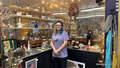
Spelt and sourdough: baking bread with natural yeast in Housatonic All it takes to make a good loaf of bread is water, flour, salt, and a little time. Traditional sourdough has been made this way for thousands of years. Yeast bread is only about 200 years old, according to Richard Bourdon; he has been making traditional sourdough breads, with only the yeasts in the air of his Berkshire Mountain Bakery in Housatonic, since 1985. The public is welcome to watch. Bourdon said he welcomes groups at the bakery: he recently had group of school children spend the afternoon there, supervised by a couple of parents. They toured the bakery and made pizzas for lunch. The kids each got a piece of dough to play with and made loaves of bread. Bourdon baked them that night and brought them into school the next day. They turned out well, he said. A group will also be visiting from Camp Hill in New York, a group of bakers with disabilities that Bourdon will be teaching. And he offers a baking class for professionals — in California. Bourdon mixes his doughs with flour, water and salt, and nothing else. He adds no sweeteners, no fats, no preservatives or conditioners. He uses organic ingredients whenever possible, and he grinds his own whole grain flours fresh, daily, at the bakery: rye, wheat, spelt, oats. A year ago, he also opened a counter at the bakery, so people can come to the bakery to buy bread. The bakery building was once a warehouse for the neighboring Rising Paper Mill. Visitors can see loaves and rounds of white bread cooling, entering and leaving the oven on a long wooden paddle, and ciabatta, seven grain bread, potato and onion, a loaf made with dried fruit and pecans, and a flattish loaf made entirely with rye flour that Bourdon says is rare, and cannot be made with commercial yeast. Wheat-free breads do not rise as much, he said. His breads appear in farmers’ markets in season: the Lee Farmers’ Market, the Sheffield Farmers’ Market and the farmers’ market in Chatham, N.Y., on Fridays; the Great Barrington Farmers’ Market at the old train station and the Pittsfield Farmers’ Market in Allendale, and the Amherst Farmers’ Market on Saturdays; and the Springfield Farmers’ Market on Tuesdays. He makes local deliveries twice a week, and sometimes daily, from Williamstown down to Sharon, Conn. He sells to restaurants and hotels, general stores, organic food stores, even the Williams College Science Center. Customers can also mail order bread directly to their doors. In fact, customers in Florida, California and Texas get a weekly order of bread from them. Commercial yeast does not ferment grain in a way that makes it more digestible, Bourdon explained. He uses natural yeast. “You can make a new sourdough starter any day ... it keeps growing, like yogurt.” Sourdough uses the same lactobacilli that live in us to break down food. Digestion is a fermentation process, he said: “You are what you digest.” There is an acid in whole grains, phytic acid, that forms an undividable compound with minerals. Phytic acid can only broken down in an acidic process. “If you don’t do that, it will keep you from absorbing minerals,” Bourdon said. “It depletes you of minerals. It is essential to ferment grains first. Indigenous people knew that.” Nowadays, whole grains have had a revival, but people forget that piece of nutritional fact. Phytic acid is not broken down through the fermentation of commercial yeast. Bourdon mixes his dough in vats easily four feet across. Doughs rest and rise in plastic tubs, and are cut into sections by machine. They are proofed and shaped by hand though, because to make a good-quality bread, Bourdon makes a softer, stickier dough. Machines cannot handle it, he said. Industry has cut water out to make the dough easier to handle, but having the right amount of water is essential: it helps in the gelling of starches in the bread. Sourdough bread also rises more slowly than dough leavened with commercial yeast. A sourdough loaf takes about six hours to make, from the time the starter is ready, Bourdon said. The starter takes about eight hours to prepare. He mixes the dough, divides it and lets it rest two-and-a-half hours. Then he rounds and shapes it and lets it rest another two-and-a-half hours. Bourdon lets his loaves rise in a warmed, steam moistened room. They bake for 45 minutes. He said sourdough cultures in different bakeries taste slightly different — this has to do with the way different bakeries prepare them — but sourdoughs from any one bakery will taste the same. Bourdon bakes his bread in a French oven, a gas-fired deck oven with stone floors. It heats with indirect flame: the heat travels through pipes, like a giant hot water radiator. The flour mill is wooden, with grindstones spinning at 110 rpm. Bourdon compared freshly ground whole wheat flour and a softer, lighter spelt flour. He introduced the bakers who were then working. Carlos Hernandez is from Salvador, and Byron and Washington Rosales are from Ecuador. Bourdon spoke with them in Spanish and English, and Byron said that he had recently gone home to visit and discovered how much better he liked Berkshire Mountain bread. Bourdon is French Canadian. He moved to the Berkshires from Europe, where he had gone to pursue a musical career and stayed to pursue food production. He traveled through France, Germany, and Switzerland and stopped at every bakery he could find, asking, “What’s the best bread? What is this bread? What is bread?” At 22, he had a calling. He was invited to teach at a bakery in the Berkshires, he said. The first few years he spent here, he tried to bake 12,000 loaves a week. It got too clear that bigger did not equal better, he said, and the quality of his breads sunk, so he cut back. He now bakes about 3,000 loaves a week. His work has more integrity, he said; he also has more of a life. In fact, he is taking up music again. “I don’t have any big, glorious plans,” he said: just to go on baking bread, with General Manager Keith Sharpe, who is English, but lived for many years in Australia.
If you would like to contribute information on this article, contact us at info@iberkshires.com.

McCann Recognizes Superintendent Award Recipient

By Tammy DanielsiBerkshires Staff
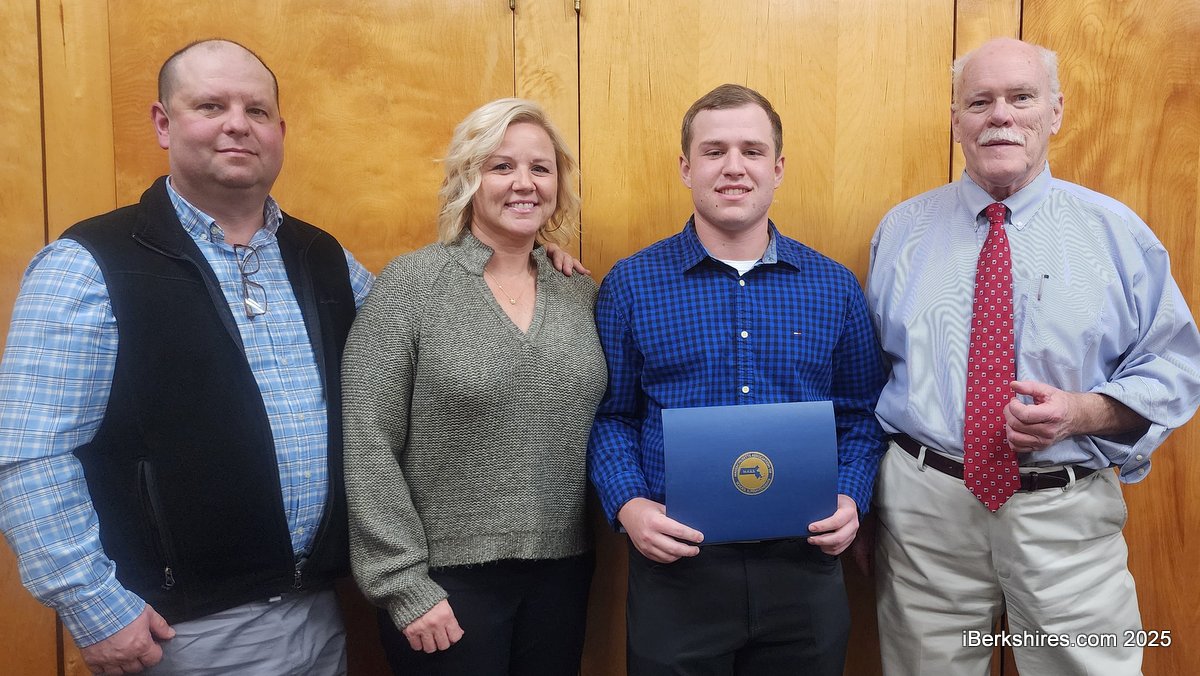
Landon LeClair and Superintendent James Brosnan with Landon's parents Eric and Susan LeClair, who is a teacher at McCann. 
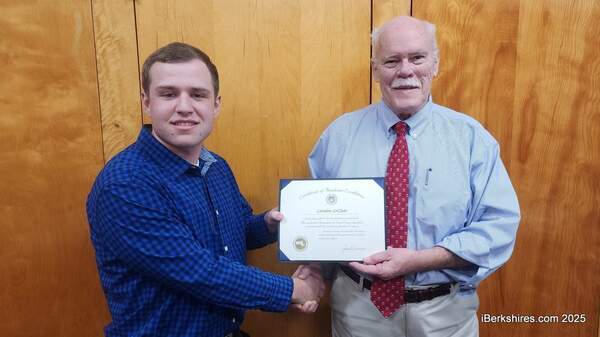
NORTH ADAMS, Mass. — The Superintendent's Award has been presented to Landon LeClair, a senior in McCann Technical School's advanced manufacturing course. 
 
The presentation was made last Thursday by Superintendent Jame Brosnan after Principal Justin Kratz read from teachers' letters extolling LeClair's school work, leadership and dedication. 
 
"He's become somewhat legendary at the Fall State Leadership Conference for trying to be a leader at his dinner table, getting an entire plate of cookies for him and all his friends," read Kratz to chuckles from the School Committee. "Landon was always a dedicated student and a quiet leader who cared about mastering the content."
 
LeClair was also recognized for his participation on the school's golf team and for mentoring younger teammates. 
 
"Landon jumped in tutoring the student so thoroughly that the freshman was able to demonstrate proficiency on an assessment despite the missed class time for golf matches," read Kratz.
 
The principal noted that the school also received feedback from LeClair's co-op employer, who rated him with all fours.
 
"This week, we sent Landon to our other machine shop to help load and run parts in the CNC mill," his employer wrote to the school. LeClair was so competent the supervisor advised the central shop might not get him back. 
 
View Full Story

More North Adams Stories