Mount Greylock Needs to Deal with Dirt Stockpile from Building Project
WILLIAMSTOWN, Mass. — The ongoing dispute over permitting fees was not the only mess on the agenda of the Mount Greylock Regional School Building Committee on Thursday.
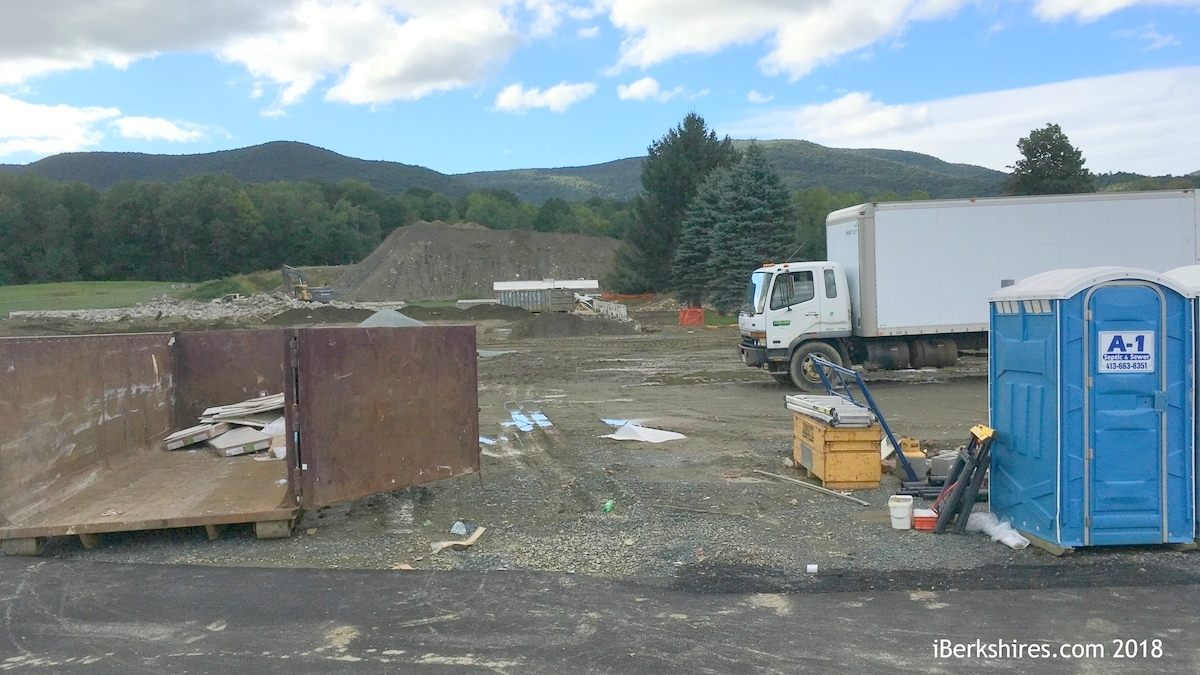
The committee kicked off its monthly meeting with a discussion about dirt, specifically, the large pile of earth to the south and west of the renovated school and how to dispose of it.
The pile has always been part of the project. It was created with the earth excavated to prepare for the middle-high school's new three-story academic wing. And the plan was to use that earth to fill in the footprint of the old, sprawling single-story academic wings that have been demolished.
The issue is that the original plan did not take into account the dirt that would be removed during construction of the school's new parking lot; the parking lot was not part of the original scope of the building project but was instead added late in the process when it was clear the addition/renovation project itself was tracking to the budget.
"We have a 15-cubic-yard 15,000-cubic-yard stockpile that some of you may have seen behind the school," architect Dan Colli of Perkins Eastman told the committee. "We need to dispose of that in some way. We didn't know we'd have this much excess soil."
The issue was before the committee Thursday because Perkins Eastman was seeking a $23,000 amendment to its contract to pay for civil engineering and design work to decide how to dispose of the pile.
"We are going to use some to fill in where the building was demolished," Colli said. "But the pile that's there is going to significantly change the topography. … We're looking to get our civil engineer on board and have [Williamstown's Guntlow and Associates] possibly there to shepherd some of these things through if needed.
"My fear is that taking a big pile like that and not having professional engineers tell us what to do with it, we might not be happy with the outcome."
Colli indicated that while most of the soil in the pile came from previously undeveloped land where the three-story addition now sits, the soil under the former parking lot may have contamination.
Committee member Thomas Bartels immediately suggested that the district test the soil in question before repurposing it on the campus.
"At a minimum, we'd like to add to the scope of work the testing," Bartels said. "I think we have to test before we spread it out on site. That needs to be the first step before we spend money figuring out how we spread it out."
Colli agreed that the testing should be done and said there already as money for such analysis in the budget.
Committee member Richard Cohen amended the original motion to accept the request from Perkins Eastman to include language that the committee expects soil tests to be conducted before the pile is reused.
Cohen also pointed out the potential that the soil could be contaminated as an "unknown" that still faces the building project. Those unknowns, he argued, should be addressed before the district pay inspection fees to the town of Williamstown, an arrangement that was alluded to in at least two communications between the entities that Cohen has cited in discussions about the fees.
"It is my understanding that the project budget has allocated $300,000 for all permitting and inspection costs," Williamstown Town Manager Jason Hoch wrote then-Mount Greylock Superintendent Douglas Dias on Dec. 9, 2015. "Further, I fully appreciate that there will be costs for third-party inspections and reviews required outside of our jurisdiction that will carry costs. To that end, it is my recommendation that we will track the eligible hours and costs through the process and assess those charges at the end of the project IF funds still remain for permitting and inspection after other external charges have been paid.
Then, in July 2017, Hoch told Superintendent Kimberley Grady: "You may recall, in an unusual allowance made specifically for the school project, I agreed to hold payment of all fees until the end of the project with an understanding that, if necessary, we may revisit a portion of those to accommodate other critical project costs."
Cohen argued Thursday that the potential of soil remediation costs could impact a project that continues, so far, to be running at or under budget.
"We don't have a remediation budget," Cohen said. "It could be an enormous expense. We have to think about that as we talk about the budget for permit fees and things like that."
While the building project continues to track well with its budget, the committee learned Thursday that Turner Construction has missed another mark on the timeline.
A couple of weeks after learning that the start of classes needed to be delayed by two days, officials were informed that the celebratory ribbon cutting with representatives from the Massachusetts School Building Authority needs to be rescheduled from Oct. 18, the date announced at the committee's Aug. 16 meeting.
The last piece of the new school, the auditorium, will not be ready for the public in time for the planned celebration.
"We are working in the auditorium right now," Turner's Mike Ziobrowski told the committee. "Right now, the substantial completion date is the third week in October. At that point, we'll do a walk through with the town and get a temporary certificate of occupancy for that area."
In the meantime, school officials continue to gather feedback from faculty and staff about any issues that they may be finding with the new building, Grady and Principal Mary MacDonald told the committee.
"It's good to communicate with the faculty and staff," MacDonald said. "Sometimes, they see things we don't know. Some things we can turn over like that, other things may take a couple of weeks."
"It's always a good idea for the owner to do its own punch list," agreed Bartels, an architect.
In other business on Thursday, Cohen reminded the committee and construction team that, as construction and demolition at the site winds down, the district should keep in mind previous discussions about preserving some of temporary construction parking space on the north side of the campus as an overflow lot.
"There was a discussion … and concerns were expressed that we'd have fewer parking spaces [in the new lot]," Cohen said. "There are several events during the year like graduation and large sporting events where we have exceeded capacity."
And, as Cohen pointed out, given the school's location on a U.S. highway in a rural part of town, there is no on-street parking potentially available for overflow.
MacDonald took advantage of the discussion of the parking lot's size to clarify a couple of comments that have come up in social media about one element of the new lot.
"One comment has been those six or eight [electric vehicle] charging stations in the parking lot," MacDonald said. "They are there because of the LEED points, in the same way we have bicycle racks out front even though we don't have any students riding their bikes, which is probably just as well given our location on Route 7."
The MSBA offers financial incentives to building projects that achieve LEED certification, a standard for environmentally friendly design and construction.
"There is no signage that says you can't park there if you don't have an electric car," MacDonald said, addressing the concern that the charging stations unnecessarily reduce capacity in the lot. "And, for the record, no one in the administration has an electric car they're parking there so they can charge it for free.
"If people have those kinds of questions, I'd rather they bring them here [to the SBC meetings] rather than putting them on Facebook."
Tags: MGRHS school project,