image description
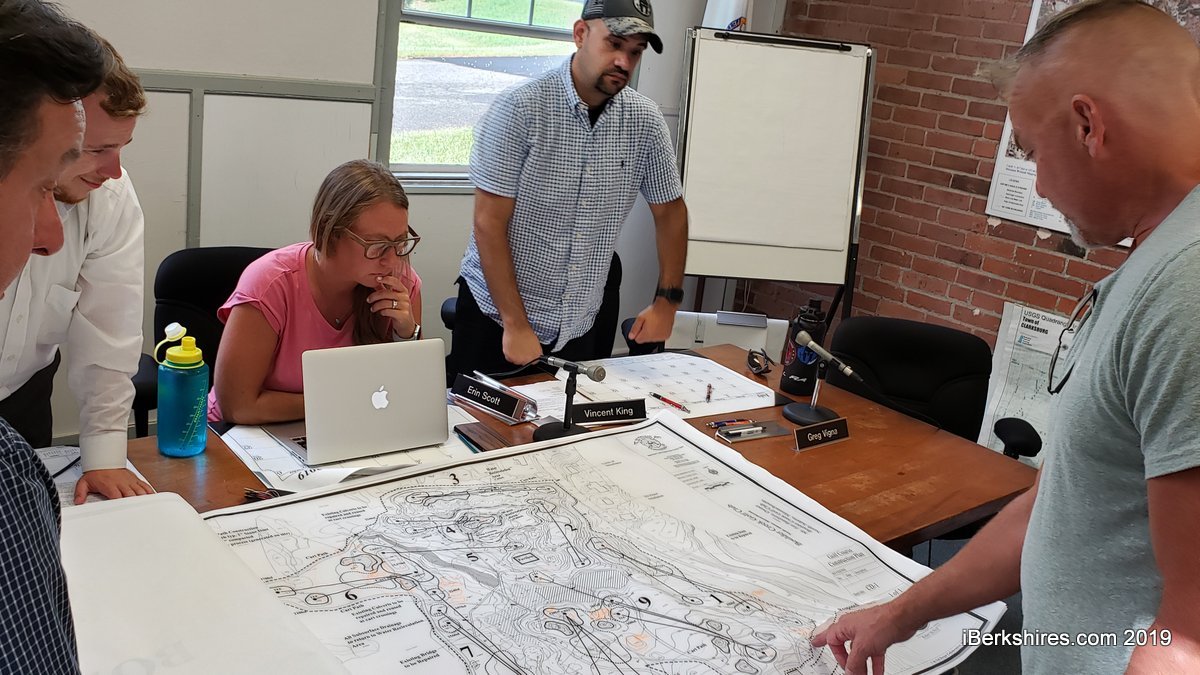
Country club owner Todd Driscoll explains plans to resurrect the golf course on River Road.

Rejuvenated Clarksburg Golf Course Eyed for Off-Grid Living

By Tammy DanielsiBerkshires Staff
Print Story | Email Story
CLARKSBURG, Mass. — The owner of the former North Adams Country Club confirmed his plans last week to renovate the clubhouse and recreate a nine-hole course.
 
And set up a cluster of "tiny homes" to cater to second home owners and vacationers. 
 
The course on River Road has been in limbo for the last eight years as plans to build an 18-hole golf course fell to the wayside, materials were take from the land and a solar array installed. 
 
But owner Todd Driscoll, who came into the picture about four years ago, is still hoping to rejuvenate the course on a smaller scale, he told the Planning Board last week.
 
"We don't want to make it more than it is," he said last Wednesday. "It's going to be a big practice facility. And I think that's going to lure people and that's our plan. And I think with the houses, it's a really important thing because I think the housing development will sell if that golf course really nice." 
 
Driscoll spoke to the board, and to the Conservation Commission immediately afterward, of his plans to remake some of the existing greens, layout a practice area and set up an irrigation system. A new well was drilled in the far northeast corner and a public water supply designation has been requested. 
 
"What we like to accomplish this year is to get the irrigation system in, which is what we're doing upstairs with the Con Comm," said Michael MacDonald, representing BVD LLC. "That requires quite an expenditure of money. So we'd like to know that the Planning Board is on board with re-establishing the golf course before we take that step. ... 
 
"Re-establishing or establishing golf courses in today's environment is not something that's being done, in fact, they are being closed all across the country."
 
Driscoll rolled out plans — still dubbed Boulder Creek Golf Club from the original designs — and showed the board where the greens would be placed and how they should be outside the wetlands areas. 
 
The clubhouse has been taken down to its original structure, Driscoll said, and reframed and brought up to code.
 
Three to five small homes are being considered in partnership with B&B Micro Manufacturing to start with the potential of up to 15 or 20. The homes won't be so much "tiny homes" as small modulars on permanent foundations.
 
The homes would be LEED-certified and would have solar panels to be off the grid, although some type of small heater from an alternative source and backup would be needed. Maintenance would be done probably through a home association so the owners wouldn't be responsible for mowing or plowing. 
 
"We're not going to actually build them and we're going to team up with B&B," Driscoll said. "And they're not going to build any until they're sold. Their plan was to do one model [for show.] ... All we're doing is getting them water and getting them sewer. ....
 
"The problem is the water. To get water from there to that clubhouse is over $200,000 so we have to sell more than three or the whole project is pretty pretty rough." 
 
He said having the golf course would be key to selling the houses and that the course probably couldn't stand on its own. However, Driscoll said talks with local high school and college teams shown a lot of interest in being able to use the course again as well as the possibility of kids' camps. 
 
The first step is a special permit to re-establish the golf course since its use is considered "abandoned" after two years. And then to work with both boards to get permitting for irrigation system and the course layout. The housing would require yet another permit, and permission for sewer hookups to the Hoosac Water Quality District. 
 
The goal at present is get the course completed and operating for opening next spring and a model home installed on the site by fall. 
 
"It's a perfect empty-nester type of home. You can practice your golf game, we have two or three, four months a year and then go to Florida," Driscoll said. "It's turnkey, zero maintenance for the the owners and the price target we're trying to get it is very reasonable." 

Tags: golf course,   tiny homes,   
If you would like to contribute information on this article, contact us at info@iberkshires.com.

Dalton Planners Hold Public Hearing on Tiny Homes Bylaw

By Breanna SteeleiBerkshires Staff

DALTON, Mass. — The Planning Board held a public hearing last week on a bylaw for mobile accessory dwelling units (ADU) that will be brought before a special town meeting.

For nearly two years, Amy Turnbull has been trying to amend the current ADU bylaws to allow mobile tiny homes.  

A movable tiny home is defined as a unit under 400 square feet that meets all of someone's daily needs, including sanitation, cooking, and other facilities, and which is also mobile. Most homes considered "tiny" are built on a trailer so they can be towed.

Her proposal defines a movable tiny house as a "residential property with an existing primary house, intended for year-round living," and outlines eight conditions for approval.

Among these conditions: the unit must adhere to accessory dwelling unit regulations, undergo site plan review, be licensed and registered with the state Registry of Motor Vehicles, have approved energy, water, and wastewater systems, and comply with American National Standards Institute 119.5 and National Fire Protection Association 1192 safety requirements.

Additionally, the unit must be certified for ANSI or NFPA compliance by a manufacturer or third-party inspector, including adherence to Appendix Q and the International Residential Code's structural guidelines and energy efficiency standards. The tiny house cannot move under its own power, and its undercarriage, wheels, axles, tongue, and hitch must be concealed from view. Wheels and leveling or support jacks are required to rest on a level gravel or paved surface.

Turnbull has gotten enough signatures for her petition to amend the current bylaws to add her definition of the mobile ADUs. Last Wednesday, the board held a public hearing on the petitions, which will be voted on at a special meeting.

Turnbull says she has two reasons for wanting to add this to the town's bylaws: aging in place and affordable housing.

"We need a variety of housing types in Dalton, and that we also need to address the idea that you know nearly 30 percent of our population by 2035 is going to be over 65 years old, and it's problematic because  ... there's not enough choice for these people to to age in place,"she said. "What movable tiny houses does, is it provides a less restrictive ADU. It's much cheaper to place, and it's easier to place, less time consuming. And what it offers to people is it offers people who are owners a place for their children to come and live, or a caregiver to come and live, or for the people who own their own house to come and live while they rent out their maybe their three bedroom home to a new family who wants to attend to Craneville simultaneously."

She said people need to move away from calling and treating the tiny homes as though they are trailers, as one former Planning Board member has voiced opinions on.

"That is an opinion, and I think we need to get over that, because I want to say that these are foundation homes, and that the chassis is a foundation, and it's a stick-built home on a chassis, and in very many ways it's like a modular house. I think we will not be surprised in the next 10 years if we see the market turn around and start to make smaller, tiny modular homes, but that is not the case right now, and we have a dire need for affordable housing," she said.

At a former Fire District meeting the Water Department drafted regulations for water hook-ups for these types of homes. The superintendent sent a letter to the Planning Board to be read at the meeting stating it will not be a hindrance for sewer system connection.

"The Department of Public Works does not feel that mobile ADUs will be an issue with the town sewer system. The homeowners will be responsible for any issues outside of the sewer main and connect and responsible for connecting in, so that would address any permits, fees, or anything like that would be added to that," the letter states. 

"The Water Department, as we've stated previous, and as you stated, the water department has come up with their own set of SOPs, standard operating procedures, for hooking up a an adu and a mobile adu, which will then have to meet winterization and all those, but they've laid out a plan for that, that they have, so I'd like to point that out," board Chair Robert Collins said.

One concern was raised that if someone can have a mobile ADU could they also have another tiny home on their property, including the main house. That situation is not likely, said Turnbull, as it would cost a considerable amount of money. Town Manager Eric Anderson also stated that in his former community when they adopted similar laws their first one wasn’t put in until a couple years later and then maybe one a year.

View Full Story

More Clarksburg Stories