image description
David Moresi of Moresi & Associates explains his plans for the Union Street mill. He had previously renovated it for office space.
image description

North Adams Planners OK High End Union Street Housing

By Jack GuerinoiBerkshires Staff
Print Story | Email Story

David Moresi plans to renovate the second and third floors of the Wall-Streeter mill into one and two-bedroom apartments.
NORTH ADAMS, Mass. — Developer David Moresi's next project is to transform the offices in the former Wall-Streeter building into high-end apartments.
 
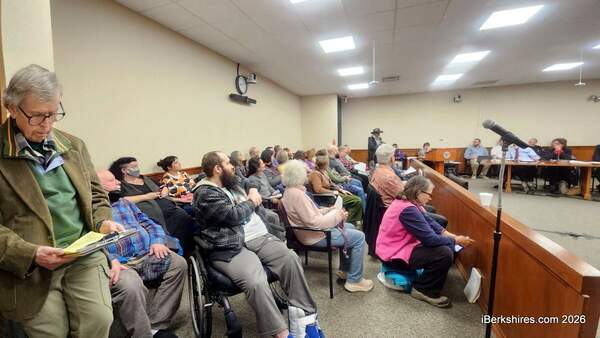
The Planning Board on Monday approved Moresi Commercial Investments' request Monday for a change of use to operate mixed occupancy of commercial and residential use in an I-2 zone at 26 Union St.
 
"For the next couple of years, we are going to focus on housing in North Adams," Moresi said. "This will be one of three projects and it will be mixed-use redevelopment of the former Wall-Streeter Shoe Co. We are bringing back the name."
 
Moresi said the plan is to build high-end housing on the second and third floors that will range from one to two-bedroom units. The first floor will remain office space.
 
"We are focused on more of a high-end nature of these residences and we are presently engaged in actively leasing and getting some commitment to them," he said. "The building is going to get a real interior gutting and we want to bring back the real mill look to the building and reclaim the hardwood floors."
 
He said there will be three commercial units on the first floor, including Northern Berkshire School Union's central office that will be relocating there.
 
The basement will have a shared bike repair area for tenants.
 
"We see a demand for this ... people are relocating here a lot of them are younger people," he said. "A lot of people are biking around so what we are going to do is create a space where they can store their bikes ... where there is a bench so they can work on them."
 
He said a pet grooming area is also on the table.
 
A portion of the west parking lot will be converted to green space but HiLo nightclub across the street will still have access to the mill's parking.
 
Moresi has redeveloped and renovated a number of commercial and residential properties, including most successfully the Norad Mill. He also renovated apartment units in the Mulcare Block on Marshall Street and was awarded the bid for Johnson School, which he also plans to convert to housing. 
 
The Planning Board also approved one of Moresi's tenants in their relocation from Union Street to the Norad Mill on Roberts Drive. Bluebell Servicing requested a change of use to operate a business in an I-1 zone.
 
"They will join the Norad community and bring a few more jobs over there," Moresi said.
 
In other business, the board approved William B. Schmitt's request to open a tea shop at 149 Eagle St.
 
"It will be a very basic retail-based situation," Schmitt said. "I want to sell high-quality loose leaf organic tea in about 50 different variations."
 
He said he may look to sell food at the location in the future or to open as a cafe.
 
The board also heard from Michael Hernandez representing Honey Beer & Wine LLC that has purchased Ed's Variety on Union Street.
 
"No changes, they just bought the business as is," he said.
 
Planner Lisa Blackmer noted that parking has always been an issue at the corner store and asked that the new owners make an attempt to have employees park elsewhere. 

Tags: housing,   mill reuse,   Planning Board,   

If you would like to contribute information on this article, contact us at info@iberkshires.com.

McCann Making Progress Toward MCAS Targets

By Jack GuerinoiBerkshires Staff

NORTH ADAMS, Mass. — McCann Tech Principal Justin Kratz told the Northern Berkshire Vocational Regional School District School Committee last week that because the school is making substantial progress toward its 2026 MCAS targets, there will be no Massachusetts Department of Elementary and Secondary Education (DESE) intervention.

"So long story short, we are not on DESE's radar for MCAS performance," he said. "At the end of the day, that is what is what we are after."

Kratz said McCann scored "a ton" of points, showing growth in most categories. He said they earned 75 percent of total possible points for all students and 83 percent of all possible points for lowest-performing students.

Kratz noted that DESE tends to change targets and formulas every year. But he drew attention to the year 2025, when a passing MCAS score was no longer a graduation requirement. In 2025, McCann received 33 percent of the possible points and 7 percent for the lowest-performing students. This equaled a score of 20 percent.

"That was the year where everything went off the cliff," he said. "We didn't do very well. This year was 79 percent, and that is knocking it out of the park. ... If we followed up with another 20, we would have been in rough water."

Kratz added this drop was typical across the state, saying he assumed students just took the test less seriously. He wanted to demonstrate how the scores and targets are "reshuffled" and gave a closer look at English scores over the years.

In 2024, the school had a target of 499.3 (average scaled score). The school scored 500.4. In 2025, McCann's new target was 502.5, but McCann scored 485.6. McCann's 2026 target was 487.7, and they scored 486.8.

Kratz said McCann is not scoring as high as they were in 2024, but they are getting more points. He said sometimes the scores needed to be taken with a "grain of salt."

He underlined that although MCAS is important in a vocational education, it only represents half of what a student does in a given school year. 

"There is no MCAS for 50 percent of their time here, which is their trade area," Kratz said. "They [DESE] don't assess that ... so this one little pocket is important, but it doesn't show the entire picture of a student."

Kratz moved from what he called the "good" section of his presentation to the "awesome." He said McCann was recognized as one of 55 schools that drastically improved chronic absenteeism by at least 5 percentage points. He said the school received a letter from DESE congratulating them that included a survey that asked how the school did it.

"It was a nice letter, but we kind of laughed and asked, 'What did we do?' " he said. "I say that sort of tongue-in-cheek because we didn't do any sort of targeted attendance improvement initiative."

He said the more he thought about it, the more he attributed the change to standardized grading and improving the school environment physically and culturally.  

"We didn't do all that wanting to improve attendance. We did it because we wanted to create more equity, and ... I think that is a byproduct of that," Kratz said. "Kids are more likely to want to go to school if that 62 they got on a test does not bury them for the rest of the year. They know they can dig their way out of it. And they are more likely to go to school if the building is a little brighter when they walk in in the morning."

Also, the importance of attendance is baked into the vocational school experience.

View Full Story

More North Adams Stories