MIAA Proposal Would Eliminate Sectional Titles, Create Statewide Tourneys
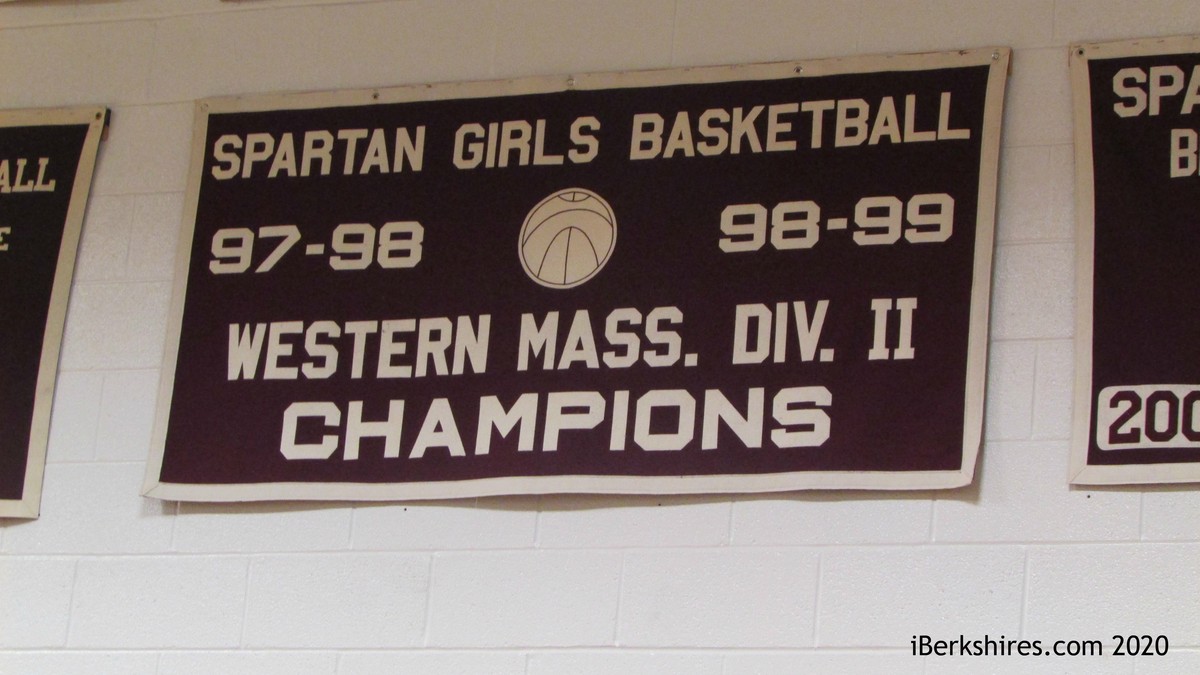
The Western Mass title, a goal for generations of Berkshire County high school athletes, would be no more under the plan.
On Thursday, four members of the MIAA's Tournament Management Committee held an open press conference call (in which iBerkshires participated) at the association's office to explain the system, which the committee says is the best way to address two concerns the state hears from stakeholders: schools forced to play larger teams in sectional tournaments and the possibility that the two best teams in the commonwealth might meet two rounds before a state final.
"People playing like-sized schools is something we've really heard," said TMC Chairman Jim O'Leary, the retired athletic director from St. John's Prep. "That and the pathway to the championship."
O'Leary and his committee were tasked by the MIAA Board of Directors with addressing a number of perceived deficiencies in the current playoff structure, including gender equity issues.
What it produced is a proposal that would create up to five statewide divisions — fewer in sports, like lacrosse and hockey with fewer teams — that would qualify a minimum of 32 teams.
The board next week will consider the TMC's request for a special meeting of the association in February, when all member schools will have a single vote on the question.
If approved this winter, the statewide tournament could be in place for the start of the 2021-22 academic year.
Starting then, the state association would use CBS Sports' Maxpreps to rank all teams in football, volleyball, soccer, basketball, hockey, lacrosse, tennis, baseball and softball to create 32-team state tournament brackets. Teams that finish their year with a .500 record but don't make the cut for the top 32 would be eligible for play-in games, meaning tournaments typically could have more than 32 teams.
The Western Mass tournament, as we know it, would be no longer.
"Honestly, this isn't where we thought we were going when we started out," O'Leary said.
TMC member Johanna DiCarlo, an athletic director at Westborough High School, said the tradition of a sectional tournament would be a loss under the plan, but she was quick to dismiss that loss.
"The kids rotate every four years, they're not going to know anything's changed in five or six years," DiCarlo said during a back and forth with members of the media.
Committee members stressed that one of the main advantages of a statewide tournament is that it eliminates current disparities that frequently create much larger sectional tournaments in the two eastern sections (North and South) than are seen in the East and West.
During the Q&A, committee members cited Eastern Mass schools that had to play six games to win a sectional tournament and Western Mass schools that sometimes could win three or as few as two games to reach the state final.
They were not asked and did not address why simply breaking up the North and South sections and creating an eight-team state tournament was not an option.
But Wahconah High Athletic Director Jared Shannon, who represents this area on the TMC, said the idea of smaller sections was one of the fixes that the committee considered.
"There were some concerns around preserving the sectional championships, but, I'll be honest, people were attracted to the idea of a 32-team bracket as opposed to smaller regions," Shannon said when interviewed about the plan on Wednesday. "The argument against [more sections] would be: What if we had the three best teams from one region in the east and two of them get knocked out before we get to a state quarter-final round?
"The motivation is to make sure the best teams move on to a state championship."
Under the proposal on the table, the top three rounds of the tournament (plus play-in games, if necessary) would be played at the home of the higher seeded team. In other words, one of the top four seeds in each tournament could have as many as three home tournament games. Neutral site games would start in the state semi-finals.
The committee originally discussed a straight 32-team tournament. It opted to preserve the .500-record qualifying criterion after hearing feedback as part of a yearlong process of engaging athletic directors, principals and coaches while developing the proposal.
While that road to the tournament would remain, two other paths would disappear. Finishing first or second in a league no longer would matter, and the new system would eliminate the "Sullivan Rule," which has allowed a team like the Lee girls basketball team to qualify for Division 4 sectional play with a sub-.500 record because most of its opponents are in Division 3 and higher.
As explained in a news conference that ran 20 minutes over its scheduled 90-minute timeframe, the proposed statewide tournament format would, generally speaking, benefit Berkshire County teams in at least one respect.
Currently, some schools are forced to compete for state titles against larger schools because of a desire to fill divisions within each section.
"Right now, there are not enough Division 1 and 2 schools in the West to fill those divisions," DiCarlo said.
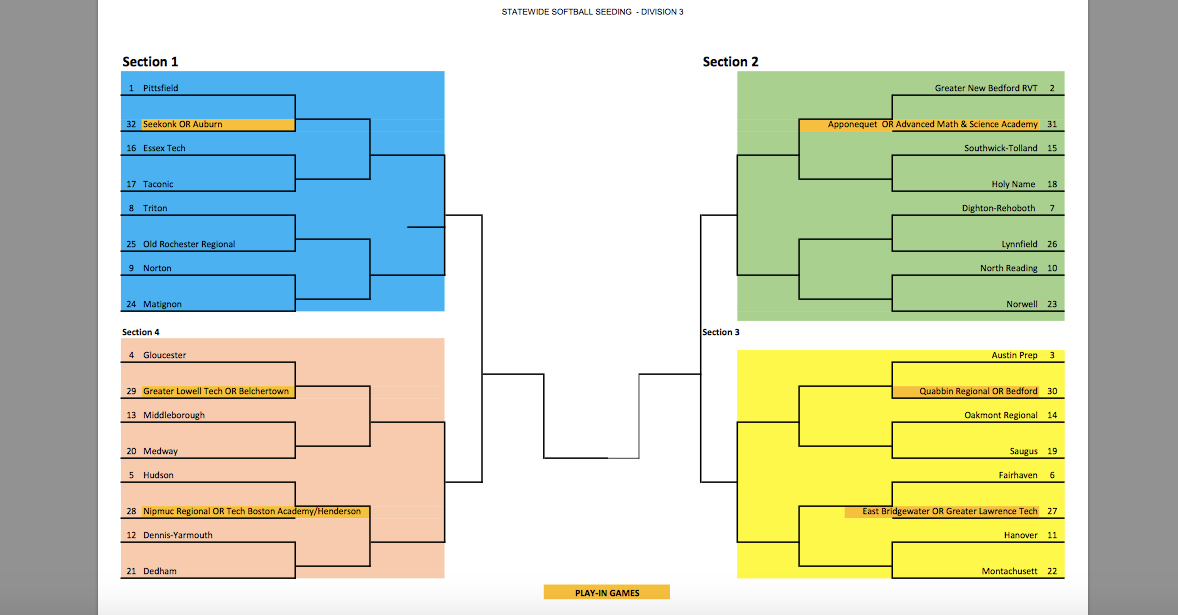
For example, two years ago, the softball team from Pittsfield High (enrollment 417) played Wachusett (enrollment 1,141) in the state semi-finals. Under the five-division statewide tournament format proposed, Pittsfield would move to Division 3; using last year as an example, the TMC found that the Generals would have been the top seed in the D3 bracket and hosted up to three games before going to the state semis.
Perusing the rest of the hypothetical 2019 statewide tournament softball brackets (the one sport and season the TMC chose for demonstration) on the MIAA website, Berkshire County schools did fairly well. Hoosac Valley would have been a No. 3 seed in Division 5 (with up to three home games). Mount Everett, McCann Tech and Mount Greylock each would have been home in the first round. Wahconah would have been a No. 5 seed in D3. Monument Mountain would have played a play-in in D4 for the right to play No. 5 Wahconah, which could have hosted as many as two tournament games.
Taconic, on the other hand, would have been seeded No. 17 in D3 and played a first-round game at No. 16 Essex Tech.
That raises one of the main complaints that the committee has heard about the statewide tournament proposal: travel time and the costs associated with it.
That first-round opponent for Mount Greylock in a hypothetical 2019 state tournament? It was Millis, a 2-hour, 40-minute drive from Williamstown. And while the Mounties would have enjoyed the home field advantage last spring, they could just as easily be the ones forced to make the long commute — on a school day — in another season or another sport.
"Those are outliers," DiCarlo said. "The majority of the tournament games will be at a lot closer distance than people are looking at."
That is because like-sized schools tend to be clustered. There are more smaller high schools in the current central and western sections and more large schools in the east.
"Eighty percent of the Division 4 schools will be in this geographic part of the state," Shannon said. "The likelihood of traveling 200 miles for a first-round game is thin."
As for losing the sectional tournaments — and particularly the popular Western Mass basketball and softball semifinals and finals at UMass — there is no way around the fact that will be a blow to tradition in this part of the commonwealth.
But Shannon said the possibility exists to create alternatives within the regular season, like a four-team "Western Mass" championship in February. The difference is that tournament would have to be part of the 20-game maximum regular season schedule with results counting toward qualification in the state tournament.
And, like the current state tournament football format with its two weeks of games for non-qualifying teams, sports like basketball would have to create the same sort of non-qualifying matchups, only those games would count toward ranking in the postseason.
Shannon admitted that such a "Western Mass" late season tournament might not be held at the Cage because the current week of sectional semis and finals lines up with UMass' spring break, which is when, presumably, the 32-team state tournament would be underway.
"I'm sure that's not been considered by the TMC," he said. "That's outside their purview. That's something regionally we'll have to decide."
And even the ultimate structure of the statewide tournaments needs refinement. The committee members Thursday indicated that a vote this year to implement statewide tournaments would begin a dialogue with the MIAA's sport-specific committees to iron out details. For example, some sports may ask to have four divisions when only three are called for by the enrollment standards in the current plan; some sports may ask to have three divisions when those standards call for four.
And there is a separate subcommittee looking at sports like golf and track and field which currently have sectional qualifiers to a state championship, Shannon said. Those sports are not part of the 32-team tournament structure or Maxpreps ranking outlined in the current proposal.
On balance, Shannon recognized that the proposal facing the MIAA membership will have its pluses and minuses. He knows of one district in the easten part of the state (there are six statewide) that voted strongly against recommending the proposal at the district level. On the other hand, the MIAA Board of Directors voted its support 10-0-2, the TMC reported on Thursday.
"I myself am in favor of this because while I think it's a big change, what's going to happen is our tournaments will become more equitable," Shannon said. "We're not going to have our small schools playing schools with 600 students just because that's where they're stuck."
Tags: high school sports, MIAA, tournament,