North Adams City Council Seeking Legal Opinion on Pillar Art
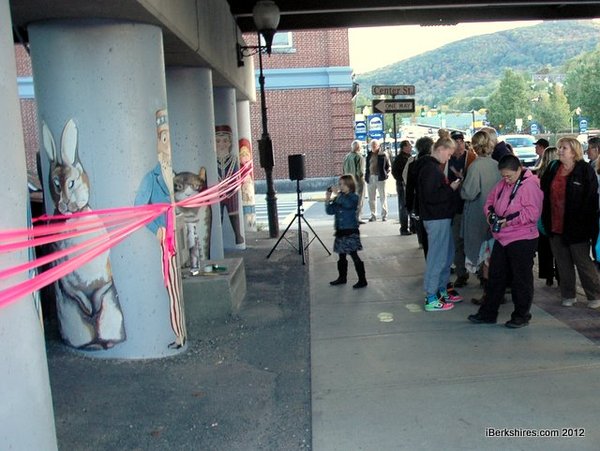
The opening of the Marshall Street murals in 2012. Two councilors have submitted a request for the city to determine if they can be restored.
Councilors voted unanimously to send a request from Councilors Jason LaForest and Marie T. Harpin to test the viability of the overpainted murals to the General Government Committee with the amendment it would formulate questions for the city solicitor.
LaForest introduced the amendment seeking a "determination of precedence."
"The 'Harmonic Bridge' was there, thus the paint or lack of paint that was on the pillars at the time has become the intellectual property of the artist even though the pillars themselves belong to the city," he said. "The counter argument is that when Mass MoCA painted over those murals, that Mass MoCA was defacing and vandalizing the art that the children you know, put in place.
"And so there has been this circular argument with no determination for the past several years."
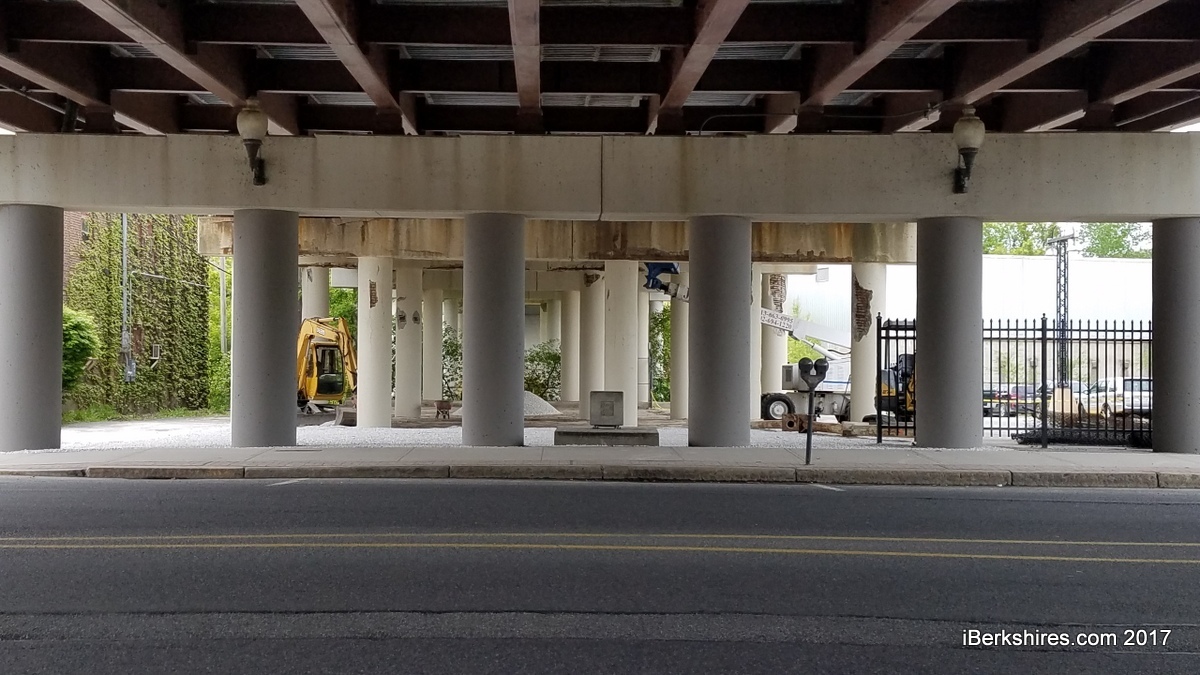
The controversy dates back to 2017, when Massachusetts Museum of Contemporary Art "restored" artists Bruce Odland and Sam Auinger's "Harmonic Bridge" under the overpass by repainting the pillars gray — which covered over a set of murals done by an after-school program with local artists Christina King and William Oberst four or five years before.
Neither group of artists had more than verbal affirmation with the city — as far as can be determined — but "Harmonic Bridge" purportedly has a contract with Massachusetts Museum of Contemporary Art.
Councilor Keith Bona agreed that a legal opinion would be in the city's best interest, ticking off a number of questions he'd like answered.
"Maybe General Government should work on questions to go the solicitor and those maybe should be answered first before we get to the next step," he said, adding, "we don't own the art, MoCA doesn't own the art, we own sort of the canvas under it, but we can't touch that. There have been lawsuits about that and they could sue us."
Councilor Benjamin Lamb said he was aware of five lawsuits related to similar situations, two of which have resulted in wins for the artists.
He didn't give any examples but one of the major cases involved a vacant building that was used as a canvas by 21 artists with the verbal permission of the owner. When the building was razed to make way for an apartment building, the artists sued and won a $6.75 million judgment. In Memphis, Tenn., several artists are suing the city after it started painting over their public works commissioned by a nonprofit.
The Public Arts Commission, which did not exist when either works were created, has rejected sampling the pillars to see if the anti-graffiti gray paint could be removed and the artwork underneath restored. Though the composition of the commission has changed, it has also stated that it did not feel ordering a sample test was within its purview.
Commissioner Bryan Sapienza reiterated that point although when he spoke at hearing of visitors he said he was there as a citizen not as a representative of the commission.
"As much as I would like to see the artwork restored on the pillars, we felt that restoring the art on the pillars could also possibly damage it, and it could also be very costly to do it properly," he said. "And I'm just wondering where the council thinks that they will pull the money from because the Public Arts Commission does not have a budget."
Councilor Wayne Wilkinson raised the same issue: where would the money come from for a study to see if the art could be restored? Harpin thought it could come from the city's engineering budget line but Wilkinson noted that it would have to go through the mayor's office.
Several residents spoke in favor of the murals that had depicted pillow patterns made at Arnold Print Works and children who had worked in the mills, including Edward Morandi and former City Councilor Frances Buckley. Also rising to speak twice in favor of the murals was Joseph Smith, who with Vincent Melito has been the main voices urging their restoration over the past couple years.
Smith noted the mural artists had agreed to a short-term restoration, giving "time for the community to enjoy the art again, if it can be restored."
"Another matter is that the sound installation artists have never directly been asked their position by any city entity the public is aware of," he said. "Instead, the city seems to have taken the word with third party throughout which is clearly improper."
In contrast, Robert Smith, his father, chastised the council for revisiting the issue when there were more important things to do.
"Here we are a new year, a first council meeting ... and we wasted so much time discussing something that didn't need to be discussed any longer," he said. "We have to work on things for our city that will benefits most of the citizens ... we can't waste time with stuff like this."
Bona said it was unfortunate that it had been characterized as the museum against children.
"I don't think it matters who did the art, they still would have wanted it gray," he said.
In other business, the council heard a presentation on parking spaces, approved a $71,000 transfer from stabilization for an analysis of inflow into the sewer system, and was updated on the actions being taken with the roofing contractor who has so far failed to complete public safety building roof.
Tags: pillar art, public art,