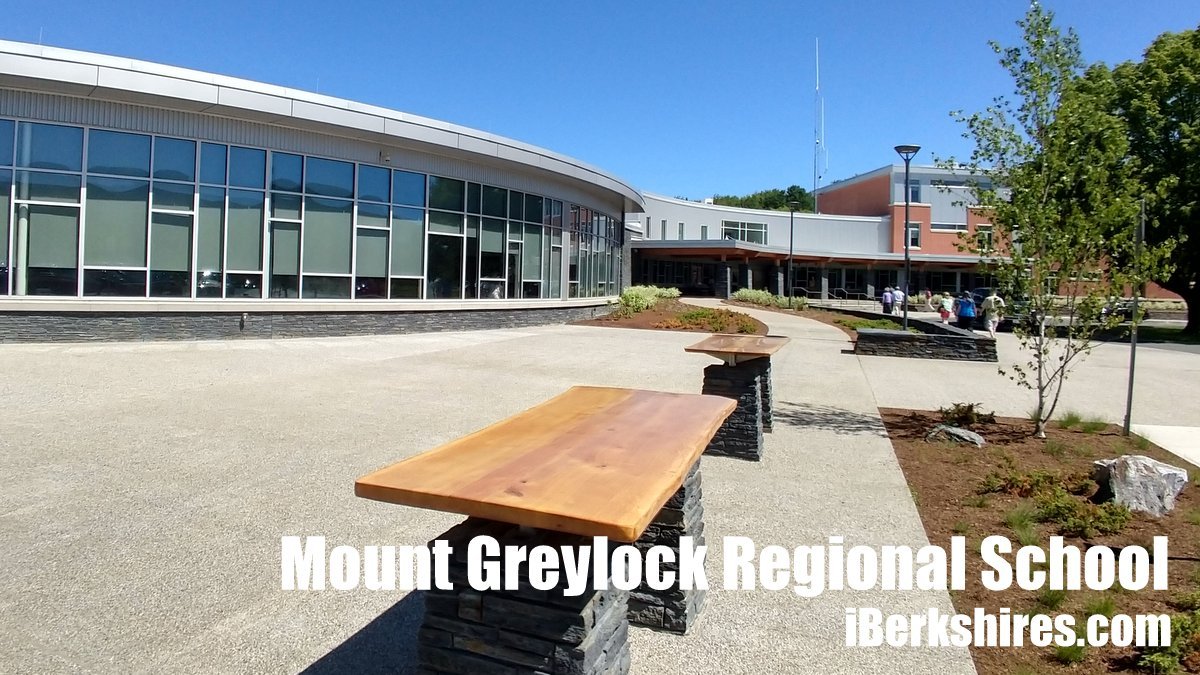
WILLIAMSTOWN, Mass. — The Mount Greylock Regional School this week learned that the $64 million adddition/renovation project at the middle-high school achieved LEED Silver certification from the U.S. Green Building Council.
The council's approval of the project's sustainable elements ensures the district 2 percentage points on its reimbursement from the Massachusetts School Building Authority.
That should translate to about $1 million of the total share the state authority will contribute to the project when all is said and done, said Hugh Daley, a Williamstown Select Board member and part of the finance working group of the district's School Building Committee.
Daley pointed out that the $1 million reimbursement in question was factored into the budget for the building project that the district presented to Williamstown and Lanesborough in 2016.
In other words, the certification does not bring "new" savings, but it does help keep the project on budget.
"This achievement ensures that the project will be reimbursed at the maximum possible rate for our project," Daley said.
In announcing the certification this week, Mount Greylock Superintendent Kimberley Grady agreed that most of the elements that led to the LEED Silver certification involved selection of building materials or monitoring procedures that did not significantly add to the cost of the project.
On the other hand, in addition to increasing the MSBA reimbursement, LEED components like a design that "optimize[s] energy performance" will save the district in the operation cost of the new Mount Greylock.
"LEED (Leadership in Energy and Environmental Design) is the most widely used green building rating system in the world," according to the USGBC website. "Available for virtually all building types, LEED provides a framework for healthy, highly efficient, and cost-saving green buildings. LEED certification is a globally recognized symbol of sustainability achievement and leadership."
Daley praised everyone involved in reaching the LEED Silver goal on the project.
"It is a very important accomplishment by the Superintendent, the Mount Greylock staff, and the project team," he said.
If you would like to contribute information on this article, contact us at info@iberkshires.com.
Your Comments
iBerkshires.com welcomes critical, respectful dialogue. Name-calling, personal attacks, libel, slander or foul language is not allowed. All comments are reviewed before posting and will be deleted or edited as necessary.
No Comments
Williamstown Studying Major Overhaul for Main Street
By Stephen DravisiBerkshires Staff
WILLIAMSTOWN, Mass. — The town is working with a Worcester civil engineering firm to redesign Main Street with an eye toward a major project sometime in the next decade.
Community Development Director Andrew Groff was before the Select Board on Monday night to talk about Town Hall's use of a $500,000 state grant to do preliminary design on major improvements to that portion of Route 2 that runs from Water Street west to the Field Park rotary, through the middle of Williams College's campus.
Groff introduced the elected officials to Amanda Bazinet of Worcester's Vanasse Hangen Brustlin, who is helping the town to develop a plan for Main Street that would align with the commonwealth's Complete Streets Program.
"Our project goals, in addition to the increased pedestrian and bicycle accommodations, is just, in general, improving the sightlines and improving the intersection geometry," Bazinet said.
"Complete Streets … has a lot of different facets to it. As Andrew had mentioned, the goal is to improve the safety for all of the roadway users — not just the motorists. We're looking at improving it for pedestrians, bicyclists, anyone using a mobility device. We want to create streets that are safe for all ages and abilities to use. So, while bicyclists will still be allowed, legally, to use the roadway, we want to look at providing a separate bicycle accommodation along the corridor, whether it's a shared use path along both sides of the streets that is a little more accessible to young children or older people with disabilities to look at all transportation options."
One goal is to encourage "active transportation." The Massachusetts Department of Transportation, who the town hopes one day might fund the construction, has a "healthy transportation policy," Bazinet said.
That MassDOT funding would come through the Transportation Improvement Program, which is managed locally by the Berkshire Regional Planning Commission. The design work underway now is being done with an eye toward going after TIP funding years down the road.
The town is working with a Worcester civil engineering firm to redesign Main Street with an eye toward a major project sometime in the next decade.
click for more
The elevated bridge between the Clark Art Institute's main museum and the Manton Research Center is being transformed into new gallery space and storage, and the permanent home of the Aso O. Tavitian collection. click for more
Nearly 90 towns and cities across the commonwealth have voted in favor or replacing the seal, which depicts an arm holding a sword above the head of a Native American. click for more