Historical Echo, Irony in Williams College Cancellations
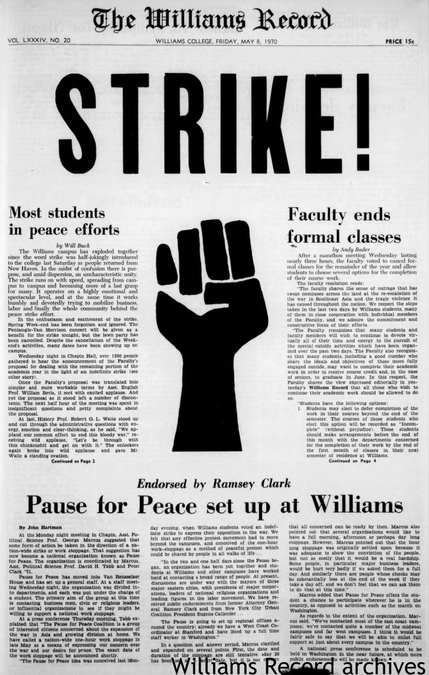
In 1970, it was a two-week student strike to fight a war.
In 2020, it's a three-month closure ordered by the college to fight a global pandemic.
Paul Miller has ties to both stoppages and sees a parallel.
"It's always been kind of a source of pride in a weird way that our class was caring enough [to strike]," said Miller, a member of Williams' class of '70. "That's kind of how I see it. We weren't in the ivory tower being totally self-centered and only being worried about grades and grad school. The anti-war thing got tied up with the social injustice movement. It was all woven together. We were doing something for other Americans, doing something for the Vietnamese.
"I think we felt it was somewhat altruistic."
In Miller's mind, the same can be said for the March 11 decision to send Williams' students home and move to a remote learning model in the face of the COVID-19 pandemic.
"I think that's totally where the college was in what they decided to do this year," he said. "[Williams President Maud Mandel] said in her letter, you may be young and healthy and able to stay on campus. Everything may be just fine for you, but we can't run the risk of what the contagion will do to others. It was totally altruistic.
"In that sense, it's a book end to the two shutdowns."
Another connection between the two. The 1970 strike disrupted the final semester for Miller and his classmates at the college. And in 2020, they were scheduled to hold their 50th class reunion in Williamstown the weekend of June 13.
As much as Miller was looking forward to celebrating the milestone, he was not surprised by Friday's announcement that neither the reunion weekend nor the college's commencement exercises will be held as planned.
"When I wrote the article [about the parallel between the closures] to go in the electronic version of our class book, I wrote it saying that our reunion would be postponed," he said in a telephone interview. "[The article] was precipitated by the school closing and the letter President Mandel sent out on the 11th.
"At that point, we were struck by the fact that the school was going to be shut down for, as far as we know, only the second time. And it would be almost exactly 50 years after we did it the first time. I said to some of my classmates there's a metaphysical irony in that."
Half a century earlier, most of those classmates were irate about the war in Vietnam, just like students on campuses nationwide.
At Williams, a couple of professors helped form the organization Pause for Peace, according to the college archives.
"The idea was to have a national one-hour work stoppage to protest the war," Miller said. "A bunch of us who maybe could do things by talking to our family who might be in a position to help create a work stoppage did so.
"My father was a director of the Scott Paper company at the time. I went to him and told him what we were doing and asked if he would consider asking the directors if they would be willing to support this effort. He said yes. He was a lifelong Republican, but he was totally against the war at that point."
Miller said the Scott Paper board ultimately decided that it could not justify the expense of the massive shutdown to its shareholders, but he gives them credit for having the conversation.
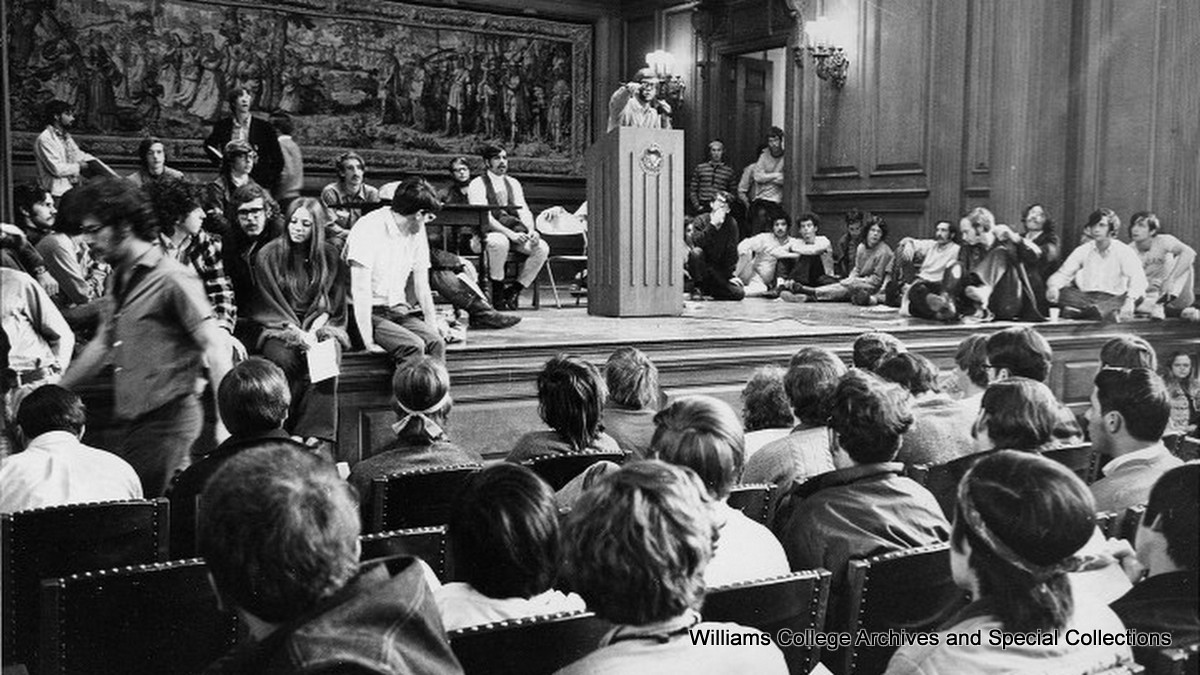
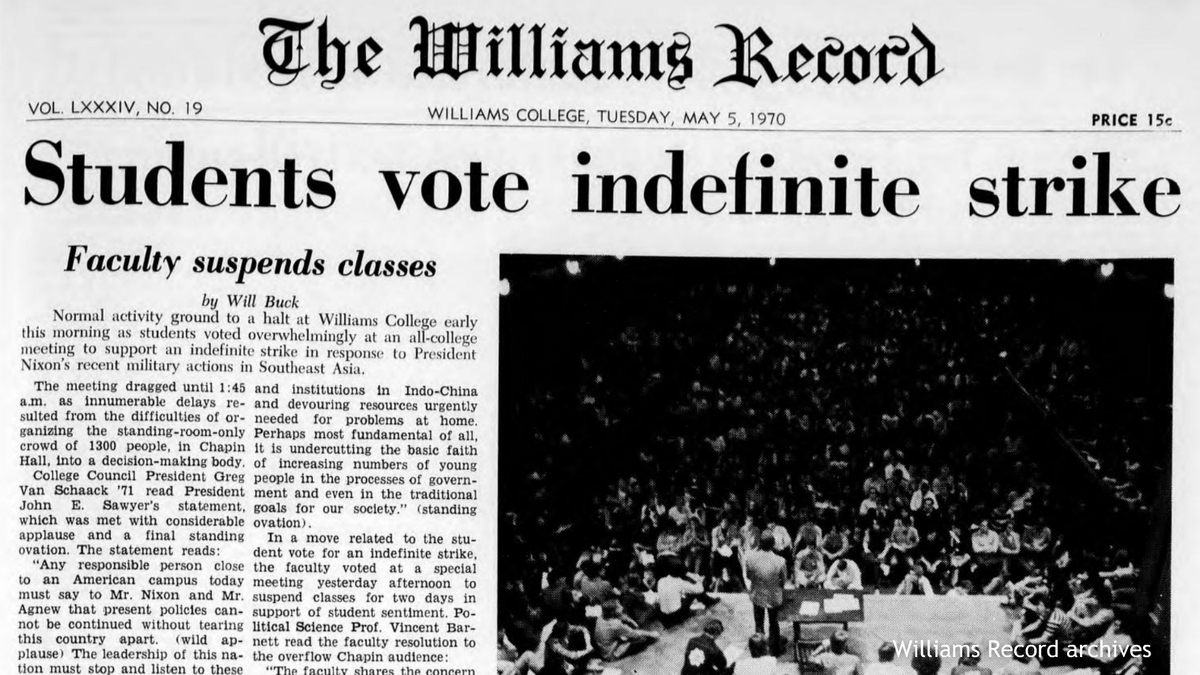
Meanwhile, back in Williamstown, the May 4 deaths of four Kent State students at the hands of National Guardsmen galvanized the undergrads 500 miles away. That night, the student body packed Chapin Hall and voted to walk out of their classes.
"It was packed to the rafters," Miller said. "I'm sure virtually everyone in the student body, which was then somewhat smaller, was in there along with most of the faculty. It was a capacity crowd and a long and interesting meeting."
The students had the backing of the administration, including President John E. Sawyer, and the faculty, which created "a resolution on class work for the remainder of the year and [read] it at another campus meeting," according to a timeline in the college archives.
By May 14, the strike protests died down and many of the students returned home, the college's official account reads. Commencement exercises were held as scheduled, but many of the participants wore shirts commemorating the strike, Miller said.
American troops were not withdrawn from Vietnam until March 1973, nearly three years after Kent State and the student strike movement.
"Bob Katt, a classmate of mine who was one of the leaders of the movement to strike said he felt the strike was a failure," Miller said. "From the standpoint of having a lasting effect on the anti-war movement, I think it was a failure.
"In terms of promoting a sense of community on campus, I think it was a success. There were many faculty members who were doing what they could, students doing what they could and the administration, to the extent they could, was supporting what was happening. So it wasn't a complete failure."
And it has been a point of pride and a rallying cry for members of the Class of ‘70 that they were the class that brought the college's operations to a halt -- if only for a couple of weeks.
They will not get to celebrate that accomplishment this June, but Miller is not complaining.
"I won't take credit for this thought, but another of my classmates, Chris Williamson, said the guys we should feel sorry for are the class of 2020 because they're losing the moment of coming together as a class," Miller said, referring to the commencement exercises and all the activities that precede them. "Who knows what impact that will have. Possibly, they'll discover some form of solidarity based on the idea that they're the guys who got cheated out of graduation.
"The thing stays with me from then and today is the sense of community at Williams College."
Tags: protests, Vietnam, Williams College,