First-Responder Profiles: Fire Lt. Timothy Conroy

Lt. Timothy Conroy, right, with Engine 5 crew members Matthew Mazzeo and Stephen Papa.
This is the first in a series profiling some of our local first-responders in partnership with Lee Bank to highlight the work they do every day — not just during a pandemic.
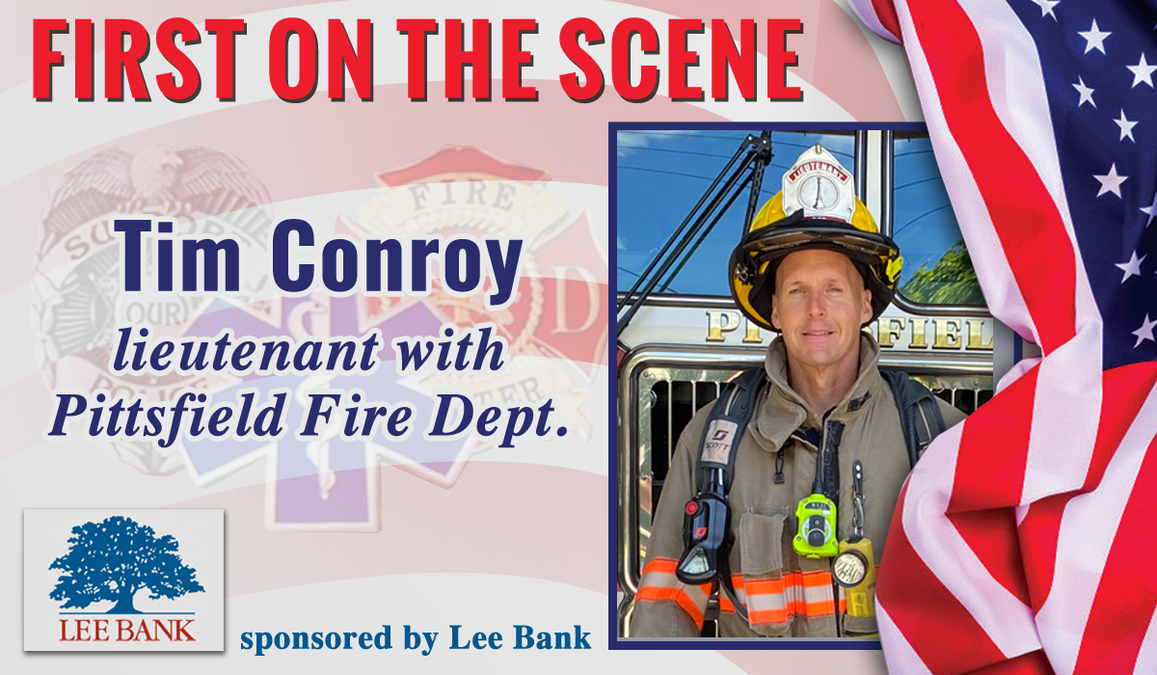
People like Fire Lt. Timothy Conroy, who has been a member of the Pittsfield Fire Department for 27 years. Conroy talked about his reasons for becoming a firefighter, how he sees his role in the community, and its challenges and rewards.
Question: What influenced you to become a firefighter?
Answer: I guess the biggest thing that influenced me to become a firefighter was I wanted to help others, to be part of a team that relied on me as I rely on them. To have a job that wasn't just a 9 to 5 do the same thing every day, to have that excitement of the unknown. To have a job that you love to go to every shift. Like the saying goes, 'if you have a job you love is it really a job?'
Q: What is the best part of your job? What is the most challenging?
A: The most rewarding part of the job is being able to help someone or multiple people who are probably having the worst day of their lives and hopefully making it better. Being part of a brother- and sisterhood that is like no other, its your second family, and getting to operate really big trucks and tools is pretty cool also.
The most challenging part of being a firefighter for me is anything that involves children. I think that anything that happens to children affects all firefighters especially if they have children themselves. No one wants to see little ones in pain, emotionally or physically.
Q: What has changed the most about your job since the onset of the novel coronavirus pandemic? Have calls increased or decreased since COVID-19?
A: What's changed the most since COVID-19? It's really hard to say just one thing because so much has changed. I'd say the change in PPE (personnel protective equipment) we have to wear to calls has changed the most. It used to be medical gloves and sometimes eye protection to medical calls. Now it's medical gloves, eye protection, and N95 masks to medical calls where COVID-19 is not suspected.
The calls where it is suspected, we don all of the previous mentioned but also put on a Tyvek suit and an N100 respirator. When bringing our equipment into a possible COVID-19 residence, we have to make sure we disinfect everything thoroughly before it's placed back on the fire engine. I don't think I've used this much disinfectant and hand sanitizer in my whole life that I've used in the last couple months.
All the stations installed washers and dryers so we can wash our uniforms after our shift and change into clean clothes, so we are not bringing any contamination home with us. That's another big change about the job — I never really worried about contaminating my family or bringing something home with me that could harm my family like I do now.
Q: What would you want the general public to know about firefighters in general?
A: The thing I want the general public to know about firefighters in general is that we do not just fight fires. We respond to the smallest water problem (water in basement) calls to the most horrific, life-threatening emergencies and everything in between, such as electrical wires down, cats in trees, LifeFlight standbys, medical calls, structure fires, automobile accidents, high-angle rescues, water emergencies in both summer and winter.
A large percentage of our calls are medical calls, and most firefighters are emergency medical technicians. Some firefighters specialize in areas such as arson investigation, technical rescue, and hazardous materials.
Q: Who or what has influenced you the most since becoming a firefighter?
A: Several firefighters have influenced me in my career, but the two who stand out are retired Deputy Chief Mike Polidoro and [the late] Deputy Chief Bruce Kilmer. Even though each officer had different personalities, they both had the same calm demeanor in emergency situations and great leadership qualities that I try to emulate.
Q: First responders have been heroic in doing their jobs during this pandemic. Have you seen firsthand a change in the way people treat firefighters and other first-responders?
A: People generally like and appreciate firefighters; however, during this pandemic individuals and businesses have given us PPE such as masks, disinfectants, and different types of sanitizer, and they have donated meals for us. We also experience general appreciation when out in the public with people thanking us for being first-responders.
iBerkshires' First-Responder Profiles are sponsored by Lee Bank.