UPDATE: Williamstown Moves to Gray; No Change Triggered for Mount Greylock Schools
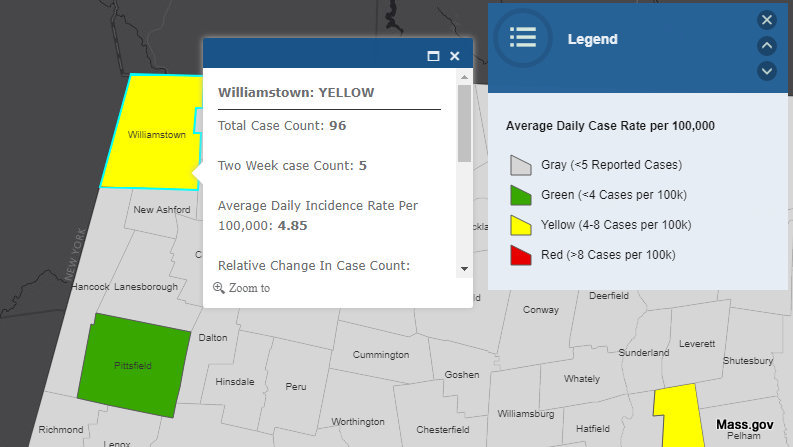
Update on Wednesday evening: The Community-Level COVID-19 Data Report from the commonwealth lists Williamstown as "gray" with a 1.9 per 100,000 average daily incidence rate for the novel coronavirus over the last 14 days.
WILLIAMSTOWN, Mass. — With just two positive COVID-19 tests in the last 14 days, the town is moving out of the yellow and into the gray in the commonwealth's weekly community-level data report.
That means the Mount Greylock Regional School District does not have to move back to remote instruction for its three public schools.
School officials and families were keeping a close eye on the weekly release of data from the commonwealth because of a trigger in the district's reopening plan. Williamstown Elementary, Lanesborough Elementary and Mount Greylock Regional School will go fully remote if either of the district's member towns are rated "yellow" for three consecutive weeks.
Williamstown was yellow for two straight weeks heading into Wednesday.
Each Wednesday, the Massachusetts Department of Public Health releases a new map of community transmission rates of the novel coronavirus. Although the map was not updated early Wednesday evening, the raw data was posted by the commonwealth.
It showed that on a basis of incidents per 100,000 of population, Williamstown had a score of 1.9 for the last 14 days, which puts it in the gray classification, like most of Berkshire County.
As of last Wednesday, Sept. 30, Williamstown was the only Berkshire County municipality categorized as yellow. No county towns were listed as "red" in the commonwealth's gray, green, yellow, red classifications.
By definition, yellow communities show and average daily COVID-19 case rate of between four and eight per 100,000 residents.
Green communities have fewer than four cases per 100,000 residents. Gray means a town or city has fewer than five reported cases in the period covered.
Red communities had case rates of more than eight per 100,000 residents. The only "red" community in Western Massachusetts on the Sept. 30 map was Springfield, which had 8.26 cases per 100,000. It stayed red in the Oct. 7 numbers with 14.6 cases per 100,000.
The Mount Greylock Regional School Distirct, which includes Williamstown and Lanesborough and which has tuition agreements with the towns of New Ashsford and Hancock, opened under an agreement with its teachers union that automatically moves learning to a remote model if either of the member towns (Williamstown and Lanesborough) are in the yellow or red for three consecutive weeks.
Likewise, the district will remain fully remote until a rating of gray or green is achieved "in either of the member towns of Lanesborough or Williamstown for three (3) consecutive weeks," according to language on the district's website. iBerkshires.com asked Interim Superintendent Robert Putnam on Sept. 16, but he did not respond with a clarification on whether the return to in-person instruction trigger should have read "a rating of grey or green in both of the member towns."
As of Wednesday afternoon, the phrasing "either of the member towns" for a return to in-person instruction remains on the school's website.
If Williamstown had persisted in the yellow, then the agreement specifies all three district schools would go remote.
The middle-high school uses an AARBB model where half of the student body can attend school in person on Mondays and Tuesdays and the other half can attend in person on Thursdays and Fridays.
Since hybrid instruction only began on Monday, Oct. 5, a move to fully remote instruction would have meant that only half of the middle-high school's student population will have had the opportunity to attend school in person at all until at least the end of this month.
The district's two elementary schools began hybrid instruction on an AM/PM model, where half of each schools pupils attend in person in the morning and the other half attend in person in the afternoon.
Tags: COVID-19, MGRSD, school reopening,
More Coronavirus Updates