Pittsfield Public Health Committee Informed on Opioid Use Disorder
PITTSFIELD, Mass. — The Committee on Public Health and Safety last week unanimously agreed that more needs to be done for opioid use disorder, or OUD, in Pittsfield after a presentation on the topic.
"It bothers me in this day and age, why we don't have a larger resource of avenues for individuals. I don't know if that comes from lack of funding from the Commonwealth or if it comes from lack of funding from the federal government," Ward 7 City Councilor Anthony Maffuccio said at Thursday's meeting. "We have a serious problem, and people just don't want to talk about it and they think it is just going to go away miraculously one day."
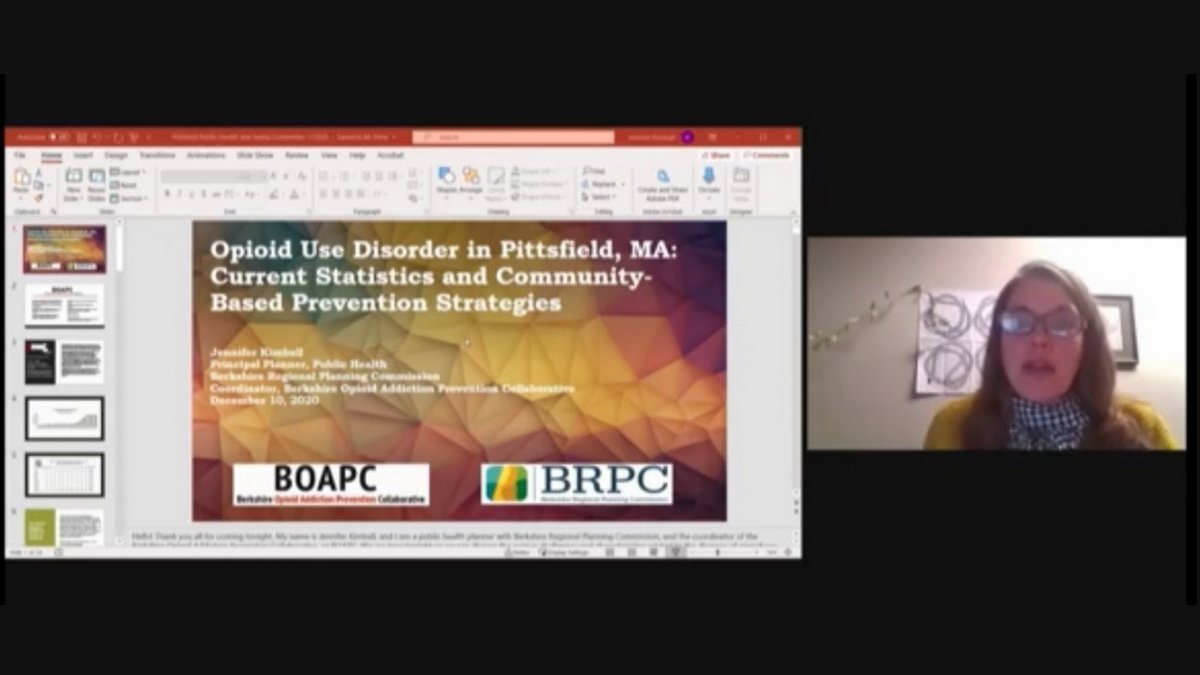
Responding to Ward 1 Councilor Helen Moon's petition that requested a presentation on opioid use, Jennifer Kimball, coordinator of Berkshire Opioid Abuse Prevention Collaborative, informed the City Council subcommittee about the city's current issues with OUD.
Berkshire County is ranked 12 out of 14 in health outcomes for OUD and has the highest rate of OUD in the commonwealth, with a conservative estimated rate of 6.06 percent.
"We are not just sitting in apart on our own in Berkshire County," Kimball said. "We are very connected to our neighbors, to our other municipalities, and to our region, so this is an issue that we all share."
In 2018, the county saw a sharp increase in overdose deaths as compared to the commonwealth's overall trend of a 10 percent decrease. In 2020, the impact of COVID-19 on individuals with OUD can be seen in the number of overdose deaths, especially in Pittsfield.
Pittsfield, the county's largest community, is bearing the brunt of a lot of this crisis, with communities of color disproportionately experiencing the effects of the opioid epidemic and the COVID-19 pandemic. Factors such as the economic effect that has caused many people to lose jobs are known to shape these disparities.
Pittsfield is seeing a greater number of opioid overdose deaths compared to other years in the same months. Information from the Fire Department showed that Pittsfield peaked in opioid overdose deaths in May and June.
County Ambulance President Brian Andrews said the numbers from alcohol overdose also recently went up an exponential amount. Kimball said the city really needs to talk about the city's mental health crisis and how substance abuse can fuel that.
If this is left unaddressed, Kimball said it is likely the synergistic effect of COVID-19 and the opioid epidemic will widen the racial, ethnic, and socioeconomic disparities in health across the nation.
The Berkshire Opioid Abuse Prevention Collaborative is part of the public health program at Berkshire Regional Planning Commission. The collaborative was started in 2013 to try and prevent opioid use disorder before it happens and as secondary prevention or harm reduction, which mitigates the harm of using through education, safe medication, and syringe storage and disposal.
BOAPC provides information about access to care, Narcan education, post-overdose engagement, and supports comprehensive drug-user services in reducing stigma and doing disease prevention related to OUD. Kimball said the collaborative also spends a lot of time talking and thinking about the root causes of opioid addiction.
BOAPC also works with infectious diseases related to OUD such as Hepatitis C and HIV (human immunodeficiency virus). In 2014, Pittsfield was identified as a hotspot for Hepatitis C deaths and there was also a great deal of Hepatitis C in Berkshire County.
Hepatitis C is directly related to injection drug use and opioid use disorder. Though the county has had a conditionally low HIV caseload, the U.S. Centers for Disease Control considers the county vulnerable or at risk for HIV outbreaks.
"I think we have a whole generation of people that using drugs that did not grow up as we did in the '80s when the HIV outbreak first happened," Kimball said. "AIDS is very ingrained in us, I think for other generations it's just not."
Kimball pointed out that the current rise of homelessness in Pittsfield correlated with the city's drug use.
BOAPC has a street/peer outreach program called B-Hive — Berkshire HIV Engagement — which works with well-seasoned harm-reduction advocates who walk the streets of Pittsfield starting conversations with people to make connections and handing out toiletries and kits.
The B-Hive program aims to connect people with HIV testing and care, as well as gathering data.
This is funded by a Massachusetts Getting to Zero grant, which funds projects that seek to implement a creative action plan to strategically address unmet needs of a local priority population suffering from inequitable HIV-related health disparities
Something that Kimball said both herself and Director of Public Health Gina Armstrong are excited about is BOAPC's Post Overdose Engagement program, which is in its development stage.
This program is a partnership with Northern Berkshire Community Coalition through a CDC Overdose Data to Action grant that runs for three years. The Post Overdose Engagement Program works with local and regional partners to enable people to follow up and provide support and case to those who experienced an overdose including disease testing and the provision of naloxone to individuals who have experienced an overdose as well as family and bystanders.
BOAPC will expand this program to all 32 communities in Berkshire County with a grant through the Northampton Health Department.
Armstrong said she has been working closely with Kimball for about six years and is happy to see how this collaborative has evolved. She said the county is fortunate to have Kimball as an advocate with her high level of expertise, connections, and her tireless work.
"We have to do more, our rates this year in 2020 are the highest we have ever seen for overdoses and overdose deaths," Armstrong said. "So I would really like to work with Jennifer to put together a proposal and work with City Council to present something where we could have a full-time coordinator working for the city on the opioid problem."
After seeing these data points, the committee agreed that this issue needs to be further addressed.
"We have to do everything we can to deal with this and try to attack the problem as best as we can." Ward 2 Councilor Kevin Morandi said.
Tags: substance abuse,