image description
An air-flow analysis of Zogic's warehouse in Lee. The company is using air-purification fans to create a safer environment for employees.

Zogics Using COVID-19 Fighting Fans To Keep Staff Healthy
By Brittany PolitoiBerkshires Staff
Print Story | Email Story

LEE, Mass. — Zogics is installing COVID-19-killing air purifications fans in its Lee warehouse and company gym to keep employees safe and healthy. 

The company which provides cleaning and sanitation supplies for facilities, has also teamed up with the manufacturer, Big Ass Fans, to be able to offer the disinfecting fans to customers.

The fans use UV-C and ionization technology to dramatically reduce the transmission risk of a variety of pathogens including SARS-CoV-2. CEO Paul LeBlanc believes that this is the first deployment of this technology in the Berkshires.

This system is said to kill 99.99 percent of pathogens.

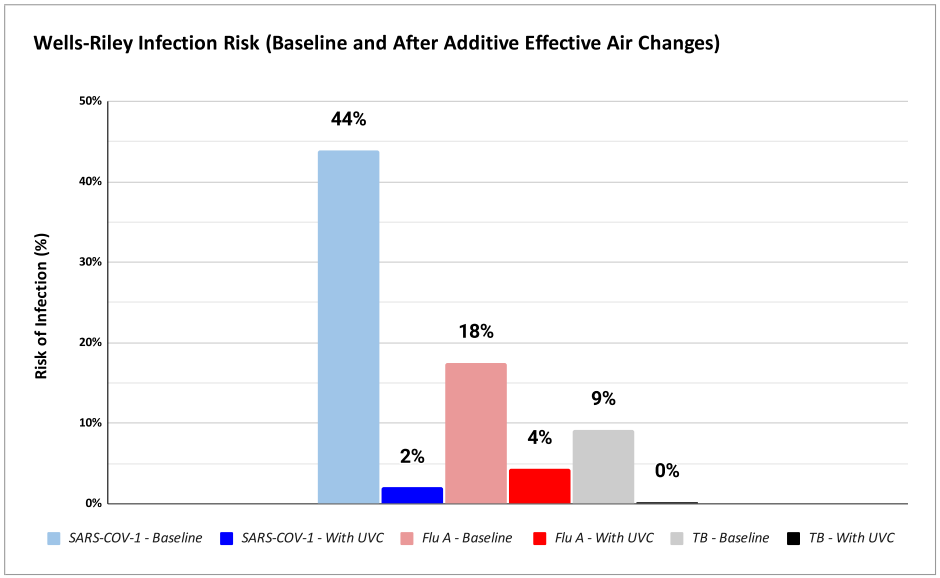
Based on an airflow study, Big Ass Fans says it reduces the 44 percent chance of transmitting COVID-19 in Zogic's gym to a remarkable 2 percent. With added safety protocols such as sanitizing, social distancing, and mask-wearing, the chance is even less.

"We've been fans of Big Ass Fans for more than a decade," LeBlanc said. "They're a highly respected company with great name recognition and we're a leader in facility health and safety so when Big Ass Fans came up with their clean air technology we got really excited."

To evaluate the impact of the fans, a custom 3D airflow analysis of a space is conducted so Zogic's team of airflow experts can show exactly how the product will transform air quality and safety. The team can then make recommendations for optimal equipment selection and placement. This work can be performed either remotely or in-person and this technology is being offered locally and nationwide.

Zogics temporarily closed its office on March 17, 2020, because of the novel coronavirus and staff has been working from home since. LeBlanc said this was not done for the good of the business but for the safety of employees. Those who work in Zogic's warehouse in Lee are essential workers and don't have the option of working from home. LeBlanc described them as the company's heroes.

"The more we learned about the technology, the more I realized that this was something we should put in our own facilities," LeBlanc said in regards to the air sanitizing fans. "The ability for us to be able to dramatically reduce the chance of transmission whether it's COVID-19 or any other number of potential risks is really significant and really it's my job to keep my employees safe."

As soon as LeBlanc became aware of this technology and saw the data and reception from customers, it was an easy choice to install the fans in Zogic's warehouse distribution facility and company gym, he said.

The company benefits from these fans because most importantly, they are keeping staff healthy, but they are also increasing the ability for operations to keep going at a normal pace.


LeBlanc said the cost of interrupting distribution for just one day exceeds the cost of the fans.

With the steady flow of operations, employees' jobs and financial well-being are also safe.

Zogic's on-site gym has been off-limit to employees since March but will be in use once the fans are installed.  This is a huge benefit to employees because it is difficult for people to feel safe at other facilities that don't have these types of safety measures.

LeBlanc said the air purifying fans are a perfect addition to Zogic's lineup, as it creates a comprehensive series of recommendations that it can provide to facilities, and themselves, to ensure that they are able to operate as safely as possible.

"Combined with our surface disinfecting products, our hand hygiene products, and our personal protection equipment, air disinfection essentially completes the loop," he said.

Because of the pandemic, businesses are seeing a pivot from being concerned about how often they can open and how much money they can make to a concern for making the environment as safe as possible for employees and customers.

COVID-19 is severe enough where you want to throw everything at it, LeBlanc said, it's all part of a comprehensive protocol to do everything in reason to keep those around you safe and healthy.

Even before the Big Ass Fans, Zogics had pandemic protocols in place at the warehouse to mitigate transmission of the virus. There are Zogics hand sanitizers throughout the facility along with various disinfecting sprays used on a regular basis, the requiring of masks and social distancing. Now, LeBlanc can rest assured that his employees will be even safer.

"It's very exciting, these are products that we are now installing nationwide," he said. "And it's a great addition to what we do."


Tags: COVID-19,   


More Coronavirus Updates

Keep up to date on the latest COVID-19 news:


If you would like to contribute information on this article, contact us at info@iberkshires.com.

Dalton Planners Hold Public Hearing on Tiny Homes Bylaw

By Breanna SteeleiBerkshires Staff

DALTON, Mass. — The Planning Board held a public hearing last week on a bylaw for mobile accessory dwelling units (ADU) that will be brought before a special town meeting.

For nearly two years, Amy Turnbull has been trying to amend the current ADU bylaws to allow mobile tiny homes.  

A movable tiny home is defined as a unit under 400 square feet that meets all of someone's daily needs, including sanitation, cooking, and other facilities, and which is also mobile. Most homes considered "tiny" are built on a trailer so they can be towed.

Her proposal defines a movable tiny house as a "residential property with an existing primary house, intended for year-round living," and outlines eight conditions for approval.

Among these conditions: the unit must adhere to accessory dwelling unit regulations, undergo site plan review, be licensed and registered with the state Registry of Motor Vehicles, have approved energy, water, and wastewater systems, and comply with American National Standards Institute 119.5 and National Fire Protection Association 1192 safety requirements.

Additionally, the unit must be certified for ANSI or NFPA compliance by a manufacturer or third-party inspector, including adherence to Appendix Q and the International Residential Code's structural guidelines and energy efficiency standards. The tiny house cannot move under its own power, and its undercarriage, wheels, axles, tongue, and hitch must be concealed from view. Wheels and leveling or support jacks are required to rest on a level gravel or paved surface.

Turnbull has gotten enough signatures for her petition to amend the current bylaws to add her definition of the mobile ADUs. Last Wednesday, the board held a public hearing on the petitions, which will be voted on at a special meeting.

Turnbull says she has two reasons for wanting to add this to the town's bylaws: aging in place and affordable housing.

"We need a variety of housing types in Dalton, and that we also need to address the idea that you know nearly 30 percent of our population by 2035 is going to be over 65 years old, and it's problematic because  ... there's not enough choice for these people to to age in place,"she said. "What movable tiny houses does, is it provides a less restrictive ADU. It's much cheaper to place, and it's easier to place, less time consuming. And what it offers to people is it offers people who are owners a place for their children to come and live, or a caregiver to come and live, or for the people who own their own house to come and live while they rent out their maybe their three bedroom home to a new family who wants to attend to Craneville simultaneously."

She said people need to move away from calling and treating the tiny homes as though they are trailers, as one former Planning Board member has voiced opinions on.

"That is an opinion, and I think we need to get over that, because I want to say that these are foundation homes, and that the chassis is a foundation, and it's a stick-built home on a chassis, and in very many ways it's like a modular house. I think we will not be surprised in the next 10 years if we see the market turn around and start to make smaller, tiny modular homes, but that is not the case right now, and we have a dire need for affordable housing," she said.

At a former Fire District meeting the Water Department drafted regulations for water hook-ups for these types of homes. The superintendent sent a letter to the Planning Board to be read at the meeting stating it will not be a hindrance for sewer system connection.

"The Department of Public Works does not feel that mobile ADUs will be an issue with the town sewer system. The homeowners will be responsible for any issues outside of the sewer main and connect and responsible for connecting in, so that would address any permits, fees, or anything like that would be added to that," the letter states. 

"The Water Department, as we've stated previous, and as you stated, the water department has come up with their own set of SOPs, standard operating procedures, for hooking up a an adu and a mobile adu, which will then have to meet winterization and all those, but they've laid out a plan for that, that they have, so I'd like to point that out," board Chair Robert Collins said.

One concern was raised that if someone can have a mobile ADU could they also have another tiny home on their property, including the main house. That situation is not likely, said Turnbull, as it would cost a considerable amount of money. Town Manager Eric Anderson also stated that in his former community when they adopted similar laws their first one wasn’t put in until a couple years later and then maybe one a year.

View Full Story

More Pittsfield Stories