Williamstown Trust OKs Emergency Mortgage Program; O'Connor Won't Seek Re-Election
WILLIAMSTOWN, Mass. — The board of the town's Affordable Housing Trust on Wednesday decided to move ahead with an emergency mortgage assistance program for residents impacted by the COVID-19 pandemic, approved a solution for a problem vexing a different town committee and learned that one of its members will be rotating off after May's town election.
The board member in question is Anne O'Connor, who made her colleagues on that panel the first to learn that she will not seek another three-year term on the Select Board this spring.
O'Connor, who occupies the trustee position designated for a member of the Select Board, noted that she brings a particular perspective to her work with the trust and all her town service: that of a resident who is a lifelong renter and who lives in Williamstown housing that was created to be affordable.
"Hopefully, I've also brought some reflections and useful comments as much as possible," O'Connor said.
She informed her fellow trustees and the audience watching the meeting on the town's community access television station that as of now there is one person who has taken out nomination papers for the three-year seat; no one has pulled papers for a separate race to fill out the unexpired year on the term of Jeffrey Thomas, who announced this winter that he will be leaving the board after town meeting.
Her announcement came toward the end of a productive meeting of more than two hours that saw the trustees reach consensus on a framework for a mortgage assistance program that will look a lot like the Williamstown Emergency Rental Assistance Program created in the spring.
But first, Chair Thomas Sheldon suggested a solution to a funding shortfall facing the Community Preservation Committee, whose fiscal year 2022 requests include a $160,000 application from the housing trust.
The CPC is stuck with multiple applications that exceed its available funds for FY22 by $26,518.
Sheldon suggested that the trust solve that problem by increasing its own request by $40,000 and, essentially, absorbing a request from Northern Berkshire Habitat for Humanity.
Habitat is seeking $80,000 from the town to fund a project manager for two years to oversee construction of affordable homes on land that the housing trust gave (or will give) to the non-profit.
Sheldon asked his fellow trustees to commit to helping Habitat for Humanity secure an additional $40,000 in FY23, either by supporting its application next January or by including the extra $40,000 in the trust's application for Community Preservation Act funds and serving as a pass-through once again.
In return, Sheldon said, the trust will ask Habitat for Humanity to withdraw its FY22 application, which will give the CPC the flexibility to recommend to town meeting full funding for all the applications on the table and have a little carryover into the next fiscal year.
He said he had discussed the idea with the leadership of Northern Berkshire Habitat for Humanity and that they were amenable.
The trustees were as well, voting 7-0, to authorize Sheldon to pursue the plan in advance of the Community Preservation Committee's next meeting on March 24.
"The metaphor I like to use is we're all pulling on the same oar," Stan Parese said. "Whether it's rental assistance or Habitat's mission or mortgage assistance. To me, it feels naturally complementary.
"If it causes the CPC process to be easier … There's not a lot about life in general that's easy, so if we can make this piece of the exercise easier and it's consisten with our mission, I'm all for it."
The bulk of Wednesday's meeting concerned plans for the emergency mortgage assistance program, which the trustees have been discussing for a couple of months.
Dan Gura, who has been serving on a working group to explore what is possible for such a program, reported that the best option to manage it will be Pittsfield's Berkshire Housing Development Corp., which already administers the trust's WERAP.
Gura took his colleagues through a series of baseline questions that it needs to decide about how the program will be structured. The board was able to decide several of them but agreed to leave final decisions on a couple until after it receives a draft agreement from BHDC; the board hopes to be able to ratify that agreement and get the mortgage assistance program "on the street" at its next meeting, which it set for March 31.
"I move to adopt an emergency mortgage assistance program as outlined in this meeting, using Berkshire Housing as the program provider with a focus on lower-income residents, with the plan to develop the program with Berkshire Housing and come back toward the end of March to solidify the program," Gura said.
Sheldon pointed out that the program is intended for town residents adversely impacted by COVID-19 who meet income and other requirements.
The trustees agreed Wednesday that the program should be open to residents earning up to 100 percent of area median income, the maximum income level for recipients of CPA funds; the Community Preservation Act has been the sole source of AHT funds since its inception.
The trustees discussed whether to set the income cap lower but decided to instead settle on language directing BHDC that lower-income recipients will receive preference if there is competition for the program's grants.
"Personally, I don't have a problem going above 80 percent AMI because there are a lot of people who you'd call the 'working poor,' who are one month away from losing their house," Gura said. "I think there's also an element of, quite frankly, if you're only 80 percent of AMA, we may not get enough people who qualify. … I'm not sure how many people become homeowners in Williamstown at 80 percent AMI."
The trustees agreed that the program should cap the assessed value of the homes of homeowners eligible for the program. But they were unsure what that cap should be. For the purposes of Wednesday's discussion, they left $500,000 as a "placeholder" and agreed to get input from the town's assessor, Berkshire Housing and, perhaps, local real estate agents about what a reasonable number would be.
In other business on Wednesday, Patrick Quinn reported that the Habitat for Humanity Home being built at the corner of Cole Avenue and Maple Street is "coming along very well" and that the non-profit hopes to start a foundation for a second home next door in April.
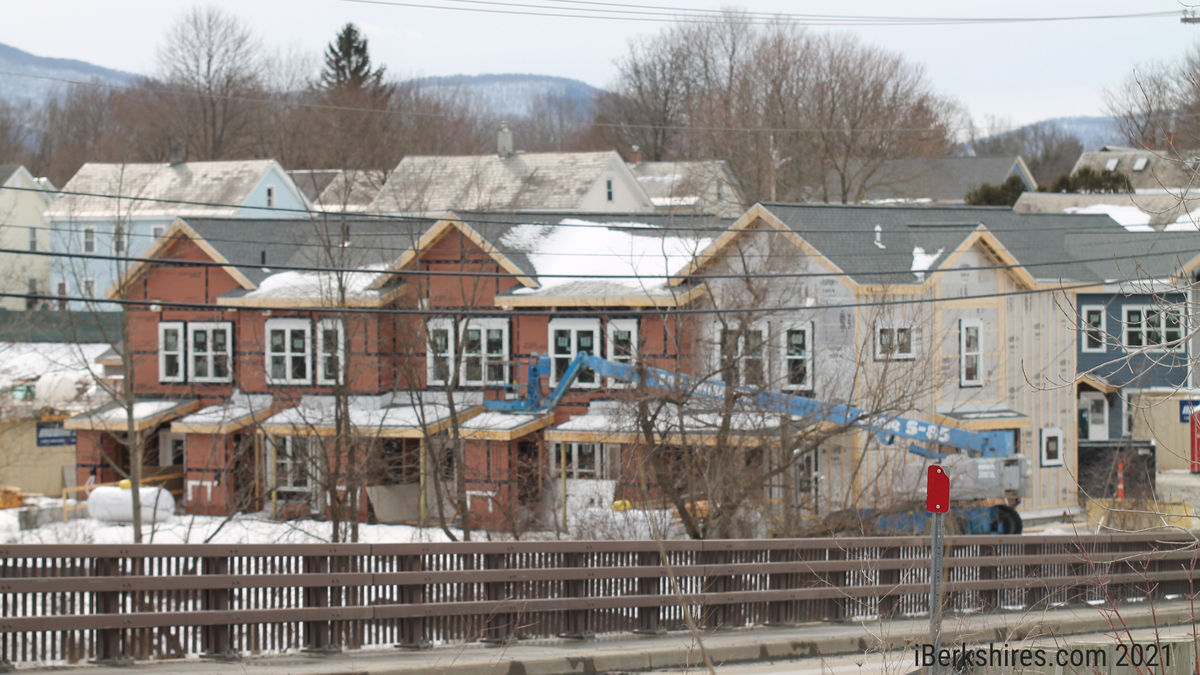
And Liz Costley suggested that the trust organize welcome baskets for the residents who will be moving into the 330 Cole Ave. complex, the former Photech mill site, this summer. Costley said Berkshire Housing, which is building 41 income-sensitive units at the site, hopes to start moving in residents by July 1.
Tags: affordable housing trust, habitat for humanity,