Williamstown Planning Board Agrees to Minor Change to Cannabis Bylaw Proposal
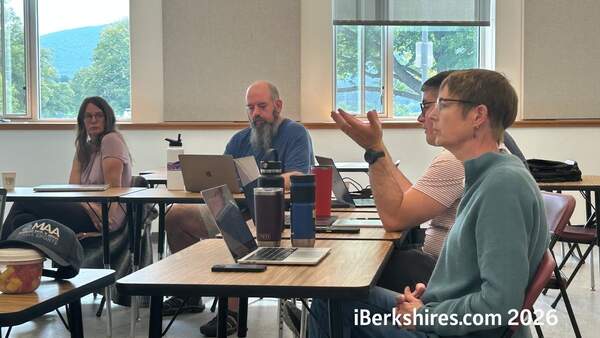
WILLIAMSTOWN, Mass. — The Planning Board on Tuesday discussed how to make one of its proposed bylaw amendments more palatable and how to make another more understandable.
The board has proposed four zoning changes to June's annual town meeting, where each will need a two-thirds majority vote for passage.
The one that has generated easily the most public discourse concerns the rules governing cultivation of cannabis. But that was not the only bylaw to get pushback from the Select Board at its Monday meeting.
That board voted, 4-1, against recommending that town meeting accept the pot bylaw as written. And one night later, the Planning Board agreed to propose an amendment at town meeting to address one of the concerns raised by the bylaw's critics at a public hearing earlier this month.
The Select Board took no action and instead sought more information about a less controversial Planning Board proposal, to rezone about 19 acres in and around the Westlawn Eastlawn Cemetery from Limited Industrial to General Residence to better reflect the actual and likely use of the land, most of which is municipally owned.
On the cannabis cultivation front, the Planning Board agreed unanimously to support an amendment to address a potential loophole pointed out during its public hearing.
"I was thinking about the comment that I think Andrew Skinner made regarding how it didn't look like there was anything in the bylaw that would prevent a landowner from leasing several portions of a property to end up with, effectively, more than Tier 11 [100,000 square feet] of canopy on a single property," Chair Stephanie Boyd said.
"So imagine you have 50 acres, and you leased out a couple of acres to one person and another couple of acres to another person … I don't think that's what we intended."
Boyd said she and Town Planner Andrew Groff consulted with the town counsel, who confirmed that Skinner was correct about the bylaw as drafted and approved by the Planning Board at the April 13 public hearing.
She also told her colleagues that she had heard from a couple of residents who asked what happened if the commonwealth increases the definition of Tier 11, the largest cannabis canopy allowed by the Cannabis Control Commission? If the local bylaw only references the CCC language, the town would be at the mercy of changes by the Boston body.
Boyd said both issues could be addressed with a single amendment to the proposed bylaw.
"Right in where we're talking about lot area, we'd add a sentence, 'The maximum total canopy on any single parcel of land shall not exceed the equivalent of Tier 11 or 100,000 square feet, whichever is less," Boyd said.
"I think this captures the spirit of what we all assumed we were talking about," Chris Winters agreed.
The other three members of the Planning Board agreed that the additional language will clarify the board's intent. Short of calling another public hearing and resubmitting a new bylaw at this late date, the floor amendment is the only way to write the new language into the proposal.
"[The land owner] could still subdivide their property," Boyd said, referring to the cap on total acreage. "But then they have to make sure they have the frontage rules and all those kinds of things. It puts some control, but not complete control, on how much you can grow on a property."
The Planning Board members were at a loss to understand the hesitancy of the Select Board to take a position on the proposal to reclassify the land on the Green River that includes part of a cemetery and Linear Park.
One member of the Select Board, Jeffrey Thomas, concerned about the potential of lost potential for industrial development in a town with very little property zoned for that use.
"It's kind of a point of economic development principle for me," Thomas said. "This could be developed into some job-creating opportunity."
Groff showed the Planning Board that between the cemetery, the park and a flood plain in the zone, there was little chance that more than two acres could be available for development.
Except for a small portion of the zone that is part of the Clover Field Farm property, "it's owned by the town, it's in active use as the cemetery, ancillary support for the cemetery and park land, which is likely subject to Article 97 protection from the state constitution," Groff said.
"This zoning designation dates from the 1963 Master Plan that had all sorts of stuff we'd look at now and be horrified by," Groff said.
Boyd explained that she and Groff discussed a bylaw amendment to properly classify the land this year because the cannabis bylaw allows indoor cultivation facilities in the Limited Industrial zoning district.
"The big motivation for doing this is when we bring the cannabis bylaw in, if someone sees, ‘Oh my gosh, there's that big industrial property there, they're going to put a cannabis facility in the middle of town,' " Boyd said. "That's not going to go over."
Groff told the Planning Board he would discuss the issue with Interim Town Manager Charlie Blanchard, who will take over the job of advising the Select Board before its next meeting, about the issue. Boyd also indicated she would be available to help explain the reasoning behind the proposed zoning change to the Select Board; although she did attend Monday's meeting and did speak on the cannabis bylaw, she was not asked by the board to address the proposal to change the industrially-zoned property to residential.
Tags: cannabis, marijuana,