Mount Greylock Announces Class of 2021 Speakers
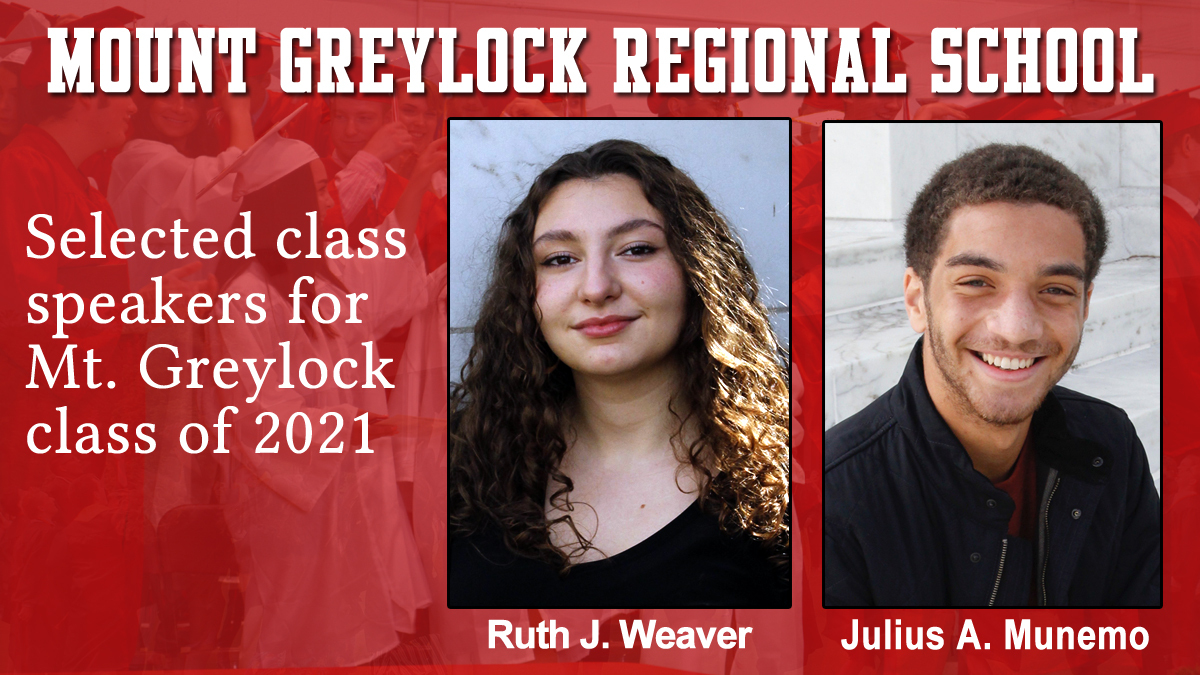
WILLIAMSTOWN, Mass. — Speakers have been selected for the Mount Greylock Regional School 2021 graduation that will be held on Saturday, June 12, at 11 a.m. outside the school. The speaker profiles, as submitted by Principal Jacob Shutz, are as follows:
Ruth J. Weaver was chosen by the faculty to speak at graduation. The daughter of Katie Kent and Ben Weaver of Williamstown, she has completed seven Advanced Placement courses and spent a semester in a Williams College dual enrollment seminar studying 19th-century British literature. Exceptionally talented, she has a passion for acting, music and classics. In roles as varied as Dolly Levi in "Hello Dolly!" to "The Tempest's" Prospero, Weaver has mesmerized all with her on-stage theatrical performances for the past six years both in school and at local repertory companies. She also participated in the performing arts band playing both the alto and baritone saxophones. Her performances in Greylock Plays are captivating, and she is as generous on stage as she is talented. As a member of the Junior Classical League, she moved through the leadership ranks serving as a local technical coordinator, publications editor, local president and eventually the state secretary.
She will be attending Barnard College in New York City in the fall to study theater, classics and English.
Respected and well-regarded by his peers, it was no surprise that Julius A. Munemo was chosen by his classmates to speak at graduation. Academically talented, Munemo, the son of Ngoni and Julia Munemo of Williamstown, is both curious and enthusiastic about learning. As a senior he was enrolled in a Williams College psychology course and has pursued a talent for writing with both. He completed nine Advanced Placement courses while at Mount Greylock, earning recognition as an AP Scholar with Distinction. His membership in the National Honor Society reflects his exceptional achievement, integrity and citizenship. He is taking a Williams College dual enrollment course in psychology and a screenwriting course through independent study.
A dedicated athlete, he has had a passion for soccer since childhood. He attended many soccer camps, has worked as a soccer camp counselor and is a four-year high school varsity player serving as captain of his team this year.
In the fall, Munemo will study psychology at New York University.
Tags: graduation 2021, val & sal,