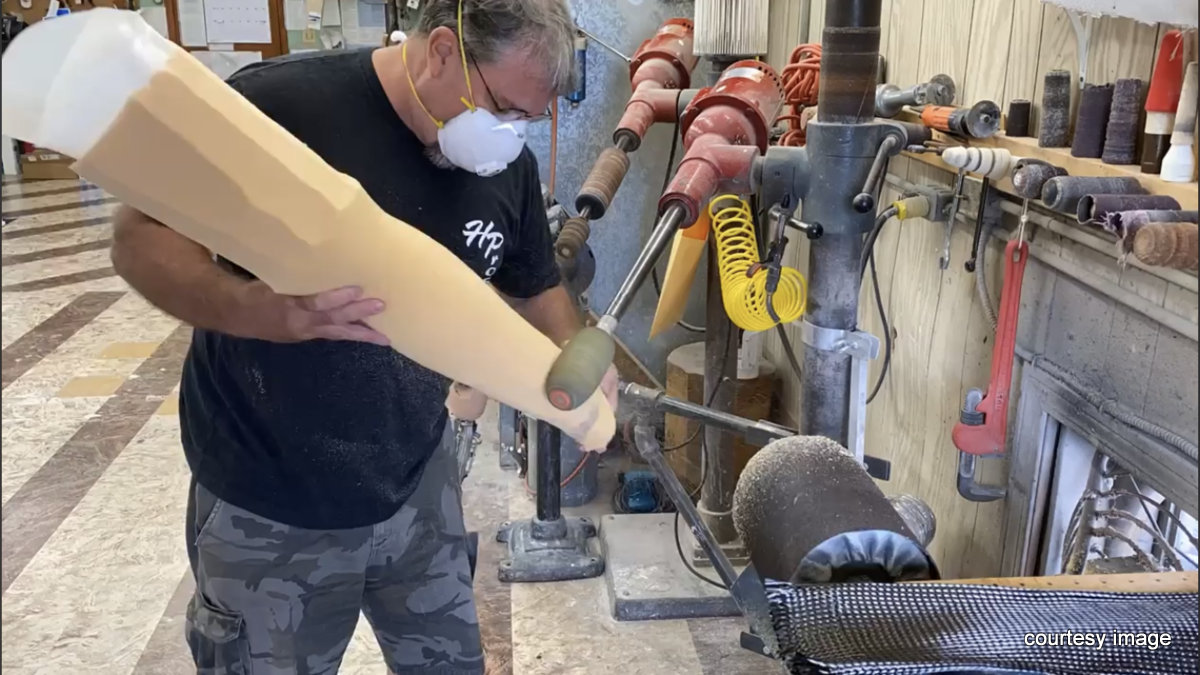
David Hayes, of Hayes Prosthetic Inc., fabricates a prosthetic leg at the company's Springfield location. The Pittsfield native is hoping to open a location in the city.
Pittsfield Native Prosthetist Seeks Location in Hometown
A prosthetic arm hydrodipped with a flag image for a client who is a veteran.
PITTSFIELD, Mass. — A Pittsfield native prosthetic specialist wants to return to the Berkshires with a second office and is scoping out the interest level.
David Hayes, of Hayes Prosthetic Inc., said he prioritizes listening to clients' experiences to provide a prosthetic that is comfortable and empowers them to have a better quality of life.
"My statement is wearing a prosthesis shouldn't be a painful experience, if it hurts you, something's wrong," he said.
"I tell people in the casting room before I cast them, I have a little talk with them, I say, listen, you need to remember something that you're going to go through a whole host of emotions as you go through the process of being able to use a prosthesis every day, and that is you're going to laugh, you're gonna cry, you're going to be angry, you're going to want to throw the prosthesis across the room. ...
"But what you need to understand is, that's normal to feel that way after what you've been through and you always have to remember when you feeling like that, that I'm here. It's my job to listen to you."
His location on Riverdale Road in Springfield has been successfully in operation for more than 50 years and he feels a need to also provide services to his hometown.
"We've got 100 years of combined experience with my brother and my father and there's a lot of stuff that I can still do that other guys don't," Hayes said. "It's like a lost art, there are people that just don't do the kind of work that I do anymore, and I specialize in prosthetics, that's all I do, where a lot of these other companies, they do orthotics as well."
Orthotics are generally support devices such as braces and footwear; prosthetics are artificial limbs.
He wants to service his hometown but said he first has to make sure there is a clientele.
His father, company founder Robert Hayes, started his career in prosthetics after leaving Marine Corps and incorporated the business in 1961 in Pittsfield. He took part in the development of the National Accreditation Examination and was a past president of the American Board for Certification and of the Academy of Orthotics and Prosthetics.
Hayes the son became a technician in 1985 and was mentored by his father and his brother, Brian. Hayes took over the operation a few years ago after his father's passing.
He prides himself in the highly detailed and personalized way that he tailors prosthetics to clients. These values were handed down to him by his father, he said.
"I take a special interest in it because I really do care about the people that I'm working on, I kind of treat them like family, like I was working on my brother and my sister," Hayes said. "When you're dealing with the loss of limb on somebody ... you want it to be the best it can be because you can compare it to what God gave them, but I want it to be the best. That comes from the heart."
His experience is comprised of education and a lifetime of observation. He is accredited with multiple nationwide certifications on top of his long apprenticeship.
Hayes makes it a priority to listen to the needs of his clients' so they can be best fit for a prosthetic.
"I had a woman come in here one time, she was bent over, she could barely walk, prosthesis didn't fit her for beans so I started to work with her and she said, 'Well, you don't know as much about the prosthetic, because you don't wear one,' and I said, "to the contrary because I don't wear one, I have to listen very, very close to what you're saying. So that I can get you where you need to be.' And I got her up walking straight and everything."
He is also sensitive to the customers that want a cover for their prosthetic so it passes as a standard limb, even if insurance doesn't pay for it. That gives people a better quality of life feeling, he said.
"A lot of times insurance companies, they don't pay for certain things, and I like to make sure that it's provided, now I can't provide, you know, a $4,000 foot for somebody, but something like a cover and that little personal touch that makes people happy and feel good about it is what I try to do," Hayes said.
Hayes also hydrodipped an American flag onto a veteran's prosthetic arm after making a new hand out of two old ones. He said there was no extra charge for that and was just a special thing that he did because he knew he would love it.
Adding an extra layer of thought into his products, Hayes is both the prosthetist and the fabricator of the devices. He said this is unique for the industry, as many prosthetic companies outsource fabrication.
He said he always pushing for perfection in his craft, knowing that a false limb will never be just like the real thing for clients but wanting to make it as close as he can.
Eventually, he would like to hire a young prosthetist to pass on his knowledge as he doesn't want it to go to waste.
If you would like to contribute information on this article, contact us at info@iberkshires.com.
Your Comments
iBerkshires.com welcomes critical, respectful dialogue. Name-calling, personal attacks, libel, slander or foul language is not allowed. All comments are reviewed before posting and will be deleted or edited as necessary.
No Comments
Pittsfield Man Creates Device to Clear Lakes of Algae Blooms
By Breanna SteeleiBerkshires Staff
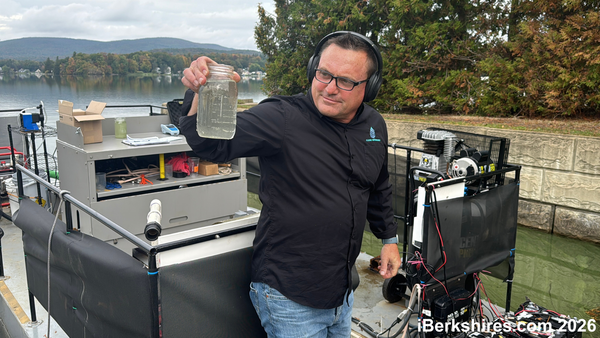
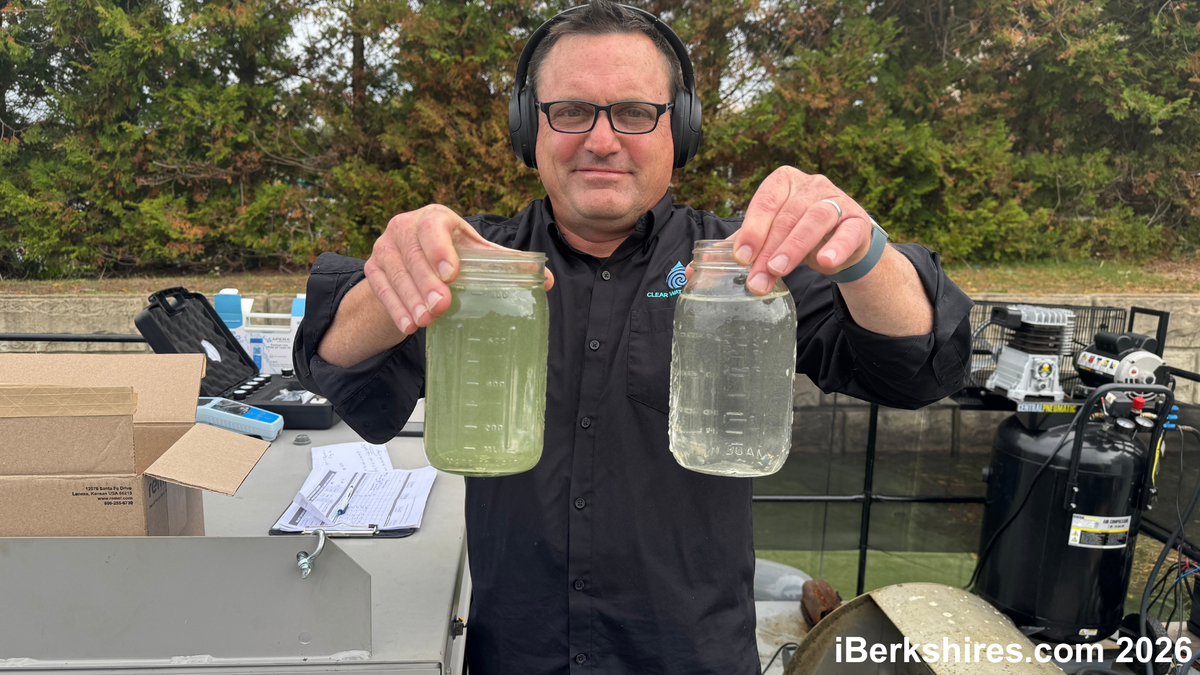
Marc Bellora holds a jar of lake water, left, to compare to water cleaned by his Aqua Clarifier Water System.
PITTSFIELD, Mass. — Marc Bellora has high hopes for a device he's created to treat lakes from harmful algae blooms.
His patented water clarifier can physically remove captured material rather than letting the nutrient-rich material settle back into the lake, which occurs when herbicides are used.
"It's a long-term lake management tool that can be used to reduce legacy nutrients in lakes and ponds over time," he explained. "We built the prototype, this is a prototype. It does approximately 65 to 70 gallons per minute. It's very environmentally friendly. Can be used with air only, or we can use a low-dose potable polyaluminum chloride (PACL) or chemical on board that can help improve results."
The water clarifier barge is based on well-proven technology for water treatment, he said. "It's a self-contained, portable, mobile unit that removes algae blooms, nitrogen, phosphorus, and the associated nitrogen and phosphorus within lakes."
Bellora founded Clear Waterways Group with business partner Mark Simon. They built a prototype mobile unit and are still working out the kinks. It's taken Bellora about five years to bring the project to fruition as he is also a full-time Realtor.
He says the repurposed barge they use has a device that uses air to filter the water to separate harmful bacteria or uses a chemical at low doses. They are testing both to see how well each does at cleaning the water.
"They would do the same thing here, except they would spray it, and it blocks all that stuff together," Bellora said of the use of herbicides. "But then it drops to the bottom. So now all the nutrients that are attached in that plot go to the bottom and contribute to the legacy nutrients only to fuel next year's bloom. Ours removes it."
He said just using air alone has removed 70 to 90 percent of harmful algae where he has been operating on the south end of Pontoosuc Lake.
"Essentially, we take in the bad stuff, we take in the lake water. We separate the good stuff from the bad stuff. Clean water goes back into the lake, and the bad stuff can either be composted, or it can be taken to the wastewater treatment plant, which is what we're doing here," he said.
Bellora explained that tiny air bubbles attach to particles in the water, making them buoyant so they rise and can be removed. The unit can operate with air alone, or with a low dose of potable polyaluminum chloride.
PACL helps through flocculation: it gathers small particles into larger clumps that are easier for air bubbles to capture. He said this can help remove dissolved nutrients that air alone may not capture as effectively.
Bellora said he was inspired to build something like this after noticing the lakes he enjoys being shut down because of algae blooms.
The city issued a health advisory for Pontoosuc in August, warning residents not to swim or come in contact with the lake water because of an algae bloom. The cyanobacteria can cause skin irritations, vomiting and diarrhea and nerve or liver problems.
Bellora previously worked for a company that used traditional dissolved air flotation (DAF) systems to treat water. In that role, he traveled around the country to work at paper mills and food-processing plants.
That experience gave him a practical understanding of DAF, and while flying between jobs, he would see green ponds and wonder whether the technology could be adapted to treat lakes.
His water clarifier can physically remove captured material rather than letting the nutrient-rich material settle back into the lake, which occurs when herbicides are used.
click for more
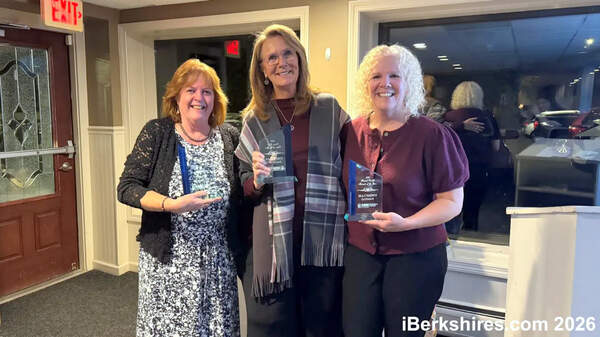
NAMI of Berkshire County celebrated community advocates and gave its annual report on how the organization has been navigating troubling times. click for more
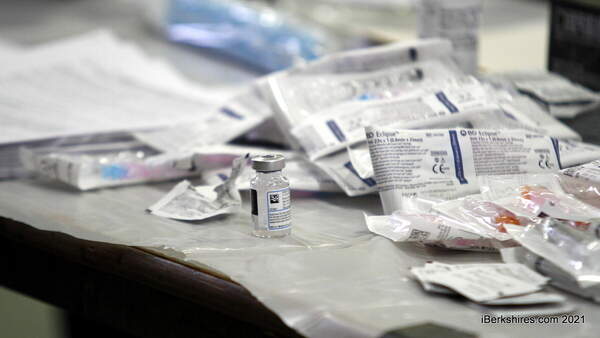
The Berkshire Vaccine Collaborative will provide public vaccination clinics in Berkshire communities this fall, including the Influenza and COVID-19 vaccines. There are about 49 clinics. click for more
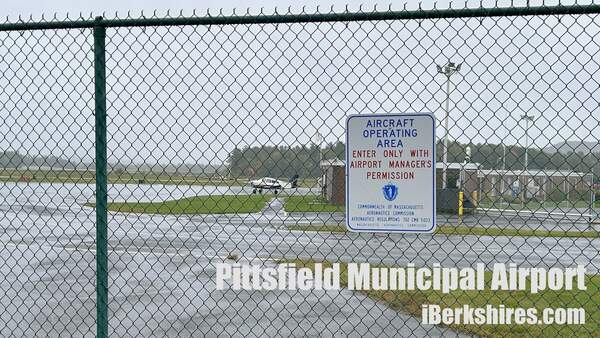
In early February, the airport was approached by a prior tenant, Leon Shabott of Hangar4Planes, about the possibility of constructing a hangar at the airport.
click for more
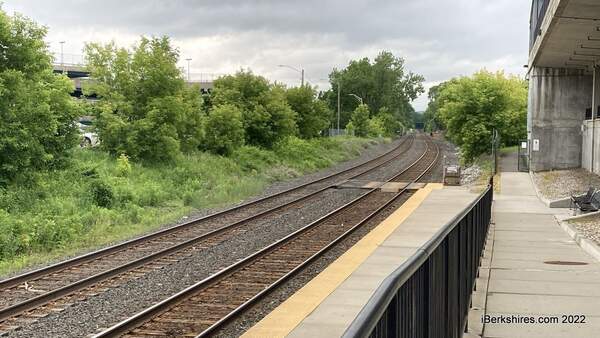
The state Department of Transportation and CSX have reached an agreement for local infrastructure improvements that will be a "major step" to making the Berkshire Flyer a permanent seasonal service.
click for more