RMV Extending Use of State-Owned Vehicles for Road Testing into 2022

Print Story | Email Story
BOSTON — The Massachusetts Registry of Motor Vehicles (RMV) announced the agency will continue with the use of Commonwealth-owned vehicles for Class D road testing services through April 30, 2022 and has delayed the return to the use of private passenger vehicles for road tests.
 
Due to the pandemic and health and safety protocols, since June of 2020, the RMV has deployed a fleet of Commonwealth-owned vehicles for road tests which are cleaned and sanitized on a regular basis. Plans to return to private vehicles have been delayed and existing protocols will remain in place:
  • All occupants of a vehicle used in a road test, including the applicant, sponsor and examiner will continue to be required to wear a face covering.
  • Windows will be open for ventilation.
  • All vehicles will be cleaned prior to each test beginning.
Applicants with scheduled Class D road tests appointments in the new year will receive an email fr om the RMV notifying them of the use of state vehicles. Applicants are given time to become familiar with the state vehicle they will be using in Class D testing. Applicants for a Class M, or Motorcycle license, will continue to supply their own motorcycle for testing. Road test applicants scheduled for testing through a driving school should confirm they have access to their school's vehicle. 
 
The RMV reminds all customers this winter season to visit Mass.Gov/RMV in inclement weather to ensure locations are open and honoring appointments and walk-ins. Cancellations and closures are posted on Mass.Gov/RMV.
 
The RMV has launched a new webpage to help applicants locate all information related to their road test, Mass.Gov/RoadTest. The page includes information on what to expect, videos to help prepare for the road test, links to checklists and applications to increase an applicant's chance of passing their exam.

Tags: RMV,   
If you would like to contribute information on this article, contact us at info@iberkshires.com.

Pittsfield Considers Repairing East Part Cemetery

By Brittany PolitoiBerkshires Staff

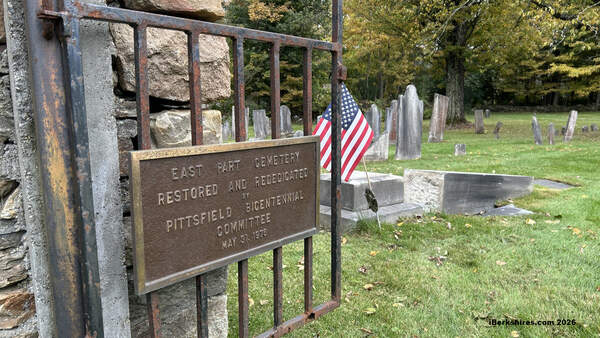
PITTSFIELD, Mass. — The Historical Commission will consider grant opportunities for repairs to East Part Cemetery.

A resident reached out to the city with concerns about degradation in the half-acre burial ground at the top of Williams Street. East Part Cemetery was established in the early 1800s and has about 300 interments. 

“It's a nice old cemetery, and basically, (the resident) had had concerns that the stone wall had taken some damage, the gravestones have taken some damage, and was wondering if there's anything that could be done to repair the gravestones and the wall," City Planner Kevin Rayner told the commission on Monday.

In cooperation with cemetery leadership and residents, the Historical Commission will consider applying for Community Preservation Act funds to support repairs. West Part Cemetery, on the other side of Pittsfield, has previously used CPA funds for revitalization work. 

The 1080 Williams St. property is owned by the city and managed by the Pittsfield Cemetery Commission. Rayner presented photos of broken and overgrown gravestones, parts of the stone wall collapsing, and knocked-over obelisks. 

Some aspects could use general maintenance and restoration, he observed. 

According to the Pittsfield Cemetery and Crematory's website, East Part Cemetery was established around 1808 on land owned by Nathan Webb, who permitted and authorized its use as a public burying ground.  

In 1842, Nathan Webb's son, also named Nathan Webb, deeded the property to the Methodist Episcopal Society of Pittsfield as a public burying ground, and in 1893 the Trustees of the Methodist Episcopal Society transferred their control of the cemetery to the Proprietors of the Pittsfield Cemetery. Their action was confirmed by the Berkshire Probate Court.

View Full Story

More Pittsfield Stories