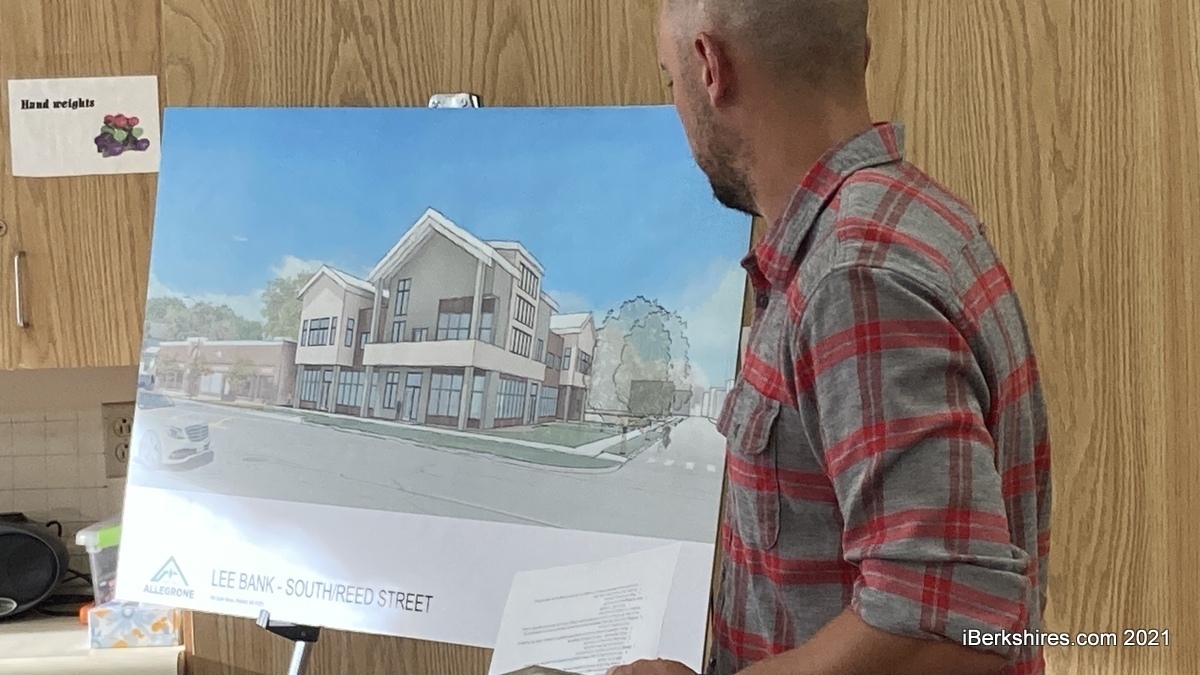
Lee Bank to Start Construction on Second Pittsfield Location
PITTSFIELD, Mass. — Nearly six months after Lee Bank was given the OK to move forward with a second location on South Street, the bank intends to begin construction.
The Community Development Board reviewed and approved the proposal's landscaping plan on Tuesday. This was the condition of a prior approval made last summer before the issuance of a building permit.
"They are ready to begin construction, I signed off on the foundation permit after speaking to [Chair Sheila Irvin] last week just to allow them to get started," City Planner CJ Hoss explained.
"But I think they are hoping to get a sign-off potentially as soon as tonight even if the board does have some outstanding concerns that would like to see addressed."
The bank intends to build a mixed-use, two-story, 5,400-square-foot building that will consist of a first-floor bank with two drive-through windows and second-floor residential units located at the corner of South Street and Reed Street.
In August, the board had passed two special permits and a site plan for the new build, one to waive loading zone requirements and a 25-foot setback exception was approved with the condition that the applicants submit a more detailed landscaping plan and have the bank's sign mounted on the building rather than on the lawn.
The panel wanted to see a plan that resembles more of an urban plaza than traditional landscaping, Hoss explained.
"This particular solution that we came up with was derived for a few reasons," project architect Anthony Allegrone said.
"One, it incorporates green space or grass ways as a result of the desire to incorporate greenery into the setback condition, from our standpoint, both us and SK Design, urban doesn't necessarily mean entirely hardscape, it means sort of shaping the landscape between these buildings and assisting with softening the Reed Street overall, which partly was due to the reason as to why we wanted to pull the building back a bit along with gaining some daylight to that space."
He pointed out that there was an original goal for the bank to have an outdoor space, which influenced the setback proposal.
"And the setback condition at the corner is really meant to in part tie in with the new sidewalk scope of work as you move down Reed Street," Allegrone said.
"So you can see there's landscape as you move down Reed Street that incorporates greenery and plantings as well and it's really meant to merge with that entire greenway to some extent, overall, and really tie in together for sort of seamless way to soften Reed Street in some ways."
In October, the City Council passed a special permit application for the construction of a drive-through window service on the site with one condition -- requiring a raised right-turn median instead of a painted one at the intersection of the streets.
To accommodate the drive-through, the first 290 feet of Reed Street from South Street will be converted to two-way traffic.
The architect also addressed previously voiced concerns about the upkeep of the green space. He said that this influenced the planners to create a simplistic area with minimal maintenance to avoid it becoming overgrown.
Allegrone's explanation was predated by some concern from Irvin and support from fellow board member Libby Herland.
"As I recall, there was some concern, first of all about having that kind of non-urban green space in the first place, and from my perspective, it's still non-urban green space, it's just a couple of benches and some shrubs," Irvin said.
"So on the part of the board, we need to know kind of what your assessment is of that green space as an urban green space and what advice or concern you want to relay to the applicant."
Herland did not have a problem with the landscaping plan that was brought before them.
"I actually don't have a problem with the design, I like the design, I mean, I know we talked about a more urban design for that space, but I also like the fact that there's a lot of greenery in here. It's green and I like the benches if people want to sit there if they're stopping," she said.
"I think maybe we need to be a little clearer, at least for my sake on what we mean by more urban green spaces because I like the plan that they submitted, personally."
Board member Matthew Herzberg observed that the plan creates a lot of outdoor seating and asked who it is really for.
Allegrone said the bank alone will use it often.
"If you recall the programmatic requirements of the bank this what we feel is an innovative bank designed programmatically, the bank can speak to this very well as well because this is an operational thing for the bank, but the community space which is located on the corner of the building, which you can't see by the landscape plan, but the corner of the building that is located closest to the intersection holds what is considered a community room, so that community room is accessible by the public," He explained.
"It's going to hold a variety of functionalities, it's really a mixed-use space, and it's an assembly space, educational gathering space, event space, it has the tellers as well for the bank so obviously the public is going to be coming in and out of the space just naturally due to its use, but the nature of it is flex space and assembly space, it's meant to hold certain groups of people just specific to the bank, so the bank alone to answer your question will be expected to use this space quite a bit."
Herland thought that the plan will look beautiful and that it will be a vast improvement from what was on the site before.
The board also received a presentation on the city's land use and parking table review. It was centered on what is described to be a "long overdue" update of the city's regulations for parking.
Planners looked at other communities similar to Pittsfield such as Portland, Maine, and other communities in the state such as Arlington, Haverhill, Medford and Westport.
The key finding was that Pittsfield's requirements are quite complex for parking, meaning that the required number of spaces is often higher than other communities for similar uses.
"Our use table was something that was really based from probably going back into the (1960s) and just don't really represent modern land use categories and same goes for parking, and then the fact that parking uses were added, but never joined or without any guidance on how they should be interpreted," Hoss said.
"So basically, it's just this mishmash of uses between the two tables that are puzzling to staff, and that's from our from our perspective on the development side, or the building department side, the actual zoning enforcement and interpretation arm of the city so this just will remove a lot of, there's always going to be question marks but this at least helps remove some of them as far as some things and we haven't yet tried to bring in some more flexibility."
The board also addressed a number of petitions from the City Council on short-term rentals, abutter notifications related to the 877 South Street cell tower, and the abolishment of the planning board.
This was in response to Ward 1 Councilor Kenneth Warren's petition requesting the abolishment of the Planning Board and substituting the Department of Community Development as its replacement.
The board voted to become petitioner through the council by replacing the Planning Board with Community Development Board in the city ordinance.
Tags: Planning Board,