Williamstown's WilliNet Adds App to Streaming Services

"My son was in law school," Deb Dane recently recalled. "And they closed down like that Tuesday. He said, 'We're going to do this thing where we're going to meet remotely.' And I was like, 'How are you going to do that? What does that even mean?'
"He said, 'I don't know. We're going to use this thing called Zoom.' "
Since then, Dane has become very familiar with the Zoom platform and the non-profit she directs, WilliNet television, has become integral in keeping the town connected through countless virtual meetings on the videoconferencing system.
Technology has always been central to the mission of WillNet, but that never has been more true than it has during the COVID-19 pandemic.
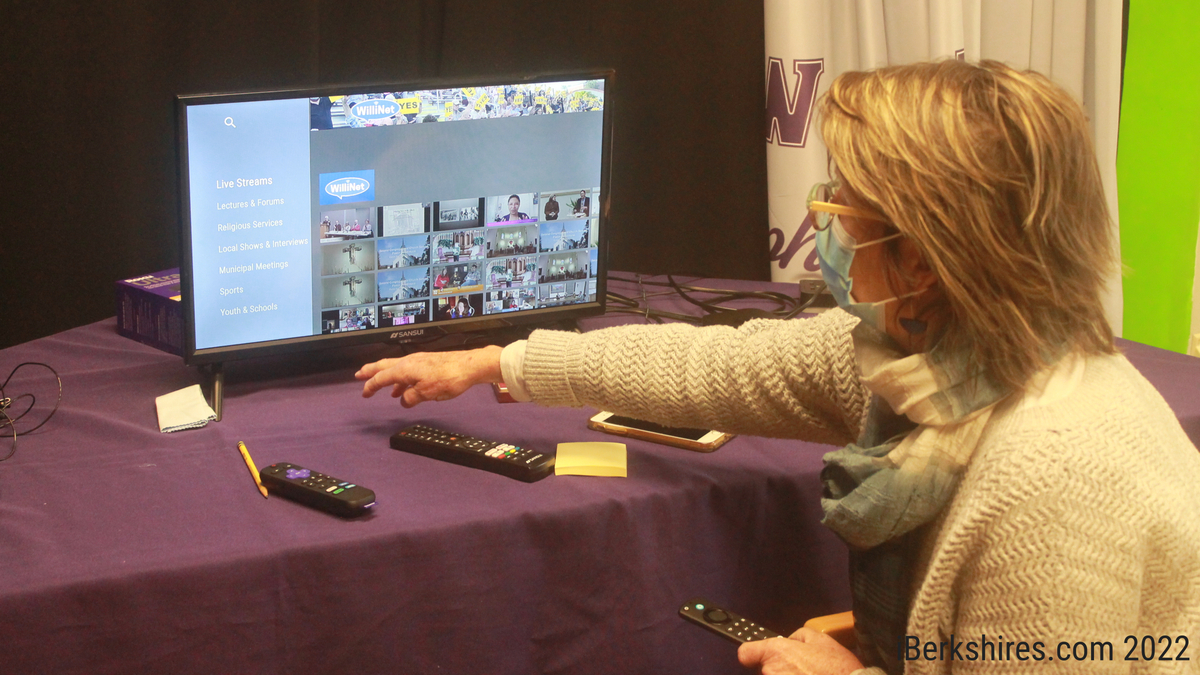
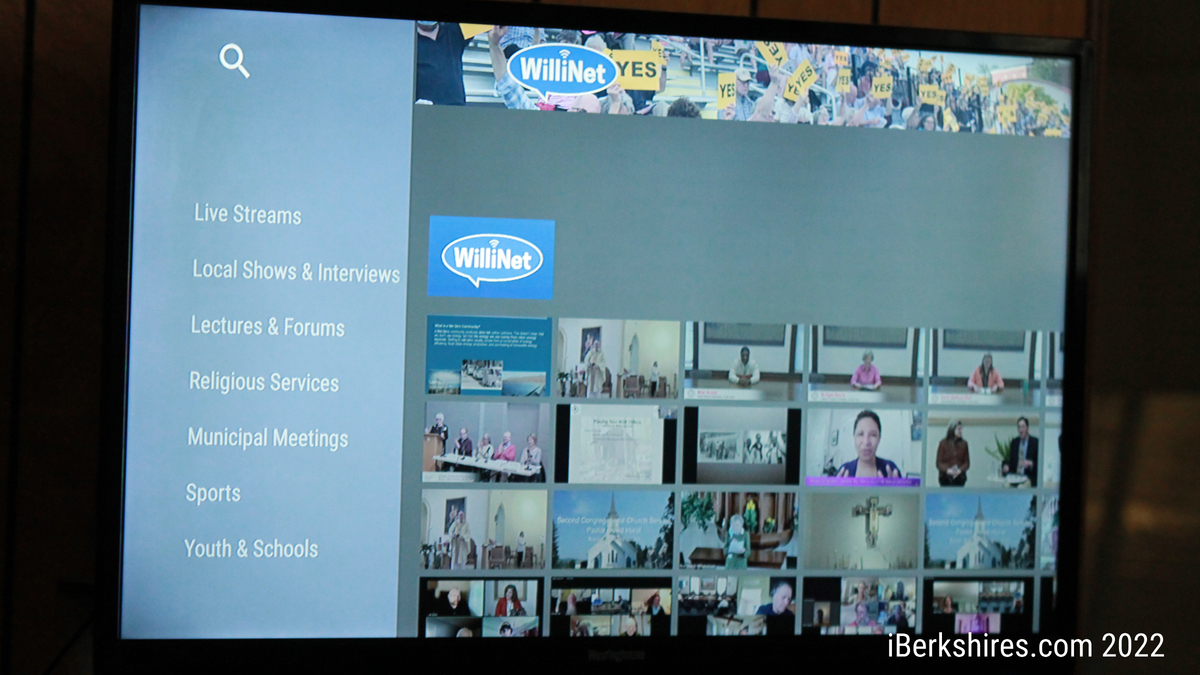
Recently, the town's community access television station took another technological leap forward when it established a presence on three major streaming services: Roku, Apple TV and Amazon Fire TV.
Now, just as local cable TV subscribers can watch WilliNet's dedicated channel, 1303, viewers around the world can download the WilliNet app and watch the live feed or call up archived meetings, lectures, religious services or any of the myriad programs produced for the station.
Both live streams and archived content already were available on demand through the willinet.org website, but the ability to stream the local programming on television will help Willinet serve its public even better and reach more potential viewers.
The technology that allows WilliNet to provide content through streaming services has been around for a while, but its cost was prohibitive for the station until former Town Manager Jason Hoch suggested that the town could help fund the upgrades with money from the federal Coronavirus Aid, Relief and Economic Security Act.
"He helped me set up a spreadsheet with all the extra things we were doing that were COVID-related, non-budgeted, and it was a lot," Dane said. "It was enough that we were then able to actualize a dream I had four years ago: How can we get on streaming services?
"It requires a VOD — video on demand — server. It requires, basically, tens of thousands of dollars to get there that we did not have. Last spring, we were able to buy from [Cablecast Community Media] the video-on-demand server that services Channel 1303, and we were able to afford to operate it into the future."
Simultaneously, WilliNet and the town faced another technological challenge: how to preserve the best elements of Zoom when all those municipal meetings returned to Town Hall.
As pandemic restrictions eased and town boards and committees were allowed to meet in person, those committee members were eager to again start collaborating face to face. But they also recognized that the "remote participation" allowed by Zoom had increased public engagement starting in the spring of 2020, and town officials wanted to be able to allow residents to continue providing input at meetings without having to be in town hall.
"They could view the meetings live, remotely, without a cable subscription because we had started streaming [on the website] by then, but to interact was a different thing," Dane said. "That interaction came because of COVID but also because of the cultural reckoning that was going on.
"Frankly, it was the [Diversity, Inclusion and Racial Equity] Committee, as an advisory committee, that adopted an interlocutory way of being with the community. That interactive mode, I think, has really influenced a lot of the other committees when they think about public comment."
Some in town wondered why boards did not simply meet in person with laptops in front of committee members to stream a simultaneous Zoom meeting. That solution could have solved part of the problem, but it would not have worked for WilliNet.
"Our budget is supported, 75 percent, from Spectrum cable television subscriber fees," Dane said. "The TV part is really important to us."
And while cable TV does not have the dominance it once had, the service continues to be widespread in Williamstown. Dane said she has been with WilliNet more than 15 years, and has seen a falloff in cable subscriptions but not as steep a drop as some might speak. In the early part of the century, between about 2,250 out of 3,000 households in town had cable; in December, that number was 1,590 — still more than half.
Running meetings in person with Zoom elements and live telecasts on the cable channel was not as easy as some would have thought.
"All these codexes — the language the signal comes in — are different," Dane said. "The Zoom signal is different from the streaming signal which is different than a TV signal. But it all needs to be made compatible at the user end."
Dane credits her colleagues at Pittsfield Community Television and Lanesborough's LCATV with helping WilliNet overcome that hurdle and now produce telecasts that seamlessly incorporate both in-person and remote participants.
Municipal meetings make up a big part of WilliNet's programming, and that percentage only grew during the pandemic. In 2021, the station covered twice as many meetings as it did the year before, and viewership of those meetings on the station's website jumped by 67 percent.
But COVID compelled WilliNet to reach beyond Town Hall and offer regular weekly church services for multiple denominations, exercise classes and the first "virtual" graduation program at Mount Greylock Regional School in June 2020.
"We worked on all of that remotely," Dane said. "None of the kids could go back in the building. I felt so lucky because we had, sort of, the keys to the town.
"There were two kids who were [class] officers, and they didn't have good enough Internet. I had to go with them to record in the school, and they were like, 'Can we go look in the auditorium? Can you take us to go look?' To think of that and how those kids all came together to figure out all the little Instagram-y things they did, there was so much cohesion and beauty but it was so shocking at the same time."
Last spring, WilliNet was recognized with the town's Scarborough, Salomon, Flynt Community Service Award for the way the station helped Williamstown cope with the shock of the pandemic.
"The streets were empty," Dane said in an interview in WilliNet's offices overlooking Spring Street. "You weren't seeing people. You just kept doing it and answering people's calls: 'Can you film this? Can you help with that?'
"We worked really long hours putting out almost twice as much programming in different ways. And I remember saying to [production manager Jack Criddle], 'What we're doing matters,' "
Tags: public television, WilliNet,