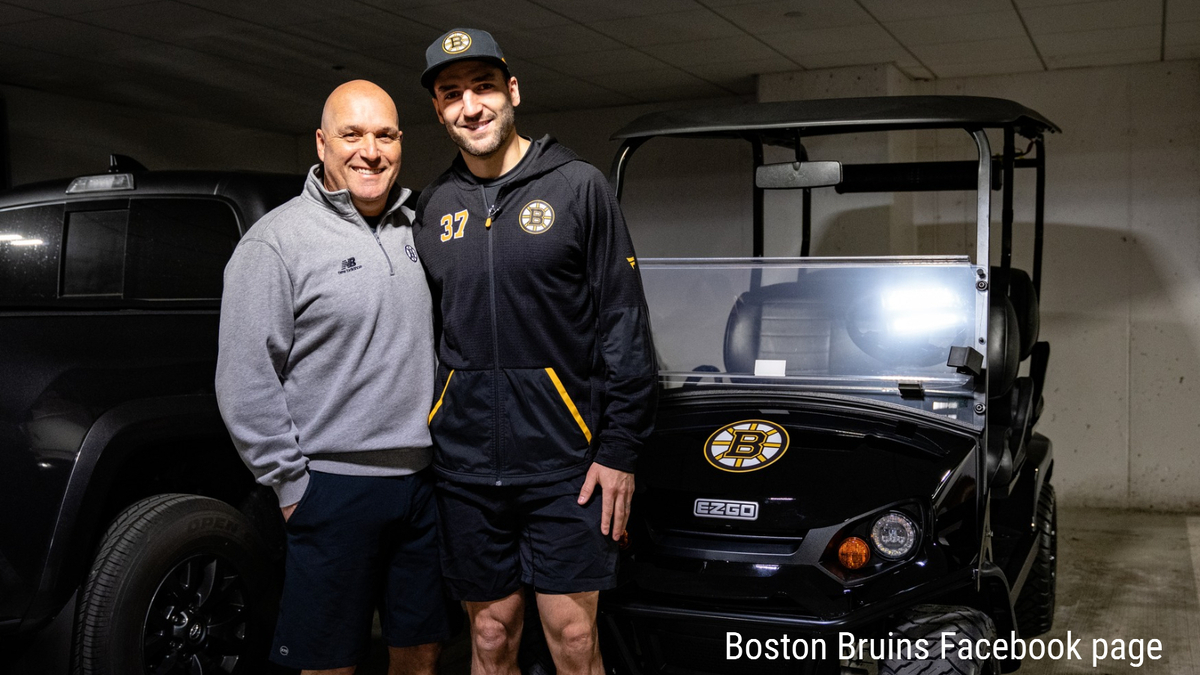
North Adams' DelNegro 'Never Worked a Day' in 29 Years with Bruins
BOSTON — North Adams' Don DelNegro was doing HIPAA before HIPAA was a thing.
The landmark Health Insurance Portability and Accountability Act of 1996 included, famously, a rule for protecting the privacy of patients.
Three years earlier, in 1993, DelNegro took over as the head trainer for the Boston Bruins, entering a world where — especially this time of year — privacy is a priority.
National Hockey League teams and players are famous for not talking about or revealing injuries during the Stanley Cup Playoffs.
As the B's top trainer for nearly three decades, DelNegro has been the guy who knows better than anyone what Boston players are going through physically as they do battle on the ice.
And, of course, he does not tell a soul.
"It's well earned," DelNegro said of the game's reputation for secrecy around injuries in the post-season.
"It's all gamesmanship. If you're going into battle, you don't want your opponent to know any weaknesses. In the regular season, you're managing it. You might have a guy miss a game or two. But in a seven-game series against the same team, every game, you've got to keep a lot of things quiet so vulnerable areas aren't attacked.
"It's an analogy to war. It isn't war. But there's an analogy."
DelNegro recently was recognized by the Bruins for his 29 years of service, and the team gave him a black-and-gold golf cart to enjoy in retirement.
He and legions of hockey fans throughout New England hope it will be a while before he has a chance to use it.
On Thursday morning, he sat down with iBerkshires.com to talk about his time in Boston, what kept him with the team so long and why this summer is the right time to ride off into retirement.
Question: I appreciate you taking the time to chat. I'm sure you had a late night coming back from Carolina [Wednesday] night. I imagine you won't miss that part of the job.
DelNegro: No. Call it reason No. 67 why I'm retiring. It's a grind. One hundred nights a year, you're getting in late one way or the other — either from a home game or a road trip. It starts to add up after a while.
Q: I want to ask you a little about your background and what you did before you got to Boston.
DelNegro: I went to graduate school and, after that, I was an assistant trainer at the U.S. Olympic Training Center in Lake Placid. Working up there, you work with every sport — bobsled, luge, ski jumping, hockey, obviously. In the summer, they had canoe/kayak, boxing, wrestling.
I had some opportunities to travel with team handball, luge, bobsled, a lot of different sports.
Q: And I assume it was the same at Williams? You worked with football, basketball, whatever?
DelNegro: There was a gentleman named Ron Stant who was the primary football trainer and hockey trainer. I worked with basketball and men's and women's soccer in the fall. I did a variety of sports at Williams, but I never actually did hockey.
Q: So how did you end up hooking up with the Bruins?
DelNegro: I was at Williams for five years, still doing a lot of U.S. Olympic stuff like the Pan-Am games in Cuba or there used to be something called Olympic Festivals, where they would bring in all the athletes in the summer. I did that for USOC.
And I heard through the grapevine that the Bruins were looking for a trainer. I literally called the office and talked with a woman who put me through to Mike Milbury, who was the assistant general manager. He said, 'Send us your resume.'
Of course, back then, no one had faxes, so I had to go to a Kinko's-like printing shop and pay my 25 cents to fax it to them. Then I drove from Lake Placid down to Boston to interview with them. They hired me, and six months was my first contract — kind of a tryout type basis.
My wife and I had a life-changing conversation and decided that if it worked out, great, and if it didn't work out, I'd get six months of experience in the NHL.
Q: So could you have imagined you'd be there for 30 years and retire from the job?
DelNegro: Absolutely not. My wife and I said, let's do it for five or 10 years. It's going to be a grind, a lot of hours. But if I get to do it for five or 10 years, it will be great, and then I'll go back to a university or a college.
But it's a great organization to work for. I've had a great staff working for me all these years — the trainers we've hired through the years, the equipment staff. There's an old saying that if you have a job you love, you never work a day in your life. And that's what it's been. I've never had a bad day. I never remember wanting to not do it.
Q: And thinking about your early days, they were in the Garden, right? How did your job change when the Bruins moved into the then-new facility, the FleetCenter?
DelNegro: In 93-94, we played the entire year at the Garden. 1994 was the lockout, and we played half the season, 48 games. That was the year Cam Neely scored 50 goals. The next year we moved into the FleetCenter.
Q: And for fans, obviously, it's a much different experience than the Garden. But I'm guessing for you, too, there were advantages to being in a modern facility.
DelNegro: The training room at the Garden was very old. When that place was built, there was no such thing as athletic trainers. It was just a 'stitch room,' they would have called it, a place for players to go and get stitched up.
If I was stretching an athlete out on one of the tables, my butt was against the wall. I'd guess the room itself was 12 feet wide by 20 feet long, if that. There were no hot tubs, no cold tubs, no saunas or steam rooms like we have now. The weight room was a tiny room one floor above us. And they had barbells that were literally a bar with Folger's coffee cans filled with cement.
Q: So how much easier was it to be effective where you are now?
DelNegro: It makes it a lot easier to be in a larger room with state-of-the-art equipment. It's easier to motivate players to do the work, too. Think of your own experience if you go into an old, dirty gym as opposed to a place with glass and mirrors, bright lights, music and all the equipment is up to date. You're motivated to work hard.
Q: Along with that, I'm guessing that the players themselves are more focused on the conditioning part of the job than they were 30 years ago.
DelNegro: When I first started, we literally used training camp to get into shape. Back then, we had no cell phones, no internet, no communication like it is today. The season ended, and players packed up their gear and drove to Calgary or Edmonton or wherever they lived in the off-season. You might have called them once a month, and we had some [workout] programs we'd print up, Xerox and give to them.
Now, with technology, we can get real time data when they're working out 1,000 miles away in Prague or wherever.
When I started, we might have seven to 10 days of conditioning before we drop the puck. Last year, we started camp on Friday and we had a game on Sunday.
Q: With newer equipment and maybe a different style of play, arguably a faster game, are you still seeing the same types of injuries and ailments now that you did when you started in the profession?
DelNegro: It's very similar. The sport's still played the same way. There's still a lot of body contact. There's still fighting allowed. There are still lacerations to the face. The injuries are similar. The severity is probably a little less because the equipment has come a long way. I mean, if you look at the skates we have now compared to the leather-type skates in '93, the player it's so much more protective if a player gets hit with a puck.
Injuries come and go. They vary year to year. But if you look at a 25-year window, it's pretty much similar.
Concussions are one thing where we've come a long way with the protocol. We're much more conservative in treating and returning to play.
Q: Obviously, the 2011 Stanley Cup Champion team had to be one of the highlights for anyone in the organization. What do you think about when you remember that season?
DelNegro: For me, it was a great learning lesson to watch a sports team literally look at that run as one game at a time.
[Bruins coach] Claude Julien was adamant when we got down 2-0 at Montreal. The message wasn't, 'We've got to win four out of five.' It was, 'We've got to win tonight.'
And we're in a similar position right now. If the mindset is, 'We've got to win four out of five games, that's very daunting.'
That was the message with that team, and it was amazing to me to watch. And we were the underdog against Vancouver [in the finals], and they just believed, 'We've got to win tonight.' That's what happened in Game 7.
Q: And what other memories that maybe are not so obvious are top of mind when you think back on your years with the team?
DelNegro: The outdoor games are special — Fenway, Gillette, Notre Dame. Our trips to Prague and Northern Ireland, those were pretty special.
To play the first hockey games at Fenway, to be in that Red Sox locker room, as a kid from North Adams, it was mind-boggling. And then to go to Notre Dame and walk where all those great athletes walked.
Q: Logistically, though, for an outdoor game, I'm guessing that's tough on you. I imagine there are times in a game in a regular arena where you're going back to the training room with a player during the period. That's got to be harder when the room is all the way across the field in a football or baseball stadium.
DelNegro: It's months of work and meetings, a lot of conference calls — I was going to say Zoom calls, but we didn't have Zoom — to facilitate all the equipment we need there, all the little things you need to prepare. From my perspective, the safety side, making sure of the paramedics in case something bad does happen on the ice. If you plan ahead, it makes things easier.
At Fenway and Gillette, we didn't have this, but at Notre Dame and [Lake] Tahoe, we had medical tents close to the rink. You probably didn't notice because it blended in with the whole staging of the event. But with concussion protocols, we had to have a quiet room to take players — similar to what the NFL does now on the sideline.
Q: I saw the video tribute that the team shared on social media and, I'm guessing, shown on the screens at TD Garden the night you were honored. What was your reaction when you saw that they had not just current players and staff but some of the former players you've worked with over the years who chose to be involved?
DelNegro: I think the answer is that's why I stayed in hockey for 29 years. The athletes, the hockey players, are incredible people. They're 'please and thank you' type athletes. They appreciate everything that gets done for them. The fact that they did that shows why it was easy to stay with them for 29 years.
The equipment staff, the medical staff is one big family. I couldn't stay here under this workload for 29 years if everyone wasn't incredible. I can count on one hand the number of people I didn't get along with. Everyone is rowing the boat in the same direction.
I was surprised and shocked [by the tribute]. Very overwhelmed by it, to be honest with you.
Q: What's next for you? I know, given the gift the team gave you, that golf is a big part of your retirement plans, but what else?
DelNegro: I don't have any plans.
To use an old hockey analogy, it's been a long shift. I need some time to sit on the bench and recover, recoup. And the pandemic drained a lot of energy, as it did for a lot of people. Returning to a season in the middle of a pandemic is hard. It made that shift feel like a penalty kill.
I'm going to take some time to relax and think about what's next for me.
Tags: Q&A, retirement,