State Lawmakers Push for Medicare For All
PITTSFIELD, Mass. — Some state legislators argue that passing Medicare for All in Massachusetts could lead to a movement across the nation.
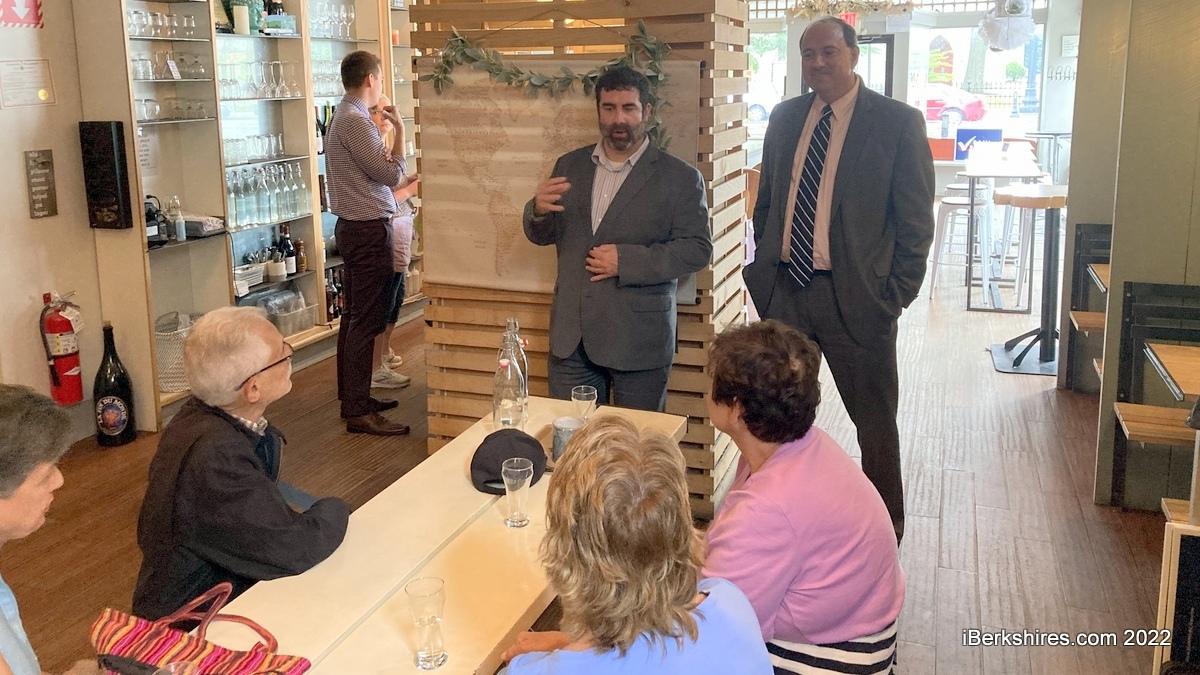
That was the topic of a roundtable discussion state Rep. Paul Mark led with state Sen. Jamie Eldridge of Acton and state Rep. Lindsay Sabadosa of Northampton at Methuselah Bar and Lounge on Monday, prior to an event there for Mark's state Senate campaign.
The lawmakers spoke about the future of health care in the commonwealth, as Eldridge is the Senate lead and Sabadosa a House sponsor on a bill to establish Medicare for All through a single-payer health care system.
With single-payer health care, the costs of health care for all residents are covered by one public system.
Eldridge said there was a "tremendous" amount of organizing done this past legislative session even though bill was sent to study a few weeks ago. He and Sabadosa created the Medicare For All caucus to zero in on this work.
The senator believes it would be beneficial to get organizations such as the Massachusetts Municipal Association to prioritize the bill but recognizes that it is harder endeavor nationally.
"It's like any top issue," Eldridge said. "It's about organizing it's about the outreach and obviously, it's about getting more legislators that already had the courage to lead on an issue and helping them when they're running for office."
The lawmakers noted the widespread support for single-payer health insurance in a number of nonbinding ballot petitions over the years. Ten Western Mass districts including Mark's 2nd Berkshire passed a resolution with a favorable 77 percent in 2018.
Health care costs are eating up the state budget, said Mark, and nearing 40 percent of spending.
"It continues to increase in spite of everything that we do and at some point that's just not going to be sustainable," he said.
"And if you're thinking about it from the point of view of you're paying the taxes, we pay more in taxes to health care in Massachusetts and the United States than every country that has guaranteed universal health care, so it actually would lower taxes in theory because it creates an efficiency."
Mark explained that his experience in a worker's union brought him to advocate for Medicare For All. Before his time in the Legislature, he worked for Verizon and was a part of the International Brotherhood of Electrical Workers union.
Every three years, health care was a sticking point in contract negotiations and the increasing cost of health care kept jeopardizing all of the other union benefits, he said. One of the reasons he first ran for elected office was to support laborers, he added.
Sabadosa's support was inspired by an unfortunate incident. After her partner was diagnosed with cancer at an out-of-network hospital, she was shocked that early conversations included dialogue about out-of-pocket payments.
Having lived in countries with single-payer health insurance, she said this was an eye opener.
Eldridge said he has always been a supporter of the universal model but was especially moved by Michael Moore's 2007 documentary "Sicko" that investigated health care in the United States.
A number of county residents attended the roundtable in support of Medicare For All.
Dr. Henry Rose, a retired physician, said it is a myth that physicians do not support single-payer because they feel their self-interest is being harmed.
The legislators' day began in Franklin County, where they spoke about green banking and, before the roundtable, they had a community meeting to speak about criminal justice reform with Pittsfield residents.
Eldridge spoke of his experience on the Joint Committee on Judiciary and a couple of bills that are related to the topic.
Mark said the conversation included the use body cameras and alternative responses to policing. He reported mixed reactions to body cameras, with some feeling they would be positive and others that they would do more harm.
Eldridge also said there is a lot of uncertainty in the progressive community around body cameras. There are concerns about who controls the data, manipulation of data, footage further incriminating people, and if the cameras will actually address police brutality.
The attendees reportedly agreed that they would like an alternate response to police in situations of mental health crises. Two fatal shootings by police were brought to light on this topic: the death of Miguel Estrella in March and the death of Daniel Gillis in 2017.
"From my perspective, it was good to have a community discussion," Mark said.
"It's good to have a community discussion with someone who is really involved in that committee that oversees issues and it's something I've done in the house and I want to keep doing in the Senate."
Tags: health care, legislators,