Early Hairstreak Brings Eureka Moments
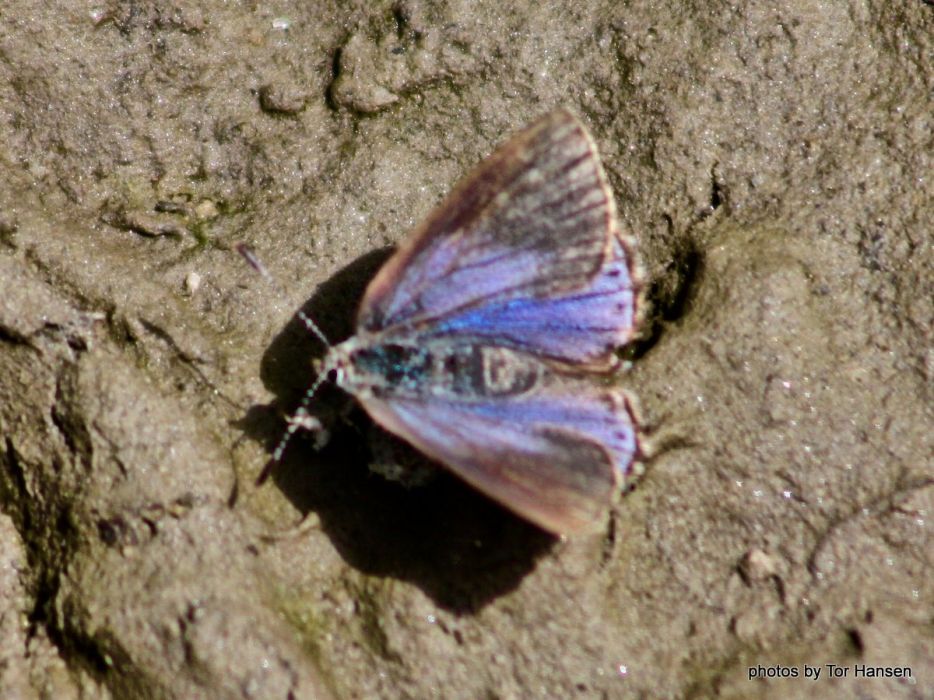
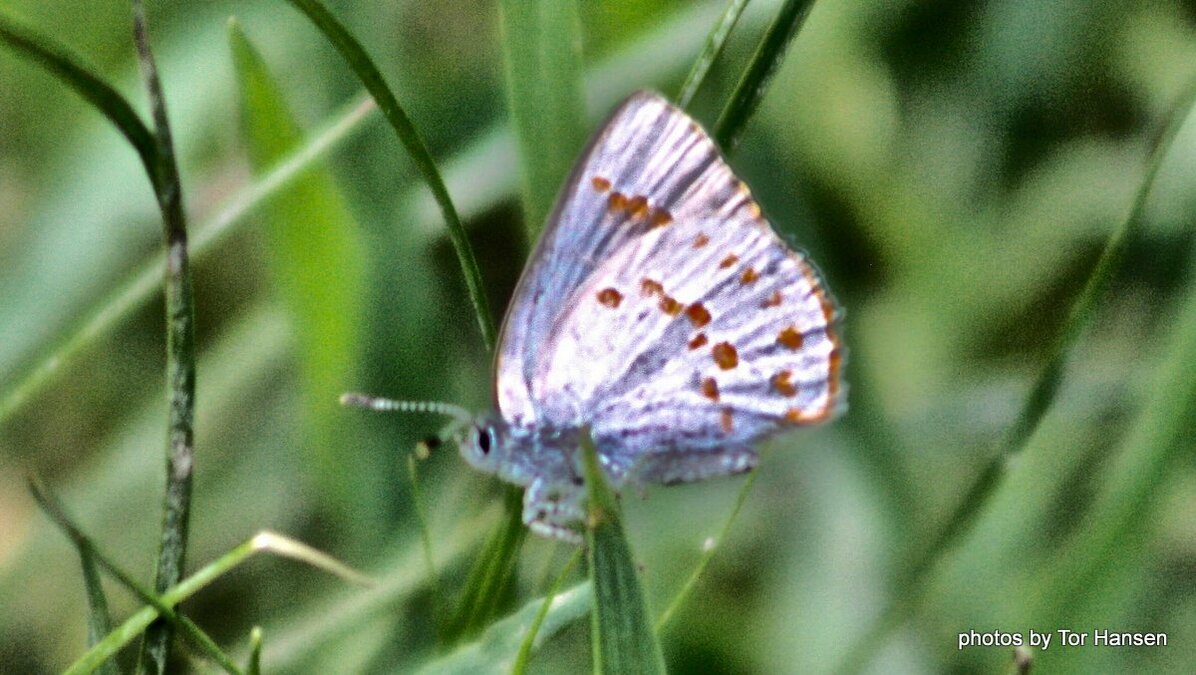
By no means abundant throughout New England, this tiny butterfly is no larger than one's two thumbnails, and blends in with pebbles and stones that litter the trail. When they are roosting with wings folded, look for a pretty turquoise blue accented with small orange spots. The only hairstreak with such striking decorative underwings, it's quite obvious when this bio-gem sipps moisture and minerals from the morning dew or probes the nooks and crannies for hidden water.
At first, early hairstreaks may be confused with the harbinger of the spring season, the spring azure (Celastina ladon), that emerges earliest of the two species in April and May as winter cold and snow decline. They appear at trailside oases -- namely violets for imbibing nectar. These skilled acrobats draw attention as they turn somersaults in the sunlight. But wing patterns differ significantly, with contrasting blue and black outer shadings and, above all, the telltale ventral wings of early hairstreak (Erora laeta) are greenish blue with red/orange spots.
Find the Sperry Turnout on the road to Mount Greylock, and pack some water before hiking in almost two miles, culminating in a stunning overview of wilderness at hand, and the green mountains rolling away in the distance. A prize for endurance will be, in the last days of May and early June, a rookery of several butterfly species engaged in hill-topping, or pre-mating courtship including mourning cloak, question marks, red spotted and banded purples.
These separate species do interact and engage in stirring aerial acrobatics, encircling and swirling upwards in lofty ascent perhaps 30-40 feet or more, wherein they break off and float leisurely down to earth. Most often the different species do not hybridize, like swallowtails and purples, as if "getting to know you" is an innate response that would only lead to a reproductive dead end.
While standing at the precipitous ledge itself search for an accessible wild azalea where the pink profusion is not only most fragrant, but host to imbibing tiger swallowtails, also abundant enough to suggest Ralph Waldo Emerson's revelation of halcyon grandeur, wherein the swallowtails flit into the canopy indicative of ancient biological diversity once agin flourishing intact.
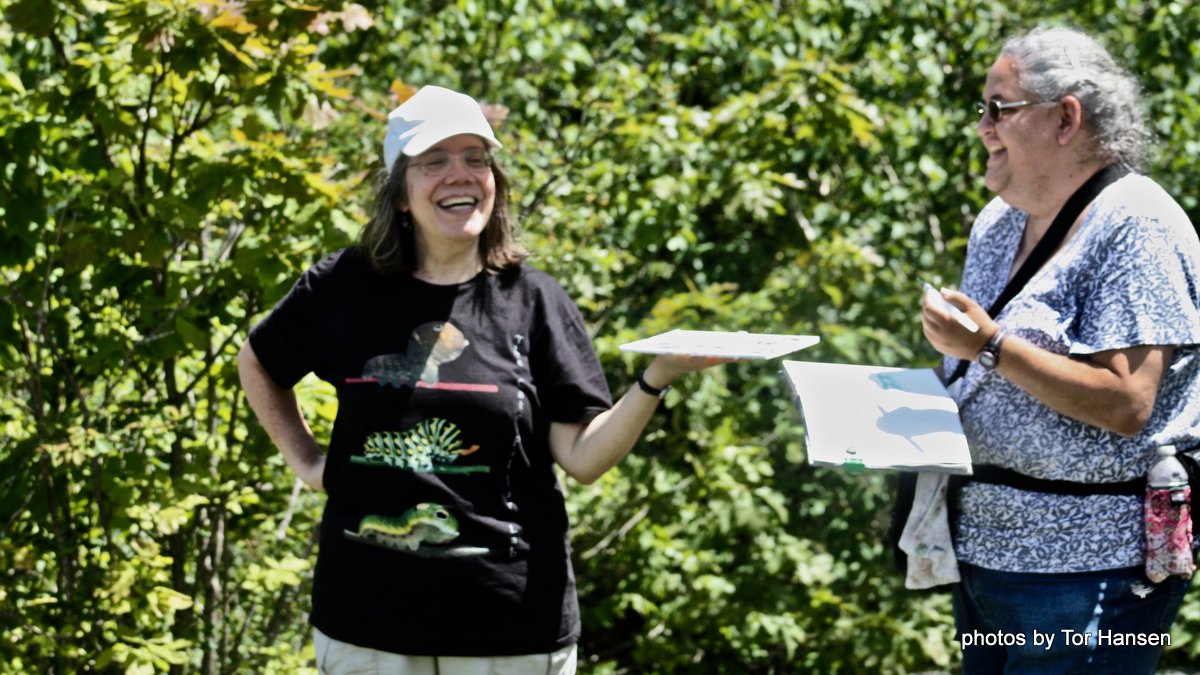
After parking at a generous pullout, I met two ladies also determined to go the distance to find and record the early hairstreak, found only on Mount Greylock in all of Massachusetts! The Lepidoptera (butterfly and moth) attract those fascinated with metamorphosis, life-cycle, and ecology of the diverse denizens. Thus I enjoyed their company as we walked out to Stoney Ledge.
Kim Plofker, professor of mathematics at Union College, and Susan Beckhardt, artist/illustrator, stopped now and again to examine to trailside flora, getting to know the botanical names and some properties of the flowering wildflowers and "weeds" that flourish in the light gaps or shade. I had lingered back to photograph a pollinating fly, and when I caught up, Kim was stretched out prone on the ground. I thought she may have fainted, but as I approached Susan motioned to me to slow down and direct attention to Kim's outstretched finger whereupon roosted an early hairstreak. Such communion with nature deserves an ovation!
Biologically speaking such tender associations are more rightly caused by the butterfly's attraction to certain chemicals produced by the human body, and not by the nature mystic's commitment to seek direct union of species interaction. But who is to say? Maybe a bit of both! See the story of St. Francis of Assisi and the cicada, and his passionate encounter with a lark in song ascending.
After a while, the acrobat flew off disappearing in the foliage, and we resumed our quest in a state of much elation. Not long afterward a tall butterfly guy dressed for the jungle arrived to make a foursome in forward march. Michael Newton has an uncanny way of finding the expected and not so common genera, and before long we encountered more butterflies as we reached the canopy over the split loop trail at Stone Ledge.
Yes the nymphalids were cavorting in their hill-topping as ethology (study of animal behavior) coined the phrase; a male banded purple may roost way out on an overhanging leaf waiting to fly up and engage with an incoming butterfly. Male or female -- the butterflies sort out these encounters, and the "prenuptual couples" may fly off to mate in the greenery.
So we were occupied for some time on this sylvan nursery for procreation, when a familiar face smiled inquisitively from under her wide brim tilly hat, and sure enough Lauren Griffith had refreshed as a former acquaintance. We used to search for eggs and larvae on Cape Cod, her expertise in especially purples and swallowtails, and if lucky we could supply such livestock to the living butterfly house in Bournedale, Buzzard Bay. George and Ann Morse who ran "Butterflies of Cape Cod" were glad to get living fauna for display for the public.
Her husband, Andy, had become a recent convert to butterfly photography, complete with complex camera and accessories, and dressed for a safari, Tilley hat and all. His new dedication enabled him to kneel in close to get fine shots at last of another early hairstreak!
For the next hour we engaged in following the many butterflies, and to wait for the early hairstreak to reveal open dorsal wings aglow in sumptuous bright blue edged in black as they proceeded to extract moisture from the turf and pebbles. Resting for lunch and a chance to
record the discovery, Susan Beckhardt entered observations into her sketch book and drew some fanciful drawings of the early hairstreak from photos captured on her iPhone. Some photos showed certain hairstreaks were weatherworn and faded; nonetheless we might try again in mid-July for the pristine second brood to arrive high in their sylvan wilderness.
Tor Hansen is a naturalist writer, photographer, and musician. His column Berkshire Wild looks at especially butterflies, birds and other small creatures at home in the Berkshires and Massachusetts. He does talks and presentations and can be contacted at torhansen1946@gmail.com.
Tags: butterflies,