Local Leaders Advocate for Berkshires Inclusion in East/West Rail Plans
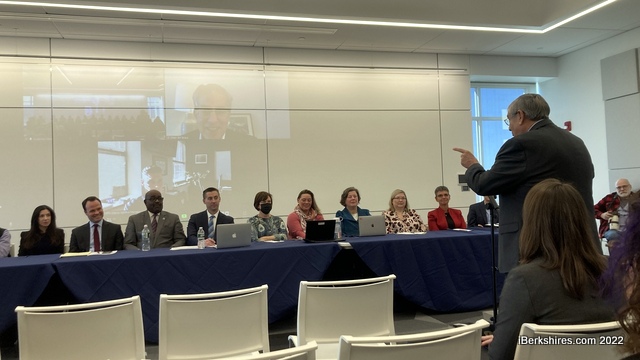
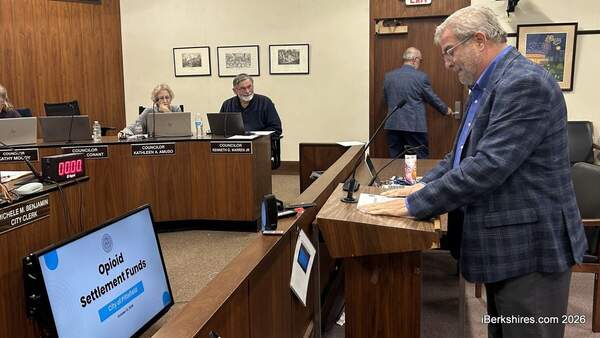
State Rep. John Barrett III says the investment will be worth it. Other members of the commission participating remotely are cast on the wall.
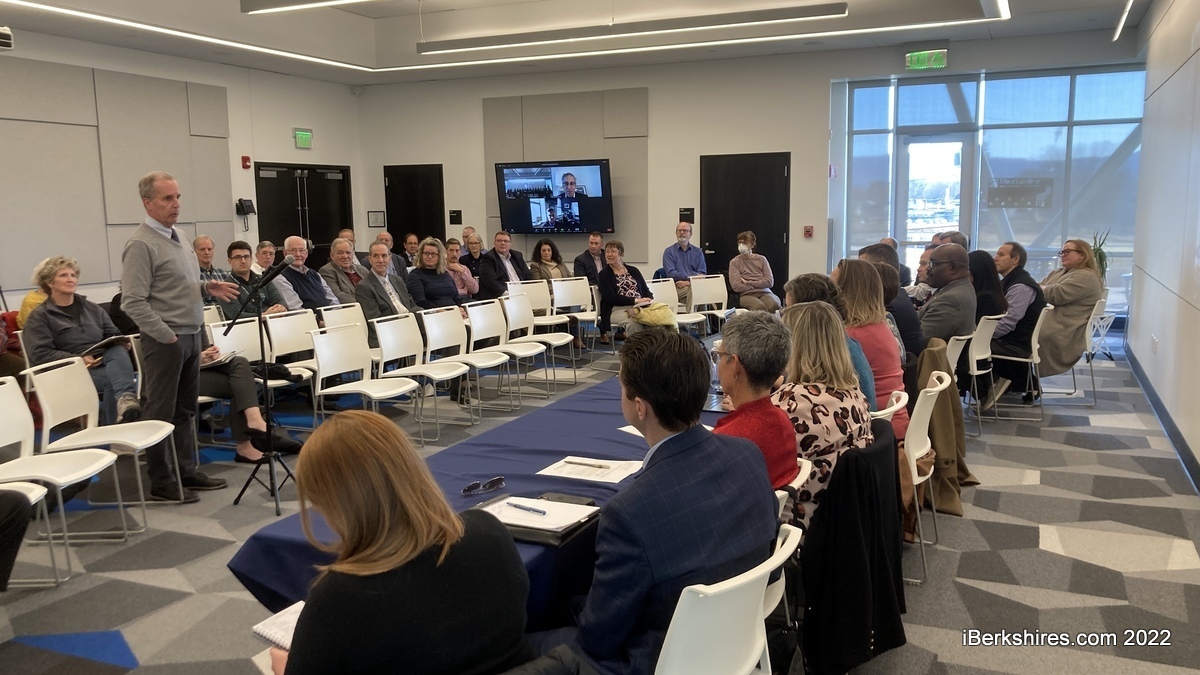
The Western Massachusetts Passenger Rail Commission held the first of six planned statewide public hearings at the Berkshire Innovation Center on Friday. Several dozen people attended in person and the meeting was available through Zoom, which a number of people used to provide testimony.
The panel heard testimony about how the rail service is crucial to economic development and statewide accessibility for residents. There was also a wealth of support for taking the connection across state lines to Albany, N.Y.
State Rep. William "Smitty" Pignatelli said he would like to see the rail connection begin with the Berkshires — working eastward instead of westward.
"I have to tell you in my 20 years in the House, I have never once seen the Western Mass 413 delegations work better together than on this particular issue," Pignatelli said.
"New legislators, old legislators, we all came together for the greater good so I hope that you would really consider the western link first."
The connection would transform Western Mass and especially Berkshire County with immediate economic opportunities, he said, adding that the county cannot wait for rail that starts in the east.
"We will see our declining population start to reverse immediately. We will receive the jobs that we have here that are needed to be filled — from hospitality to hospitals and doctors and lawyers and engineers and nurses across the spectrum of our economy," Pignatelli said.
"We're becoming an older population in the Berkshires. We're becoming a poorer population in the Berkshires. Making this once-in-a-lifetime, certainly my lifetime, once-in-a-100-year lifetime investment would be transformative to finally connect the commonwealth in its entirety from the Berkshires to Boston."
State Rep. Tricia Farley-Bouvier, participating remotely, seconded the sentiment.
"Keep the word 'Pittsfield' in mind constantly. Please do not succumb to the temptation to leave Pittsfield out, for now, to say that we're going to solve getting to the Berkshires later," she said.
"Anything short of connecting the Berkshires in the initial plan will send a strong message that this commission and the commonwealth of Massachusetts is leaving the people of Berkshire County behind, leaving us behind yet again."
This will work, state Rep. John Barrett III said, but it will take money and time and will not happen overnight.
There was a strong sentiment in favor of the rail project and state Sen. Brendan Crighton, co-chair of the commission, noted how each speaker was applauded, wondering if this was just a quirk of the Berkshires.
The Legislature created the commission and approved a transportation bond bill to investigate and receive public comment on passenger rail service to better connect eastern and western parts of the state. The panel will issue a final report in the spring based on the public comment discussions and a feasibility analysis.
Farley-Bouvier cautioned the commission to not get hung up on findings but consider possibilities, noting a study against a crosswalk on a Pittsfield fell short when walking patterns changed during the pandemic.
Last week, the state Department of Transportation announced that it submitted an $108 million application for the Federal Railroad Administration's FY 2022 Consolidated Rail Infrastructure and Safety Improvements grant program for corridor improvements between Worcester and Springfield.
President and CEO of 1Berkshire Jonathan Butler pointed out that his organization served on the initial East-West Study Committee and continues to be involved in this dialogue.
He said the rail connection will promote regional equity and support the visitor economy.
"The east-west study is a generational project for us, as our members of the delegation have already mentioned, that will represent potentially the greatest individual infrastructure investment that could be made to address a whole litany of issues from housing and economic growth, all the way to equity, and quality of life," Butler explained.
Berkshire Health Systems Director of Media Relations Mike Leary pointed out that the rail service is vital for patients who have to access care across the state and fill open positions.
Edward Sporn, who is the program manager for the Berkshire Flyer, said that the effort needs to take a regional perspective and improve Amtrak's customer interface.
"I'm very excited about the future," he said. "Everything seems to be lining up for a very exciting growth in passenger service in Western Massachusetts."
Other points brought up during the hearing were the importance of keeping costs low and how the rail has the possibility of promoting diversity in the county. It was noted that the weekend tourist Berkshire Flyer and the Greenfield-New Haven, Conn., Valley Flyer have been very successful.
The two-hour hearing did not get bogged down in details, with most of the testimony about local needs and economic potential, but there was some discussion about funding, infrastructure and authority. State Sen. Jo Comerford of Northampton questioned what would have to be in place.
Adams Town Administrator Jay Green, former regional manager for Amtrak, said there was infrastructure in place that could be utilized, including in New York State. Farley-Bouvier said funding could be based on the Massachusetts Bay Transit Authority, which has dedicated revenue from state taxes; others spoke of the Northern New England Passenger Rail Authority, which operates the Downeaster with Amtrak, as a model for governance.
Community activist Kamaar Taliaferro of Pittsfield called in to support rail but also pointed out how issues of equity, such as how tracks tend to be in disadvantaged neighborhoods. This project could be transformational but, he said, so was urban renewal. He urged the commission to consider broader impacts in its study.
To submit written testimony, email commission staff at: Siobhan.Morrissey@mahouse.gov.
Tags: passenger rail,