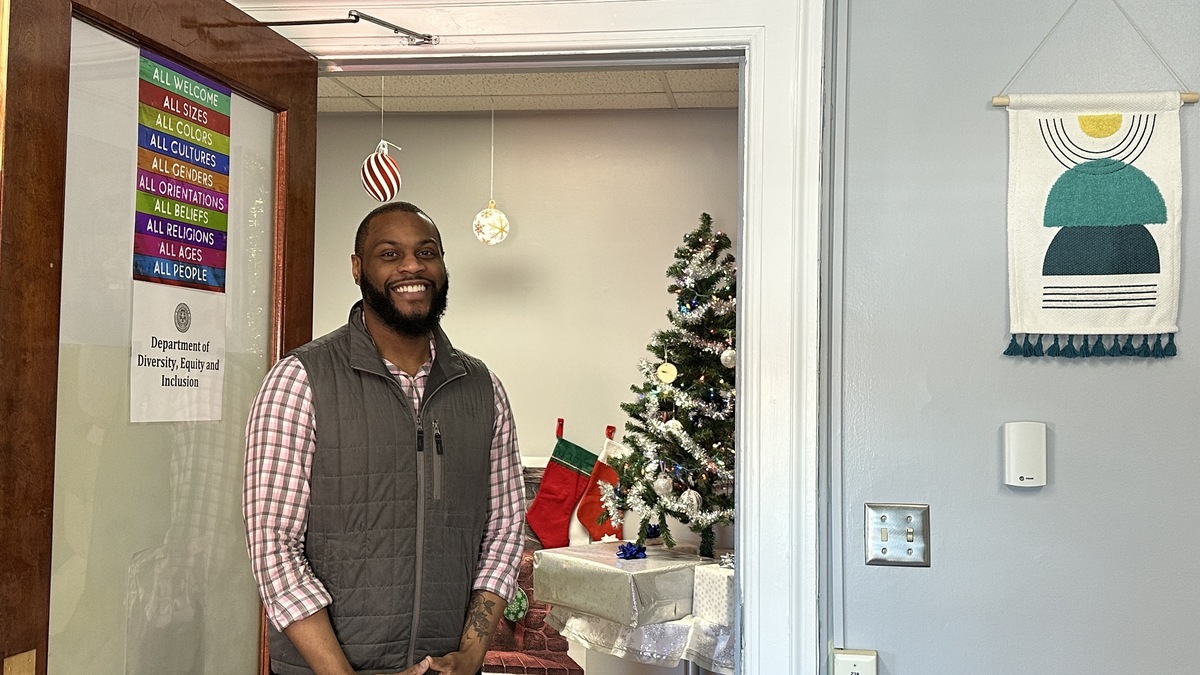
image description
Obasohan has learned a lot from city employees and has built relationships. What came out during those assessments fed the curriculum he is developing for training and workshops.

Pittsfield Diversity, Equity, Inclusion Office Has Successful First Year

By Brittany PolitoiBerkshires Staff
Print Story | Email Story

PITTSFIELD, Mass. — In its inaugural year, the city's Office of Diversity, Equity, and Inclusion (DEI) has opened up the conversation about creating safe and equal spaces for all community members.

"I would say that almost a full year has gone very, very well, exceptionally well," Chief Diversity Officer Michael Obasohan said about the work that has been done internally within the city departments and externally with other organizations.

He was appointed in February after the City Council approved a new six-month budget of $99,760 for the department during its fiscal 2022 budget process.

For the fiscal year 2023, that number increased to  $169,416.

Obasohan came in with an agenda and there were some shifts to the plan, as a need for his services came up in additional places.  

One of the actions he felt was the most impactful was the assessments of city departments.  

"I would go into all the departments and pretty much have an informal conversation with the director and then also the staff within those departments around their understanding of diversity, equity inclusion," he explained.

"What are they currently doing that focuses on equity, social justice, or what I can do as a chief diversity officer that would support them in that work and it was very well received."

Obasohan has learned a lot from city employees and has built relationships.  What came out during those assessments fed the curriculum he is developing for training and workshops.

A lot of conversation was raised around pronouns such as the understanding of pronouns and how they can be used to be more welcoming and support the community more.

A safe zone training was also conducted in May, which was a two-day training workshop around awareness of, definitions, and terms within the LGBTQ+ community led by people with lived experience.  It aimed to provide city employees with basic knowledge on how to support the community and anyone that walks into their department.


"The conversations that happened in there were great," Obasohan said. "The facilitators did a really awesome job at creating a space where people feel comfortable enough and also comfortable enough to challenge each other."

It was followed by a successful makeup session in June.

The department has also worked with external organizations to be in the conversation about opioid abuse and equality in women's health care.

Aside from some pushback from the get-go, Obasohan feels that the department has bell well-received and embraced by the community.

At the time of his appointment,  Ward 2 Councilor Charles Kronick and Councilor at Large Karen Kalinowsky voted in opposition to the appointment at last week's City Council meeting, saying the department approved last year was not needed.
 
But upon approval, it was met with applause throughout Council Chambers.

"The majority has been very positive and welcoming," Obasohan said. "And then I would say that the leadership team has been very open to look at policies or asking questions about how can we be more equitable, how can we be more welcoming."

Residents have also felt comfortable coming into the department and sharing experiences in the community or how they feel about living in the city.

One of the major goals that the DEI office has for the next calendar year is to establish a strategic plan for the department, an equity audit of the city, and to deploy DEI ambassadors as support systems for other departments.

The DEI office currently has two employees: Obasohan and an administrative coordinator.


Tags: DEI,   
If you would like to contribute information on this article, contact us at info@iberkshires.com.

BRTA Sees Highest Ridership to Date

By Breanna SteeleiBerkshires Staff

PITTSFIELD, Mass. — The Berkshire Regional Transit Authority has recorded its highest ridership in the history of the authority.

The BRTA recorded 731,444 for fiscal 2026 year, with fixed-route ridership at 666,000 passengers, paratransit (ADA) ridership at 65,000 passengers, and Link 413 ridership at 952 rides since it started earlier this year.

Administrator Kathleen Lambert and Operations Manager Benjamin Hansen said the higher ridership is likely thanks to the free fare. Free fare was first introduced to the BRTA in late 2024, this was the first full fiscal year and it won't be the last.

Lambert said she feels very good about the new number and while it's in part because of the fare free initiative, it's great to just be a service to the community.

"The point is, transit keeps more money in people's pockets if they're not paying for gas and transportation," she said. "I know there are improvements to be made, especially around frequency and different forms of opportunities to travel, and I want that to be the situation. But right now, we're kind of getting everything into shape, getting prepared for new service, and prepared for the next iteration of the RTA."

The high ridership also comes at a time of high route cancellations because of a lack of drivers. Lambert said the authority currently has 26 drivers with a goal of attaining 33 to 35. The new operating company, Keolis, is still looking for more hires. This past fiscal year, the BRTA saw 3,457 trips cancelled but hopes to have no cancellations by the end of September.

Hansen gave the ridership data at the July meeting, also showing off the new data that will be easily available on the website for anyone to view in an effort to be more transparent with the public.

The most affected routes were Route 1, the Pittsfield to North Adams Connector, and Route 2, the Pittsfield to Lee, which had more than 750 cancellations.

Although Route 1 had some of the most cancellations it still remained the most popular route with 176,123 riders through 9,729 trips. Route 34, the North Adams Loop, came in second with 127,147 riders also through 9,729 trips. Again, even though Route 2 had some of the most cancellations it came in third with 76,305 riders with 8,597 trips.

The Link413 service has also grown in ridership. Some on the board contested the start of the Link413 service, worried that the start of the service took drivers away and didn't see ridership high enough. The new data shows that the ridership almost doubled from the previous month from 179 in May to 313 in June.

Lambert also noted it was not possible to cut the service as it was properly approved and if they had to cut, they would have to give back their portion of the grant money, which would be impossible. She mentioned this to the group since former board member Rene Wood and others had asked to see what was possible with the service and when it was accepted and if it should still be running.

"We took the money, we ordered the vehicles. We took the vehicles. We've been running the service. To abandon the service is against the MassDOT contract. We do have a contract for the funds. We accepted all the money. If we rescind the contract, then we rescind the funds, and that means paying back a couple of million dollars, which we don't really have, and our portion would be at least one third of that, probably more because we run 50 percent of the service," Lambert said. 

The Link413 service is a partnership between the BRTA and the Franklin Regional Transit Authority (FRTA), and Pioneer Valley Transit Authority (PVTA). The most popular route is the Pittsfield to Northampton with over 60 percent of ridership.

View Full Story

More Pittsfield Stories