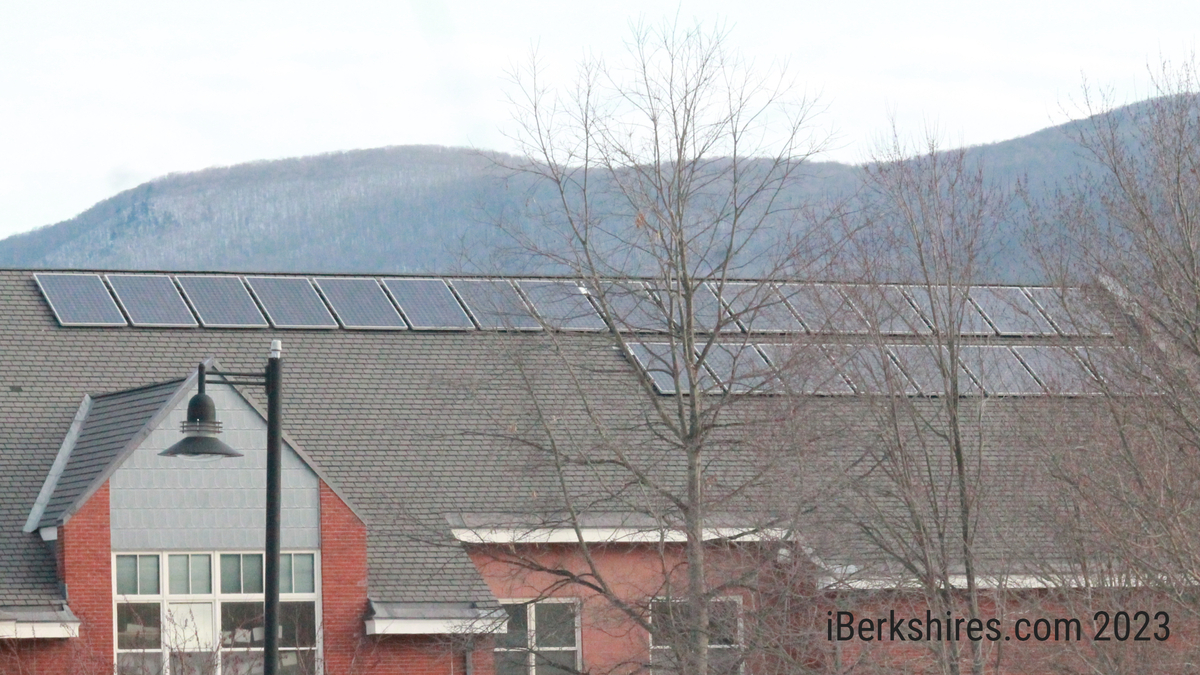
Williamstown Energy Audit Draws Attention to Solar Array Deficiency
WILLIAMSTOWN, Mass. — When a solar energy system was included in the design of Williamstown Elementary School in 2002, officials hailed the move.
"With renewable energy and other energy efficiencies, we can build a healthier and more comfortable learning environment for our children — and we can do it economically," the chair of the School Committee said when the state delivered a $58,000 Renewable Energy Fund grant.
Two decades later, the news is less encouraging.
"At the elementary school, we had one of our most surprising discoveries," Williams College senior Alana Lopez Barro Rivera said during a presentation at Town Hall late last year.
"The elementary school has a decently large onsite solar array. However, the inverters that make it so the electricity produced by the solar panels is actually usable, functioning electricity have not been working for at least the past seven years."
Rivera and classmates Gracie Guidotti and Maria Avrantini audited town infrastructure for energy efficiency as part of an environmental planning class at Williams College. The trio worked on behalf of their "client," the town's Carbon Dioxide Lowering Committee, under the direction of professor Sarah Gardner.
In December, the students presented their findings in a public forum that was recorded by the town's public access television station, WilliNet, and available for viewing on the station's website.
Not surprisingly, the students found a number of areas where the town's buildings and vehicle fleet could be more efficient — including at the town's oldest building, where they gave their presentation.
The elementary school, which opened its doors in 2002, is one of the newest. And although the school itself is now part of a two-town regional school district, the building, built when WES was a single-school district, continues to be owned by the town.
Under the 2018 regional agreement between Williamstown, Lanesborough and the expanded Mount Greylock Regional School District, the two towns own their elementary schools, lease them to the district for $1 per year and are responsible for repairs to the buildings with costs that exceed $5,000.
"One of the main priorities for the elementary schools is to fix those inverters so that the solar panels, which are functioning, can produce electricity for the school," Rivera said.
"Then, maybe, in the future explore expansion of the solar array and installation of heat pumps. However, that is not a priority given that their boilers are very, very new."
Henry Art, an emeritus professor of environmental studies and biology at Williams and longtime public official in Williamstown, used the Q&A period at the end of the students' presentation to comment on their finding.
"I'm astounded that the inverters on the elementary school are not working properly," Art said. "Has this been known for seven years or this is a recent discovery? And is that energy being fed onto the grid and we're just not getting it back or is it just doing nothing?"
The students did not have a definitive answer for when the issue was discovered but clarified that the energy captured by the solar photovoltaic panels on the building's roof is not being utilized at all.
"This was also a shocking discovery for us," Guidotti said. "Currently, the energy is not going anywhere. It's just being produced and sitting there. The inverter is the one that would transition that to energy that could be used on the grid."
Town Manager Robert Menicocci, who was hired last spring, said in an email that he became aware of the issue more recently.
"The school district brought the equipment failure to my attention in the fall and we are continuing to discuss this as we develop our respective budgets," Menicocci said in an email last month. "We do not have a plan of action as of yet.
"We are looking at several options from a simple repair to an entire redo and investigating potential funding sources but no, I don't have any cost estimates yet."
The inverter at the elementary school, while perhaps an urgent need, is one of just many items covered by the students' audit. Many of the issues they found align with priorities Menicocci has expressed about doing in-depth analyses of the town's infrastructure and compiling a long-term plan for the town's physical plant.
The trio rated the town's buildings for energy efficiency and categorized them on a spectrum from least to most.
The elementary school, leaving aside the problem with the solar system, scored high due to its double-paned windows, insulation and LED lighting. The Williamstown Police Station, completed in 2019, likewise scored well on those metrics.
At the other end of the spectrum were facilities like the 1937 Sherman Burbank Memorial Chapel at East Lawn Cemetery, one of the town's smaller buildings, and the Department of Public Works building.
The latter was called out for its wood boiler, which, while relatively inexpensive to operate on waste wood, is a large source of pollution, the students noted.
"An outdoor boiler on a residential scale is shown to pollute as much as 1,800 homes heated by natural gas, so these are very harmful to the environment," Guidotti said. "Although this is a very economical boiler, given all the fuel is free, we find the environmental impacts are far worse than the cost/benefit. So we think in the long term, once the wood boiler reaches its end of life, it would be the best option to replace that with emerging technologies."
Similarly, the trio recommended exploring new technology for the town's rolling infrastructure.
The students recommended transitioning to electric vehicles for the town's police cruisers and light-duty pickup trucks. But they recognize that viable electric options do not exist for heavy duty equipment, like snow plows.
Instead, they recommended the town look into converting its heavier equipment to biodiesel fuels.
"It can be used in any diesel engine, and any blends above 20 percent require engine upgrades that have a payback period of less than a year," Guidotti said. "We recommend transitioning to the B100 blend, which is 100 percent biodiesel, in the snowplows, because it can reduce emissions up to 95 percent."
While there are financial costs to most of the recommendations on the students' list, they pointed out that Williamstown has opportunities to defray those costs, including by seeking partnerships with neighboring communities.
"We understand funding is very important at the municipal level," Avrantini said. "Williamstown is a designated Green Community, so it's eligible for funding under the [commonwealth's] Green Communities Grants.
"We had some additional recommendations, and one of them was adding to the town management an energy manager. We know that may be hard, but we were thinking this could be another example of a shared position."
Tags: energy efficiency, solar array, WES,