image description

Pittsfield Parks Commission OKs Pickleball Facility Design

By Brittany PolitoiBerkshires Staff
Print Story | Email Story

PITTSFIELD, Mass. — Pickleball plans at Springside Park have been scaled down to fit the $500,000 budget.

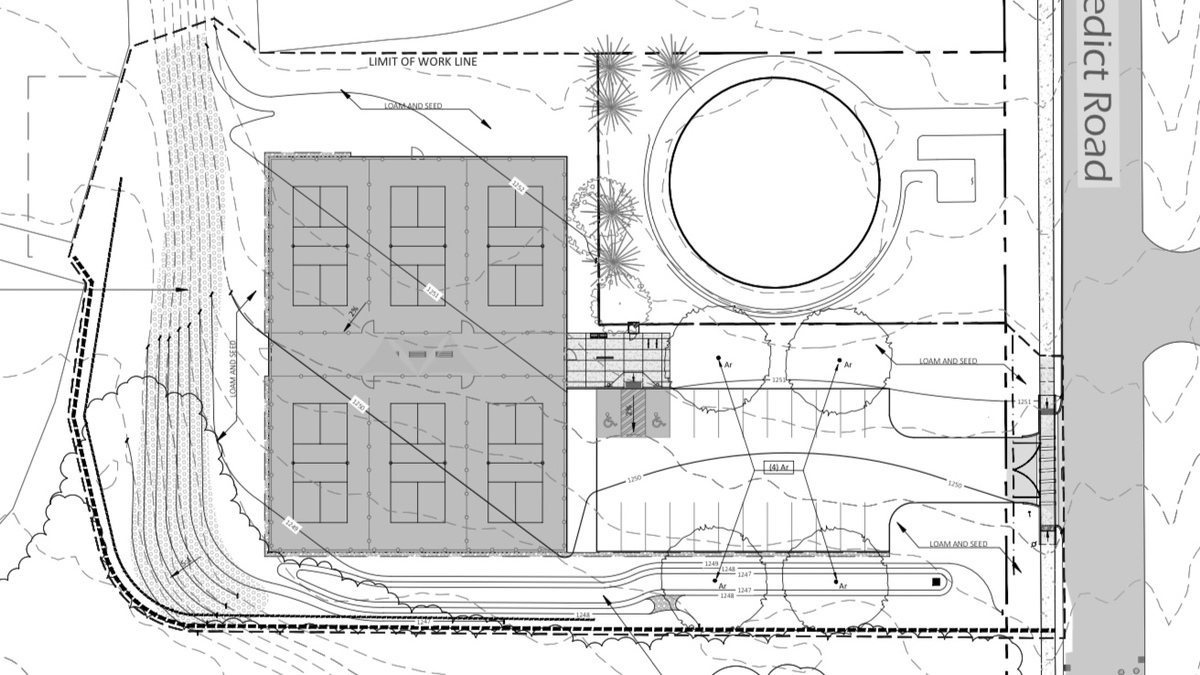
On Tuesday, the Parks Commission approved a plan that includes six pickleball courts and a smaller parking lot.

"What we're finding is that the eight-court facility was beyond the resources that we had in place," Park, Open Space, and Natural Resource Program Manager James McGrath said, referring to the half million dollars of American Rescue Plan Act funding that was allocated to the project.

The city hopes to get the project out to bid as soon as possible and have the eight to 10-week construction done this year.

There are two alternates built into the base bid if pricing allows. These include an asphalt parking lot instead of a gravel parking lot and the additional two courts.

McGrath explained that there will be four-foot fencing to separate the courts and the south side perimeter fencing will have noise-dampening mats because there are neighbors about 300 feet away.

"It would appear to be an appropriate and ample separating distance but we also want to ensure that there are additional accommodations being made to control potential noise from the final facility," he said.

Users will be welcomed by a plaza area that has a bike rack, a trash can, and possibly a bulletin board kiosk. It will be fully accessible from the 23-space parking lot with three handicapped-accessible spots.

The site will need a stormwater permit from the Conservation Commission for its drainage swale that will handle runoff.

Last year,  a site selection committee quickly narrowed down nearly 50 possible locations to six and landed on Springside as the best option for an eight-court facility in the northeast corner of the park.  The commission approved the Benedict Road location in November.


This is the approximate site of the previously approved pickleball proposal next to the Doyle Softball Complex and behind the water tower that had its funding scrapped in 2019.

Pickleball combines elements of tennis, badminton, and ping pong and is suitable for singles and doubles. It has recently grown in popularity with the Sports and Fitness Industry Association estimating 4.8 million current players, which is almost double the number of players five years ago.

Four pickleball courts comfortably fit within one tennis court, making the proposed playing area about the size of two tennis courts.

There was some discussion about bathroom facilities at the facility.

Original plans had an accessible pathway from the pickleball courts to the existing bathrooms at the softball complex but were removed from this design due to cost.

Though the paved path is not out of consideration, initial designs include a hard-packed path.

There are also accommodations for portable toilets.

"Not the most desirable but again, when we were balancing some of the costs that we're seeing with the design and with the available funding we had to make some decisions about how to accommodate that," McGrath said.

"We absolutely know we can, at some point in the future, do a pathway but it's just not shown in this iteration of the plan simply because of resources."

It was highlighted that other funding opportunities could be used for parts of the plan that did not make the cut.

Pittsfield Pickleball Courts by iBerkshires.com


Tags: pickleball,   
If you would like to contribute information on this article, contact us at info@iberkshires.com.

Berkshire Towns Can Tap State Seasonal Communities Resources

BOSTON — Governor Maura Healey announced that 18 additional municipalities across Massachusetts have been designated as Seasonal Communities, opening up new tools, support and grant funding to help them manage seasonal housing pressures. 
 
Created as part of the historic Affordable Homes Act signed into law by Governor Healey in 2024, the Seasonal Communities designation was designed to recognize Massachusetts communities that experience substantial variation in seasonal employment and to create distinctive tools to address their unique housing needs. The law also established the Seasonal Communities Advisory Council (SCAC).  
 
The Affordable Homes Act identified several communities to automatically receive the designation, including:   
  • All municipalities in the counties of Dukes and Nantucket;   
  • All municipalities with over 35 percent seasonal housing units in Barnstable County; and   
  • All municipalities with more than 40 percent seasonal housing units in Berkshire County. 
  •  
To identify additional communities, the Executive Office of Housing and Livable Communities (HLC) reviewed available data, specifically focusing on cities and towns with high levels of short-term rentals and a high share of second- or vacation homes.
 
In Berkshire County, Egremont, Great Barrington, Lee, Lenox, New Marlborough, Richmond, Sandisfield, Sheffield, West Stockbridge and Williamstown have been designated. 
 
"Our seasonal communities are a vital part of Massachusetts' cultural and economic fabric, but they're also home to essential workers, families, seniors, and longtime residents who deserve a place to live year-round," said Governor Healey. "That's why we're committed to supporting these communities with innovative solutions like the Seasonal Communities designation to meet their unique needs, and I'm thrilled that we're offering this opportunity to 18 additional communities across the state. Everyone who calls these places home should be able to live, work and grow here, no matter the season." 
 
As with the statutorily identified communities, acceptance of the designation for municipalities is voluntary and requires a local legislative vote. HLC will open an application for newly eligible communities that haven't accepted the Seasonal Communities designation to request consideration. 
 
The Affordable Homes Act created several new tools for communities who accept the Seasonal Communities designation to be able to:  
  • Acquire deed restrictions to create or preserve year-round housing 
  • Develop housing with a preference for municipal workers, so that our public safety personnel, teachers, public works and town hall workers have a place to live 
  • Establish a Year-Round Housing Trust Fund to create and preserve affordable and attainable housing for year-round residents 
  • Create year-round housing for artists 
  • Allow seasonal communities to develop a comprehensive housing needs assessment 
  • Permit tiny homes to be built and used as year-round housing 
  • Permit year-round, attainable residential development on undersized lots 
  • Increase the property tax exemption for homes that are the owners' primary residence 
 
View Full Story

More Pittsfield Stories