Jacob's Pillow to Rebuild Doris Duke Theatre
 |
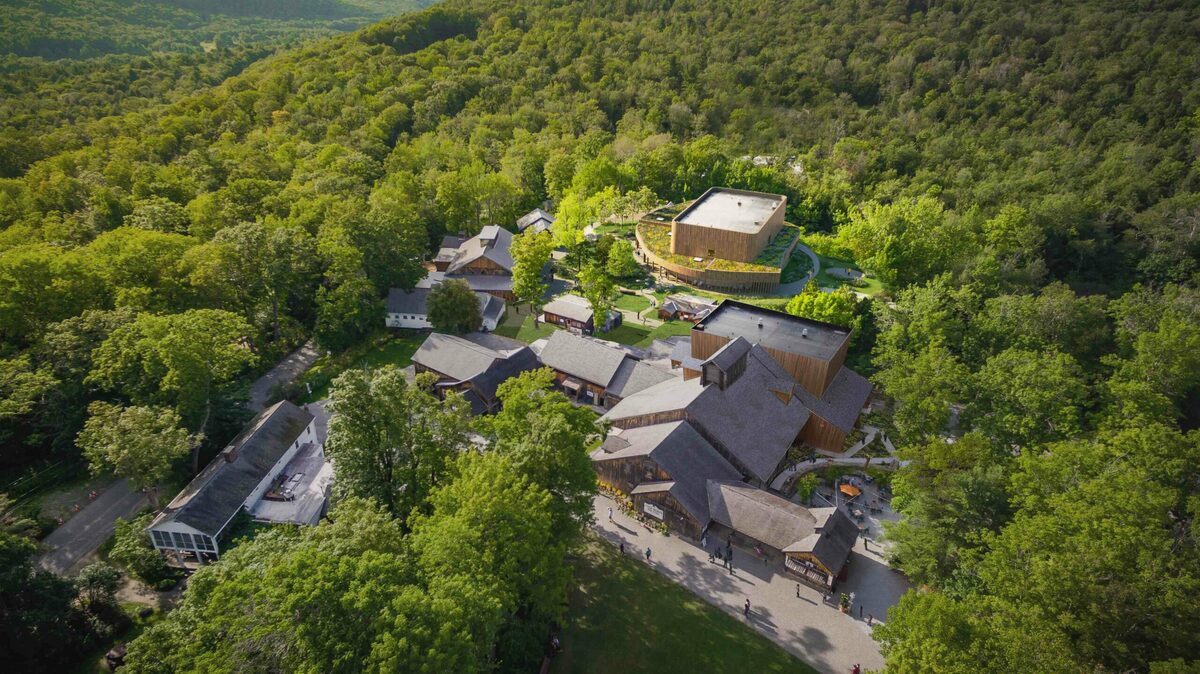
BECKET, Mass.— Jacob's Pillow announced building plans to rebuild and reimagine the Doris Duke Theatre, a flexible theater on the site of the original Doris Duke Theatre, which was lost to a fire of undetermined cause in November 2020.
The reimagined Doris Duke Theatre will be approximately 20,000 sq. ft., compared with the former Duke's roughly 8,500 sq. ft. footprint. The design allows for multi-use flexibility, so that the building can support performances, events, residencies, and more, sometimes simultaneously. The theater will seat up to 230 patrons in the main performance space, with an array of seating and stage configurations.
"We are so grateful for the leadership support that makes it possible for us to envision a re-imagined Doris Duke Theatre, one that promises to have the warmth and character of the original and beloved Duke, while at the same time being relevant and accessible to what artists and audiences will need in the future," said Jacob's Pillow Executive and Artistic Director, Pamela Tatge. "The building will deeply resonate with and respect the land and environment on which it rests. At the same time, it will be technologically equipped to ensure that the creative appetites of artists will be served in the decades to come."
The new building is projected to cost $30 million and is supported by a coalition of donors and foundations, with a formal campaign launching in May 2023. Since the announcement of the naming gift of $10 million from The Doris Duke Foundation in November, Jacob's Pillow has received leadership support from the Knight Foundation to support digital implementation, as well as commitments from Barbara and Amos Hostetter, the Barr Foundation, and Sarah Arison and the Arison Arts Foundation. The Massachusetts Cultural Facilities Fund supported the pre-schematic design phase of the project. An endowment of at least $5 million is being raised to help support the digital integration of the new Doris Duke Theatre and provide direct support to the artists who will make their work in Pillow Lab residencies in the future.
"The design creates a year-round space," added Tatge, "that will serve as an incubator for a new generation of artists seeking to integrate technology into live performance and create art native to the digital realm. It will be a porous, indoor/outdoor space for creation, performance, and community engagement that speaks to the lessons we've learned during the pandemic about the need for community-building, and our innate connection with nature, which we at the Pillow treasure greatly."
The building will feature two lobbies with sliding doors, which will create multiple entrances and exits to the building. The lobby on the west side of the building will serve to welcome visitors in from the spacious artist quadrangle, and will also provide a covered and ventilated space for pre-show talks alongside a new exhibition space. The lobby on the east side of the building will serve as a warm-up and rehearsal space for artists, and can also host receptions and meetings as needed.
"Jacob's Pillow has always been at the forefront," said Sam Gill, president and CEO of the Doris Duke Foundation. "The new Duke Theatre will enable Jacob's Pillow to harness the digital revolution to serve a more inclusive, innovative, and engaging vision for dance."
Rainwater will be collected from the green rooftops of the building to be reused for flushing toilets and irrigation.
Contributions from Indigenous artists to the design will include visual art installations, a medicinal garden with local and indigenous plantings near the entrance of the building, and a fire pit for gatherings and celebrations.
The infrastructure of the theater will include high-speed internet, as well as flexible locations for stage management and sound, and a dedicated video room for documentation and livestreams. The theater will also have improved lighting and audio capabilities, with an efficient LED stagelighting system as the baseline, and with the ability to add incandescent fixtures. Many windows and skylights (with darkening capabilities) throughout the building will connect the theater with the surrounding campus and landscape.
The building's infrastructure will support technological capabilities including the use of a digital spatial audio system with live tracking of dancers correlated to moving sound images, infrared camera tracking of performers for interactive video content, and live dance performance interaction with recorded/projected dance content. Hard-wired connectivity between buildings will enable real time collaboration across Pillow venues using simultaneous filmed performances.
"I can't overstate the importance of this sort of technologically-forward space for the dance field right now," said Sydney Skybetter, Choreographer and Founder of the Conference for Research on Choreographic Interfaces at Brown University. Skybetter is a consultant on the Doris Duke Theatre project. "Dance artists sorely need the sorts of space, tech, and expertise that the Pillow is assembling right now. This is where the future of the field will come from."
Safety, comfort, and accessibility will be improved for audiences, artists, and staff compared with the former Duke. This will include the addition of catwalks for easy technical installation, additional bathrooms, and an enlarged green room and dressing rooms for artists. New seating arrangements will include mezzanine access to the top of the retractable seating to allow for late seating and more accessible seating options. Additional functions include a support box office and office spaces for staff.
Netherlands-based architecture firm Mecanoo, led by Creative Director and Founding Partner Francine Houben, is serving as the lead architect for the new building project, in partnership with New York-based architecture firm Marvel, led by Jonathan Marvel, founding principal, as the architect of record and landscape architects. Theater and acoustics consultants Charcoalblue are working alongside the architectural team on the project.
"For me, what was inspiring arriving at Jacob's Pillow is the energy of the festival and experiencing performance in this unique natural setting," said Francine Houben. "We wanted to make a building which embodied Indigenous principles of connecting with the land and thinking seven generations forward. The sequence of moving between outdoors and indoors and the sculptural layering of the building emphasizes the feeling of movement in space, while firmly rooted to the site in this special place in the Berkshires."
Jeffrey Gibson, a member of the Mississippi Band of Choctaw Indians and of Cherokee descent, is serving as a consultant on the building's relationship to the site and Indigenous design values. According to a press release, the Pillow seeks to honor the building's context on the ancestral lands of the Muh-he-con-ne-ok, or Mohican peoples, who are now known as the Stockbridge-Munsee Community and reside in Wisconsin. Additionally, the Pillow honors the Agawam, Nipmuc, and Pocumtuc who also made their homes in what is now known as Western Massachusetts. Gibson has participated in regular design sessions and has helped steward stakeholder engagement with Indigenous community members to seek feedback on the evolving design.
"It's been great working with Jacob's Pillow and Mecanoo to develop the new Doris Duke Theatre," Gibson said. "The current design takes into account important Indigenous values and supports multiple kinds of performances that can engage the inside and the outside of the building and traditional and more intimate performances. Certain Indigenous materials, patterns, and processes will be reflected in the interior and exterior, and I'm excited to see the submissions from Indigenous artists to help realize the final iteration of the building."
The original Doris Duke Theatre at Jacob's Pillow was built as the Studio/Theatre in 1989 as one of three primary performance spaces on Jacob's Pillow's 220-acre campus in Western Massachusetts and opened for its first full season in 1990.
The new Doris Duke Theatre will restore a second indoor theater space for Jacob's Pillow's annual summer Dance Festival alongside the flagship Ted Shawn Theatre, and provide year-round studio space on the Pillow campus, in addition to the Perles Family Studio, which is home to The School at Jacob's Pillow and the Pillow Lab, artist-in-residence program.
Tags: jacobs pillow,