Pittsfield May Query Voters on Police Chief Residency Requirement
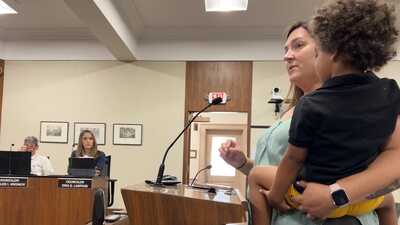 |
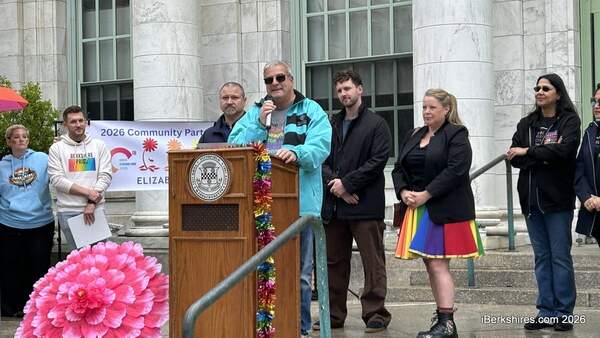
| Meg Bossong speaks to the council |
PITTSFIELD, Mass. — The City Council is considering asking voters, "Should public safety leaders be required to reside in Pittsfield?"
On Tuesday, councilors unanimously referred Ward 1 Councilor Kenneth Warren's request for a ballot question asking if the restriction that requires such management positions to live in the city should be eliminated to City Solicitor Stephen Pagnotta.
Pagnotta is expected to draft a question with clarifying language and return it to the body in August. He will also identify what a "yes" and "no" vote would entail.
The original motion was to approve Warren's petition but the panel amended it to be a referral after some pushback.
Warren said that every time there is a question that comes before the council members come up with reasons not to put it on the ballot such as being too complicated.
"This is not one of them in my eyes. To do that is basically voter suppression at the most basic level. We need to let the voters get involved. This is a thing that the voters can address," he said.
"If they can figure out whether our mayor's term should be raised from two years to four years, they can figure out whether our public safety people should be residing in the city of Pittsfield and there's only three positions that it deals with."
He explained that the provision has been in the ordinance since 1947. Originally, it required that all members of the police department were residents of Pittsfield.
"We have something that's been around since 1947 so I would think that if you're thinking of changing something, you'd want to at least see what the voters think," Warren said.
"They are the stakeholders."
The councilor did not have a strong opinion on the matter but favored keeping it so that there is an extra layer of investment in the community for the officials.
He is okay with the question being binding or non-binding.
Ward 3 Councilor Kevin Sherman did not know where he fell on the issue but wanted to give the public and the council time to mull the situation.
Sherman sad he had a philosophical opposition to putting the question as presented on the ballot. He pointed out that residents are likely on vacation over the summer and may not have time to make a well-informed decision by November.
"There are so many different narratives out there and it is a simple question," he said.
"Maybe it's a poll. I have no problem putting a poll out and getting a temperature of the public, and I'm all for that, and see where the people stand."
Later in the conversation, he clarified that he had "no dog in this fight" and does not have a decision on it yet.
"I'm not doing this from an angle of I know which way it's going to go and I don't want it on the ballot," he said. "That's not where I'm coming from at all."
Councilor At Large Pete White agreed with Sherman's testimony and said that he was also against ballot questions.
He asked Warren which specific offices would apply to the question and Warren felt it would be confusing to identify them but he doesn't have a problem doing so.
"I think that kind of proves the point why ballot questions can be detrimental," White said.
"If the 11 of us up here don't have a consensus of what this question would mean I don't think it's fair to put that to voters."
Persip also agreed with Sherman's point.
"This is too unclear for me right now. The question is just too vague. It doesn't give me what a yes vote does what a no vote does. It's not a true ballot question form so it's hard to vote on that," he said.
"I think we put ourselves back into the debacle of the bike lane being on the ballot so this is how I see it now. I necessarily don't disagree with the ballot question or trying to make up a ballot question. I'm kind of up in the air."
He pointed out that the question is currently tabled at the Ordinances and Rules subcommittee where the conversation began. It is directly related to the city's upcoming search for a permanent police chief.
Ward 2 Councilor Charles Kronick said that the state constitution accommodates ballot questions.
"We are a referendum state. We live by that, we live and die by a ballot question as self-governance," he said. "That's why it's in the Constitution because this state was founded on the principle that communities will form their own governments and people in those communities have a voice in how they're governed."
He said that going against a ballot question is antithetical to the American flag hanging in the council chambers.
He pointed to the council's prior debacle with Councilor At Large Karen Kalinowsky's proposed bike lane question.
"Every time a question comes before this body to be voted upon it should get the same treatment is my feeling," Kronick said.
"I feel like the last one that came up got a very unusual treatment, one that would not repeat itself, generally speaking, in other ballot questions."
Kalinowksy said she is "all for people having a vote."
"I don't think it's a difficult question," she said.
"This has to do with the police chief. Now, if you want to make this part of a fire chief too then, as far as I'm aware, they're the only two public safety management that's in the city so if you want to specifically spell them out because this is what it's about about hiring a chief then spell them out."
Ward 7 Councilor Anthony Maffuccio has received a great deal of phone calls in support of the ballot question and will be in favor of it with proper wording.
Warren explained that he put this on the agenda quickly because of the subcommittee conversation, saying that some were ready to approve it without hearing from people.
"I just want to hear what the voters have to say," he added.
Ballot questions have to be submitted 70 days before election day and the August meeting is over 80 days before.
During open microphone, Community Leader Meg Bossong spoke against removing the residency requirement and asked for the city to consider instating a residency requirement for the rest of the department.
"I want to speak to the attitude of this department in public comments about the people of Pittsfield who it polices. We have seen this department refer to the neighborhoods of the West Side and Downtown Pittsfield as a dense urban core. It is not and it is really important that when we begin to think about policing that people be a part of the community they are policing," she said.
"Second, if we are forking out our tax revenue to salaries and overtime some of it should really be coming back to the City of Pittsfield in the form of property taxes, excise tax, sales tax, and other spent revenue here in the City of Pittsfield."
She pointed out that the Pittsfield Police Department spent $10.7 million in the fiscal year 2023 plus $850,000 in overtime.
"If the reason that people don't want to live in the City of Pittsfield is about poor is about poor quality city services and insufficient services for residents or insufficient schools then the city needs to be spending more money on those services and less money on the department itself."
She also said that there is no public involvement in the negotiation of union contracts for police, the budget continues to rise, there is not currently a Police Advisory Review Board and when there was, it "had no teeth."
"Frankly, at this point, the police chief having to look us in the eye at Big Y is the only accountability we have," Bossong said.