Great Barrington Awarded Second Grant for Lake Mansfield Area Improvements

Print Story | Email Story
GREAT BARRINGTON, Mass. — The town has been awarded a second MVP climate resilience grant to implement improvements at the Lake Mansfield Recreation Area improvements.
 
This year's award of $709,720 is also from the Commonwealth's Municipal Vulnerability Preparedness (MVP) program, administered by the Executive Office of Energy and Environmental Affairs (EEA). These competitive grants support communities implementing priority actions to adapt to climate change and build climate resilience.
 
Great Barrington's Lake Mansfield project is one of 79 projects to have received action grant funding in the latest round of applications. Last year's award was nearly $1 million.
 
 "Lake Mansfield is an important ecological and recreational resource, and the work we implement with these MVP grant funds will ensure it can serve these functions for generations. We are extremely grateful to the Healey-Driscoll Administration for their support," Town Manager Mark Pruhenski said.
 
The project at Lake Mansfield includes enlarging the parking lot at the beach area and installing rain gardens and other stormwater management features to prevent contamination of the Lake and protect water quality. At the north end, for the lake outlet stream, a larger culvert will be installed to prevent flooding of the road. The existing vehicle road along the lake edge will be replaced with a shared use path for walkers and bicyclists. Only emergency vehicles will be permitted to use this portion of the road. The lake edge will be replanted to provide stormwater filtration and a stabilized bank.
 
When complete, northbound vehicles will no longer be permitted to use the road between the boat launch and beach. All passenger vehicles will enter the recreation area and parking area from the north, via Christian Hill Road.
 
"The Lake Mansfield improvements are the result of years of meetings and designs," said Christopher Rembold, assistant town manager and director of planning and community development. "The project will protect the water quality and the habitat of the area, provide handicapped accessibility throughout the recreation area, and improve the safety for everyone who uses it."
 
Rembold added the Town the project is now out for bid, and work should begin soon.
 
"We want to begin construction this year, so most major work will be completed by the summer," he said. "People will see that the road and the parking lot at the beach will be closed to all traffic for several months."
 
Community members interested in learning more can join the Oct. 5 community information meeting on Zoom at 6:30 p.m., and that event link can be found here, on the town calendar. Anyone with questions may contact crembold@townofgb.org or 413-528-1619 x2401.
 
The MVP program, created in 2017, provides funding for community-driven climate resilience planning and action. Ninety-nine percent, or 349 out of 351 of the Commonwealth's cities and towns, are participating in the program and over $131.5 million has been awarded for local climate resilience planning and projects. Communities originally enrolled in the program by completing the MVP Planning Grant process (MVP 1.0), which then opened up access to apply for an MVP Action Grant, or implementation funding. EEA has recently launched the MVP 2.0 update to the original MVP planning grant, and after this pilot round intends to require communities to undergo MVP 2.0 to maintain eligibility in applying for MVP Action Grants.

Tags: grants,   
If you would like to contribute information on this article, contact us at info@iberkshires.com.

Becket Looks to Wind Power for Energy Savings

By Breanna SteeleiBerkshires Staff

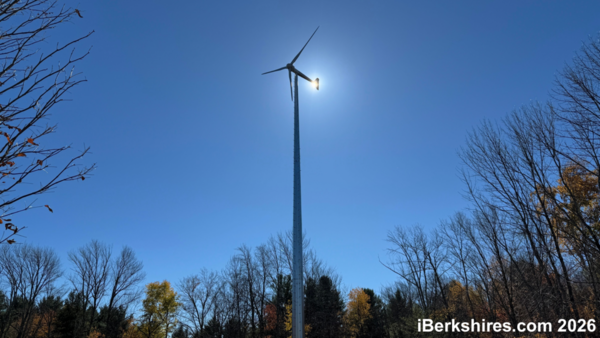
The single turbine is a low maintenance and has a 50-year life. The town went with wind power after finding a solar installation would be too difficult. 

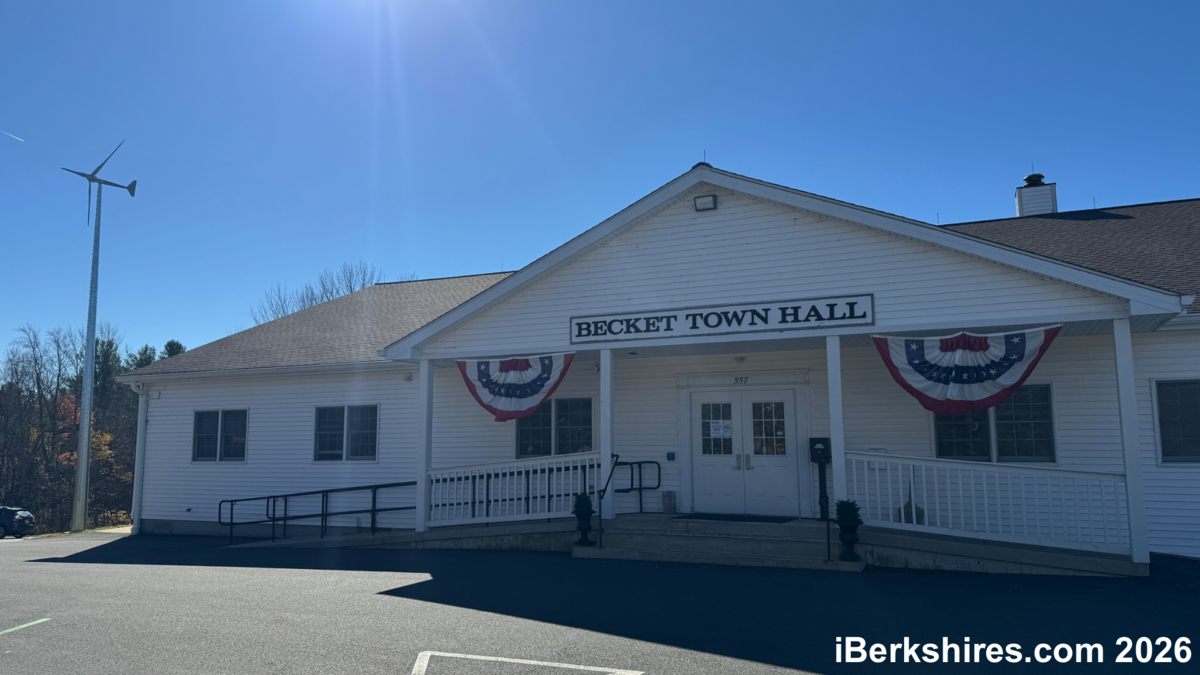
BECKET, Mass. — The town unveiled a wind turbine Monday that will reduce electricity costs and show the benefits of renewable energy produced by wind.

Residents, town and state officials gathered outside the Town Hall for the ribbon cutting on a project first conceived nearly a dozen years ago.

The wind turbine stands 100-feet tall next to Town Hall and is from Oklahoma manufacturer Bergey Wind Power. It has a 50-year life and is a direct-drive permanent-magnet design, meaning it has no gearbox, making it low maintenance.

According to Garth Klimchuk, chair of the Becket Energy Committee, the town started discussions about a wind turbine in 2014. The turbine is expected to generate about 36,000 kilowatt-hours. Klimchuk said Town Hall uses about 24,000 kilowatt-hours, with excess power expected to go to the Highway Department. This is expected to save $9,000 annually from the electricity cost.

"This turbine is just going to be such a good thing for the town. It is really incredible. Zero-cost electricity. Zero cost to the town. Carbon free. Just a huge, huge milestone for us," he said.

The town received a grant from the state Department of Energy Resources totaling $139,500. The remaining funding for the project will come from a direct-pay investment tax credit under the federal Inflation Reduction Act. If the town does not receive the funding, voters at the annual town allocated $100,000 just in case, but Klimchuk said the town will only need about $60,000 to $70,000 if necessary.

"It's going to help the community. Hopefully, it'll lower our tax bills. And as we look at everything going around around the world right now, energy volatility has been with us for a long time. It's going to stay with us for a long time," said state Sen. Paul Mark. "So any move we can make as a community, whether as Becket specifically, as Berkshire County as a whole, but anything we can do to bring some of the reliability into our own hands, to produce a bit on our own, and just guarantee that in a renewable, safe way moving into the future, I think is going to pay off dividends."

The town has spent more than a decade reducing municipal energy consumption in a variety of ways including HVAC upgrades and LED street light conversions, bringing it to a Level 2 Green Community status.

While solar had been considered, interconnection constraints and limited grant opportunities made it harder to achieve. But the high elevation of Town Hall and a Small Wind Site evaluation done in 2023 and 2024 found the site was perfect for a turbine with favorably high winds.

State Rep. Leigh Davis praised the project as an example of a small town addressing a larger energy challenge through persistence and collaboration. She stressed that the single turbine represents a practical step toward reducing reliance on fossil fuels and said Becket's effort could serve as a model for communities across the commonwealth. 

"You hear about all these kind of big wind farms and solar farms and all these ways that we're gonna you know create green energy, but at the same time what we're not being sensitive to the landscape, and what I appreciate about this is that this is it's a single turbine, but it represents so much more," she said. "You're right. It's really adding to the ability for this town to contribute to green energy and to bringing our reliance on gasoline fuels back down to solving big problems."

Mark Rabinsky, deputy director of DOER's Green Communities Division, said the state supports municipalities with technical assistance and grants, and that reducing municipal energy costs can leave more resources for other local priorities. He presented the turbine as an example of state support working alongside local knowledge and decision-making. 

"I think that this is a really a great example of what green communities can do," he said. "I'm obviously a really big fan of the green communities program, but I think that connection between the state, what we're doing at the state, and that local level, and relying on the local knowledge here with Becket is a true testament to what we're doing."

Select Board Chair William Elovirta thanked everyone for being here and shared his memories of first coming tp Becket in 1946 before utility electricity arrived. His family and neighbors used small 32-volt generating plants and batteries. He recalled utility workers installing poles and wires by hand around 1947.  

View Full Story

More South Berkshire Stories