William E. Dailey Inc., a construction supplies manufacturer in Shaftsbury, celebrates its 75th anniversary this year. In spite of a troubled economy, this family business — with 175 workers and plants dotted throughout Vermont and nearby New York — continues to thrive.
What's the recipe for this company's sustained growth and success? Start with a strong family, add experienced and dedicated employees and mix in a heaping measure of adaptability to an ever-changing environment.
The "homegrown business" remains 100 percent family owned and controlled, said President Bill Dailey III, who works as a team with his four brothers and cousins. "We are very fortunate to have some super people around us that help us run this business," he added; this includes people who started with the company in the 1950s and second-generation employees.
Reinvention also played a key role in the development of the business. "We continued to evolve ... in accordance to what was coming on in the market — what were the new types of products, what were the best ways to do things," said Dailey.
Integrating new technologies and adapting to the community's changing needs made a difference; it's tough to live off one product in a rural market, noted Dailey.
A tradition of change
The business has been reinvented again and again, but always "with a focus primarily towards the mining of aggregates — that's our core product," Dailey explained.
From gravel mines in Shaftsbury and Manchester, and a rock quarry in Hoosic, N.Y., William E. Dailey, Inc. manufactures a variety of construction products. These include ready mix concrete, precast concrete products, blacktop and stone, sand and salt products.
Though the largest operation is in Shaftsbury, where about half the company's 175 employees work, there are also ready mix plants in Wallingford, Rawsonville and Wilmington, Vt. and in Greenwich, N.Y. Tim Dailey runs a small cement and sand operation in Tampa, Fla.
Bill Dailey said the business' primary shift, from general contracting to materials supply, came with the second generation. William E. Dailey started the business in 1927, bidding on the construction of schools, post offices, and other buildings. In time, he expanded into site work, digging cellar holes and putting in septic systems, said Dailey.
When his two sons, Don and William Jr., started work full time after World War II, they saw an opportunity to use the sand and gravel being mined and processed on site to break into a new market: ready made concrete.
William E. Dailey, Inc. was the first company to manufacture and supply ready made concrete in the state of Vermont, said Dailey. Prior to 1947, concrete mixing was done by hand and moved around a job site by wheelbarrow. The Daileys transformed this labor intensive process; "We started doing it in ready mix concrete trucks and delivering it directly to the job site and that worked very well for us."
As ready made concrete became the standard practice, the methods of laying down a building's foundation changed as well. Lumber supply companies began manufacturing lumber specifically for use in forming foundations; in the past, the form lumber was reused in the construction of the building, explained Dailey. Again, William E. Dailey, Inc. took a leading role in the area, buying those forms and starting a foundation crew, he said.
The company also has a history of road building, from streets to highways to municipal state work. It produced the concrete and blacktop that paved Shaftsbury's dirt roads in the early 50s, said Dailey.
"As we continued on through the third generation, we moved into manufacturing precast concrete pieces — which again support our mining business," he said. "Because it's all sand and gravel and ready mix concrete but it's a precast, prestressed product which is underground structures like septic tanks and vaults and ...above ground ... parking garages and architectural buildings."
To meet new federally mandated highway specifications for sand and stone, William E. Dailey Inc. opened a rock quarry in New York. Dailey said that mining and crushing rock allows the company to produce the aggregate used today in highway blacktops, the longer-lasting "super pave" mix.
A family business
Bill Dailey calls his family's bond "the core that holds us all together and keeps this business going forward."
Dailey, his brother Richard and cousins Michael, Tim and Dennis share a close bond and work well together, he said. They also thoroughly understand each and every aspect of the business.
"We all grew up running the trucks, running the concrete plants, running the hot mix plants, doing the site work, laying out the site work, fixing stuff ... we were always here together," Dailey explained.
"Quite often our mothers would just send us out of the house because there were just so many of us boys they would just say ... ‘go on down there and do something down there.'’†he recalled.
Spending entire days at the Shaftsbury plant, the boys had a real education. Dailey said they were fortunate their fathers — William II and Donald — allowed them to grow up there.
There are employees today who have been on the job for just as many years. These experienced men, who started in the late 40s and early 50s under William II and Donald, now work for their sons. There are also many second generation employees, noted Dailey.
"The most important part of this business is the employees and the family that owns the business," he said.
Working in a regulatory climate
Dailey said that with developments in technology came new regulations and permitting requirements. Starting in the late 60s and early 70s, the third generation Daileys worked in a climate very different from that of their fathers and grandfather.
The most significant change came with Act 250, a permitting process began in Vermont in 1970. "We are constantly in Act 250. We have probably over 100 permits ... we're dealing with regulatory agencies — local, state, federal — every day to make sure that we do the best we can to stay in compliance,†he said.
Obtaining permits to open a mine or add a new building is often time consuming and costly, said Dailey. For a small company, tremendous pressure exists to sell out to a big corporation. Many family businesses sell to big corporations that "can stand spending a tremendous amount of money and waiting years to get decisions," explained Dailey.
William E. Dailey successfully navigates what Dailey calls a “regulatory maze†by upfront mitigation. In preparing for a permit, they take a close look at hours of operation, landscaping, lighting, as well as traffic flow, he said.
"We look at all of this to try to make sure do we fit the criteria that it looks like the neighborhood, the town and the state are looking for."
By minimizing impacts, the company is able to move forward with projects. Dailey said the process can be difficult, but it’s also exciting work.
Looking ahead to the future
Another Dailey family tradition is supporting the community through projects that promote tourist dollars, job growth and the local economy.
The company donated a significant amount of ready mix concrete for the sidewalks of Shaftsbury, he said. Recently, they made an in-kind donation of $4,000 worth of materials to help the planned Robert Frost Museum build parking lots.
As for the gravel pits, Dailey said there is always a vision for the end use of that land. By leaving enough gravel to accommodate septic systems and roads, the land can be reclaimed and used for an industrial or housing purpose, he said.
"We really want to make sure that we're stewards of the land. As we mine the resources that the surrounding population demands and uses, we want to make sure that we also take a look at what's the next best use of the land," he said.
For example, Riley Rink at Hunter Park in Manchester — a 35,000 square foot space with an ice skating rink and summer concert series — is located on the site of a former Dailey gravel pit. A housing subdivision is under construction today in Shaftsbury on the site of a former mine.
Looking ahead, Dailey said that many of the offspring of his generation are in college. Some of them are studying business with an eye to working here, others have different plans, he said.
William E. Dailey Inc. will continue to grow with its environment; "We're looking forward to going on and becoming a fourth generation family business."
If you would like to contribute information on this article, contact us at info@iberkshires.com.
Your Comments
iBerkshires.com welcomes critical, respectful dialogue. Name-calling, personal attacks, libel, slander or foul language is not allowed. All comments are reviewed before posting and will be deleted or edited as necessary.
No Comments
McCann Recognizes Superintendent Award Recipient
By Tammy DanielsiBerkshires Staff
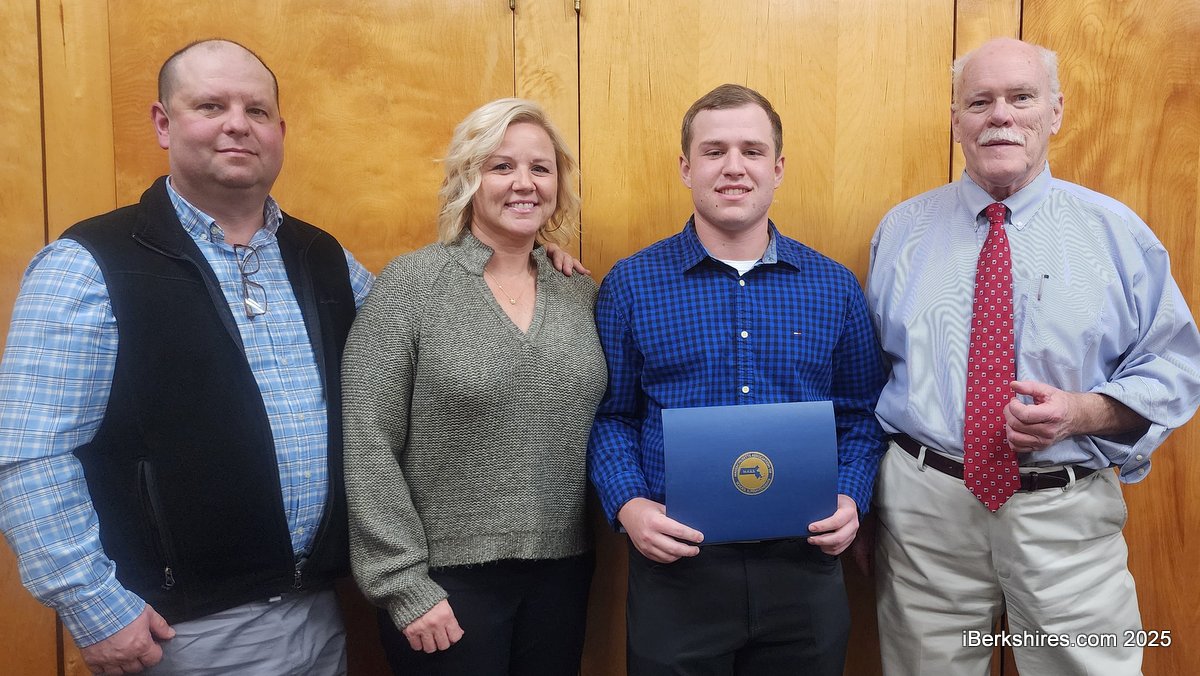
Landon LeClair and Superintendent James Brosnan with Landon's parents Eric and Susan LeClair, who is a teacher at McCann.
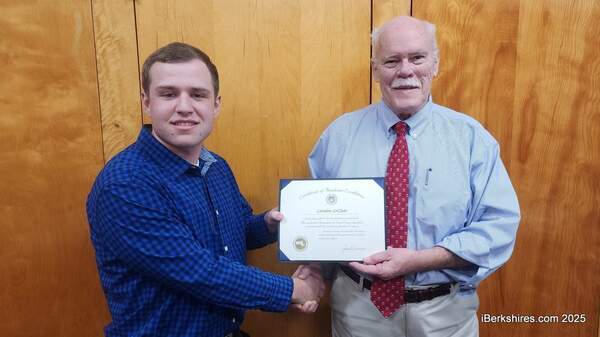
NORTH ADAMS, Mass. — The Superintendent's Award has been presented to Landon LeClair, a senior in McCann Technical School's advanced manufacturing course.
The presentation was made last Thursday by Superintendent Jame Brosnan after Principal Justin Kratz read from teachers' letters extolling LeClair's school work, leadership and dedication.
"He's become somewhat legendary at the Fall State Leadership Conference for trying to be a leader at his dinner table, getting an entire plate of cookies for him and all his friends," read Kratz to chuckles from the School Committee. "Landon was always a dedicated student and a quiet leader who cared about mastering the content."
LeClair was also recognized for his participation on the school's golf team and for mentoring younger teammates.
"Landon jumped in tutoring the student so thoroughly that the freshman was able to demonstrate proficiency on an assessment despite the missed class time for golf matches," read Kratz.
The principal noted that the school also received feedback from LeClair's co-op employer, who rated him with all fours.
"This week, we sent Landon to our other machine shop to help load and run parts in the CNC mill," his employer wrote to the school. LeClair was so competent the supervisor advised the central shop might not get him back.
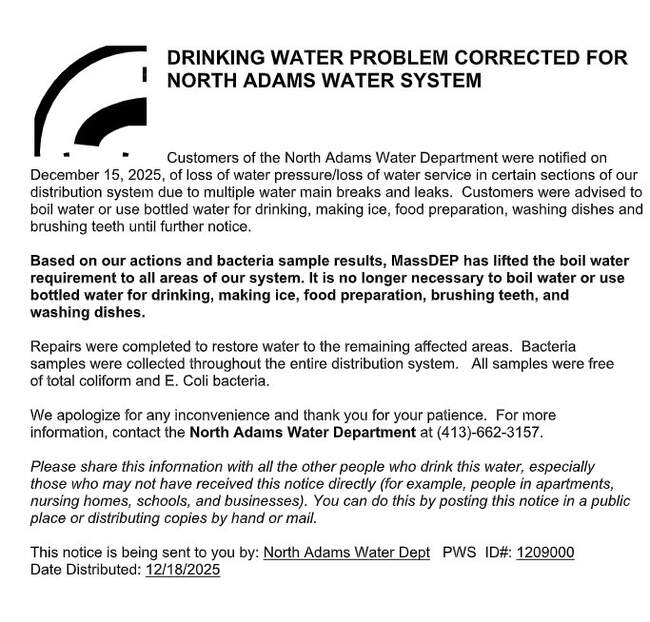
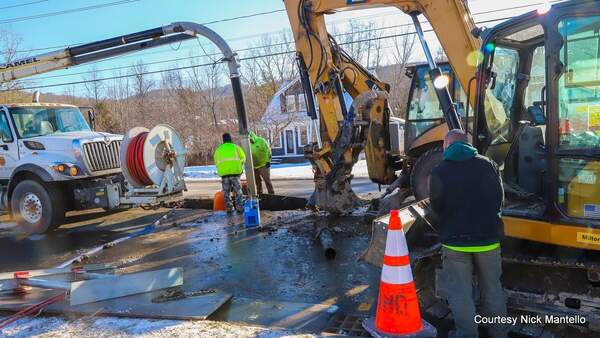
The city has lifted a boil water order — with several exceptions — that was issued late Monday morning following several water line breaks over the weekend. click for more