Friday, August 30, the New Marlboro Meeting House opened Eco Art, an exhibit featuring 33 well-known Berkshire artists. The meeting house hosts two shows every summer, according to artist Robin Tost: one of strictly New Marlboro artists, and the other more general. This general show has a theme, like river, or air. The air show last year inspired outdoor kinetic sculptures swirling and shimmering when the wind blew, she said.
Tost, Gabrielle Senza, Susan Hardcastle, Marianne Swan, who are all artists, chose the theme of the show and the artists, with help from volunteers. Hardcastle, Senza and Tost are showing work in the exhibit themselves. The choosing is informal, Tost said; the show is not really juried. She added that Anne Getsinger has been the power behind the show for years, but has taken this year off.
For this year’s show, the panel have tapped some new artists and some well known to the meeting house. Stone and earthwork sculptures range outside. Indoors, there are more sculpture, paintings, drawings, photographs. The panel sent invitations to 33 or 34 people, Tost said, and all, or nearly all, accepted. Most of the pieces were created for this show. The artists submitted one piece each; in the show for New Marlborough residents, the panel asks seven or eight artists for several works each.
The Eco Art show called for descriptions of men and women’s involvement with nature, said Sanjiban Sellew, filmmaker and cabinetmaker in Housatonic. Sellew shoots his films on weekends, and builds shutters during the week. He has entered a four minute film in the show, a video poem: in nature are both beauty and sorrow; you cannot have the beauty without the sorrow.
Sellew said he was concerned that a nature film would be corny — a mix of birds and flowers. But once he began it, he found a direction for it. “We are all led by something in our lives,†he said. He began shooting abstractions: snow falling, water dripping from an icicle, mayflies, from unexpected angles and perspectives. “You have to see it,†he said; “You’d say ‘I don’t believe this. What am I really looking at?’†He began to “accumulate visual data . . . information illustrating sorrow and beauty.â€
The mayflies, for example, caught him while he was washing dishes, at the end of the day. The setting sun illuminated a hovering column of the insects above a statuette he has in his backyard: a column five feet tall and one foot in diameter. “The bugs were lighted up, and the forest was black behind them,†he said. He went down with his camera and stood 12 feet away, watching the movement. It represented for him the chaos in living: the flies circling up and down, colliding. He zoomed in as close as he could get, and filmed a few inches of movement within the 12 inch column.
With computer manipulation, he gave the movement a strobe light effect, so that instead of following the individual bugs, the film showed white streaks where they flew. It was like a language never read, he said, like looking at Chinese; “You think, ‘how did they ever get that?’ It was the deepest thing.â€
He also created scenes where the ground bled. In the film, a forked stick is digging, and blood wells out of the hole it makes. This is not the kind of blood imagery in the movies, he said. It is not splatter. It is a way of showing a connection with the ground. It is not beautiful, but shot beautifully, a contradiction which is poetry.
Sellew added that he gets so intensely involved with each film he makes, he half jokes that he may invoke something. He spent three days with tomato juice and a pump, digging in the soil, and a few days later, he cut across his hand with a power saw and bled freely himself.
Sellew’s film will run on a loop for 20 minutes. It is programmed to run six times, he said. Then he rewinds it. Galleries are noisy, he said — he wonders sometimes whether people look at the art, while they are all looking at each other — so thought if the movie has background music, it probably will not be heard. Sellew’s twin brother John has a digital recording studio. He composed music after the edit. Mickey Friedman edited the film. Sellew shot it on a digital camera and assembled it on computer. The film gives watchers a lot to digest even without the music, Sellew said, and he has headphones.
He has spent 25 years making videos, he said, but does not advertise much. His films have run in the Mahaiwe Theatre and the Triplex in Great Barrington, and he has won awards in many festivals. He is going to Seattle in October, in fact; for the first time, in the course of 25 years, he is going to a festival to see what happens. He has been nominated for the grand prize.
“People don’t buy me — so what,†he said. “Movie making is so wonderful, and it is hard to do right. I’m not academic. I don’t read . . . I’ve got ideas; I execute and finish them.†His films have no written script. But there are a lot of themes repeated in art, themes like love and conflict. They have a mythic quality. He takes on those themes, he said, but his style and message are often unfamiliar: “I’ve got more ‘huh?’ than ‘oh yeah!’ . . . . The first thing I’m after is to entertain myself.â€
Sellew’s wife, Cynthia Atwood, is also in the show. She is a sculptor and painter, he said. Her work is “visual, sensual, provocative.†It can entice and repel at the same time. She works with fabric, wood, and sometimes metal, though she is not a metalsmith. She covers the base materials in colored cloth or wrapping. Sellew said she is represented at Ute Stebich gallery in Lenox, and earned her Master of Fine Arts at Vermont College. She makes curtains for her day job.
The Eco Art show also features Walton Ford, an internationally known painter from Great Barrington; Nancy Rubin from Mill River, who painted a three foot by five foot canvas for it; Sculptor Joe Wehaton, known for his arching, gravity-defying metal sculpture; Tom Zetterstrom, known for his portraits of trees; Michele Waldman; Gwen Meelvin; Abbe Stahl Steinglass; Anne G. Fredericks; Burton Elliot; Dale Culleton; Barbara Crocker; John Kemp Lee; Daniel Karp; Marilyn Lasek; Jon Piasecki; Meryl Joseph; Aline Bove; Jim Toia; Jean Germain; Mark Mendel; Michele Miller; Julie Scott; Guido Baratta; Vincenzo Romano; Arthur Hillman; Julie Erikson; and Julie Jones Ford.
Tost said the meeting house gallery started five years ago, in the meeting house basement. As it took off, Richard Stebbins, who runs the meeting house and the New Marlboro Village Association, helped to clean and fix up the space: hanging new lighting, replacing the walls and floors. They turned a dirt basement into Soho, she said.
If you would like to contribute information on this article, contact us at info@iberkshires.com.
Your Comments
iBerkshires.com welcomes critical, respectful dialogue. Name-calling, personal attacks, libel, slander or foul language is not allowed. All comments are reviewed before posting and will be deleted or edited as necessary.
No Comments
McCann Recognizes Superintendent Award Recipient
By Tammy DanielsiBerkshires Staff
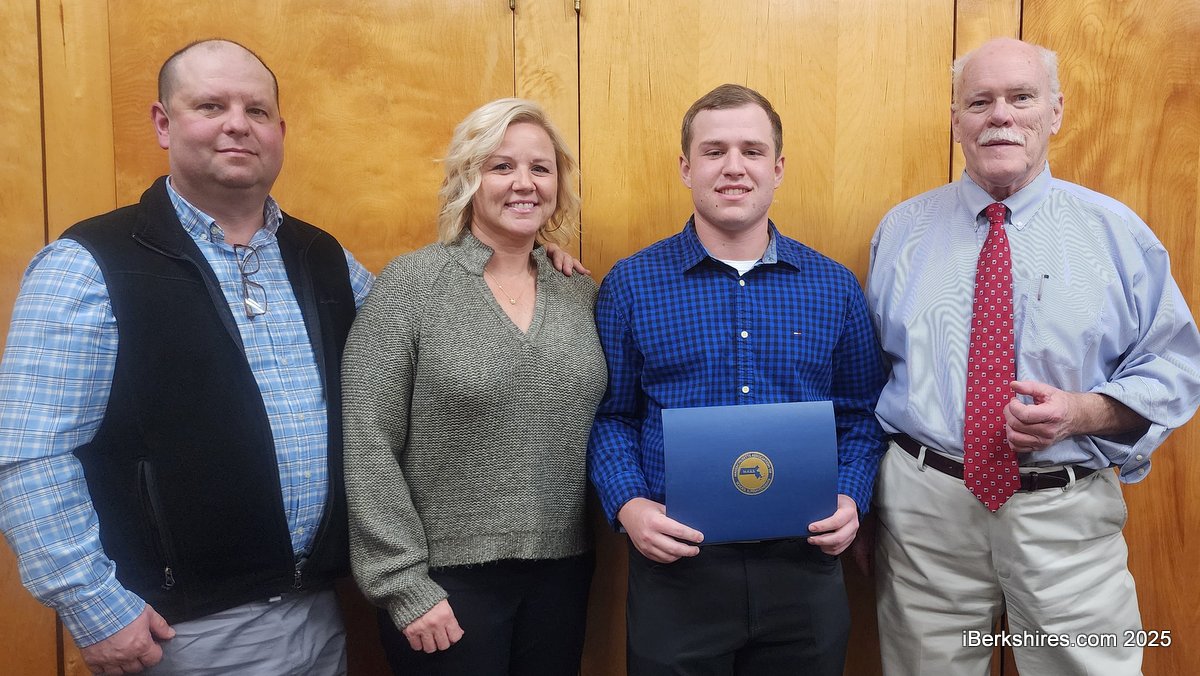
Landon LeClair and Superintendent James Brosnan with Landon's parents Eric and Susan LeClair, who is a teacher at McCann.
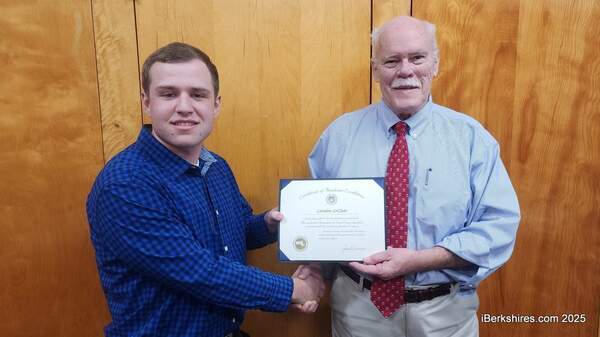
NORTH ADAMS, Mass. — The Superintendent's Award has been presented to Landon LeClair, a senior in McCann Technical School's advanced manufacturing course.
The presentation was made last Thursday by Superintendent Jame Brosnan after Principal Justin Kratz read from teachers' letters extolling LeClair's school work, leadership and dedication.
"He's become somewhat legendary at the Fall State Leadership Conference for trying to be a leader at his dinner table, getting an entire plate of cookies for him and all his friends," read Kratz to chuckles from the School Committee. "Landon was always a dedicated student and a quiet leader who cared about mastering the content."
LeClair was also recognized for his participation on the school's golf team and for mentoring younger teammates.
"Landon jumped in tutoring the student so thoroughly that the freshman was able to demonstrate proficiency on an assessment despite the missed class time for golf matches," read Kratz.
The principal noted that the school also received feedback from LeClair's co-op employer, who rated him with all fours.
"This week, we sent Landon to our other machine shop to help load and run parts in the CNC mill," his employer wrote to the school. LeClair was so competent the supervisor advised the central shop might not get him back.
The city has lifted a boil water order — with several exceptions — that was issued late Monday morning following several water line breaks over the weekend. click for more