Long winter's nap: Which animals hibernate?
As temperatures start to drop, you may start to grow envious of the animals that rest, or hibernate, through New England's snowy season. Hibernation is a behavioral adaptation that allows animals to survive low temperatures and periods of time without food. When an animal hibernates, they decrease their body temperature, metabolic rate, heart rate, and respiratory rate. This energy reduction allows the animal to survive without eating or drinking when food becomes scarce during the winter. A few animals, like woodchucks, are "true hibernators." Other species can reduce their body temperature and metabolic rate during the winter, but are not true hibernators since they can rouse easily or become active during warm periods.
Bats
Bats are some of Massachusetts' few true hibernators. During hibernation, bats slow their heart rate to 10 beats per minute and their body temperature drops to a few degrees above the surrounding air temperature. Because of this, they find spaces with temperatures between 30 – 40° F. Big brown bats hibernate in buildings, caves, or mines during the winter. Little brown bats, northern long-eared bats, Indiana bats, eastern small-footed bats, and tricolored bats hibernate in caves and mines. Bats that exclusively use caves and mines for hibernation have unfortunately been gravely impacted by white-nose syndrome. This deadly fungal disease can make bats wake up from hibernation during the winter, causing them to burn through their essential fat reserves. Learn more about white-nose syndrome and how you can help bats.
Black bears
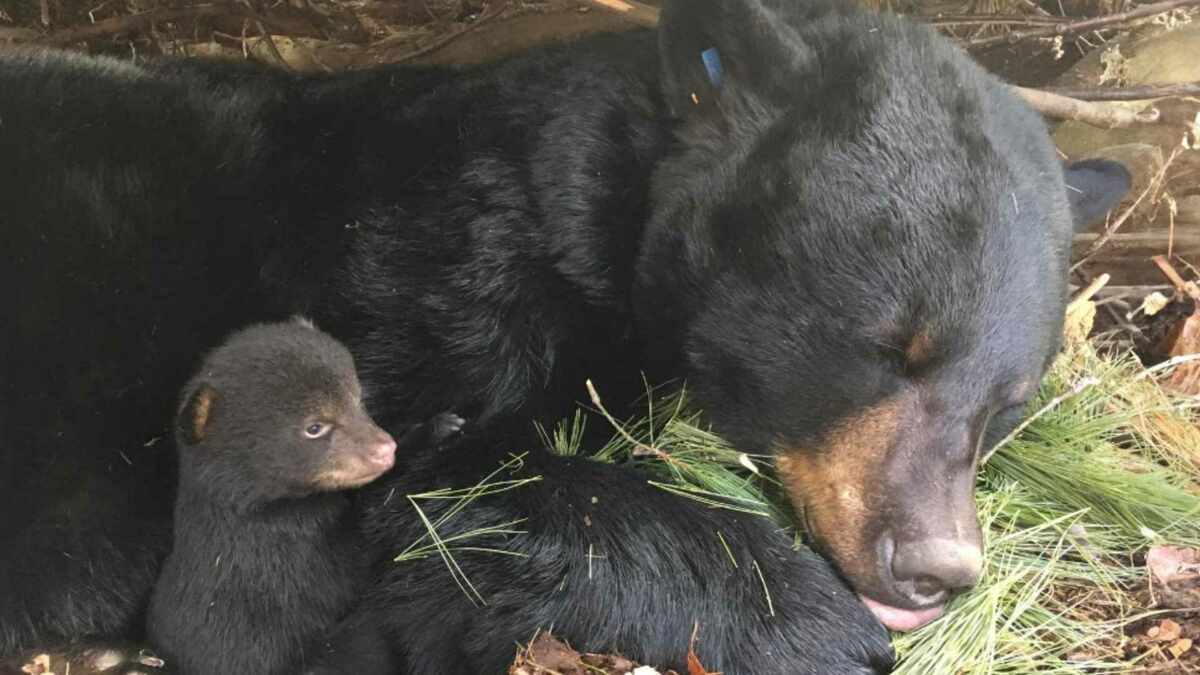
While most black bears slow down in the winter, they are not true hibernators. Bears often remain in their den without eating, drinking, or excreting waste for nearly 5 months. Even so, their body temperature does not drop substantially and they can awaken easily. To prepare for winter, bears enter a period called hyperphagia in late summer and fall when they increase their feeding activity to build up fat reserves before denning. Most bears are signaled to enter their den in November and December when food starts to become scarce. If human-associated foods, like bird feeders, are available year-round, bears may remain active during the winter. Help bears remember to enter their dens by removing all food sources on your property including bird seed, suet, pet food, and unsecured garbage.
Skunks
Like bears, skunks decrease their activity during the winter but are not true hibernators. While skunks are generally solitary animals, there have been reports of communal winter denning, with some cases of 10 or more skunks gathered together to keep warm! When temperatures stay below freezing, skunks sleep to conserve energy. However, if nighttime temperatures are over 30° F, skunks become active for short periods of time. Dog owners should be aware that these fragrant critters can still be encountered on unseasonably warm winter nights.
Reptiles
Although reptiles don't hibernate, they have their own way of coping with Massachusetts winters. Reptiles are ectothermic, also known as 'cold-blooded', meaning they rely on their environment to control their body temperature because they cannot produce their own body heat. When days become cooler, reptiles become less active, lower their metabolic rate, and wait for warmer weather to return. This dormant period is known as brumation. During brumation, reptiles can survive long periods without eating but still need to drink to prevent dehydration. On warmer winter days, they may emerge to seek out water or bask in the sun.