Du Bois Freedom Center Welcomes New Executive Director
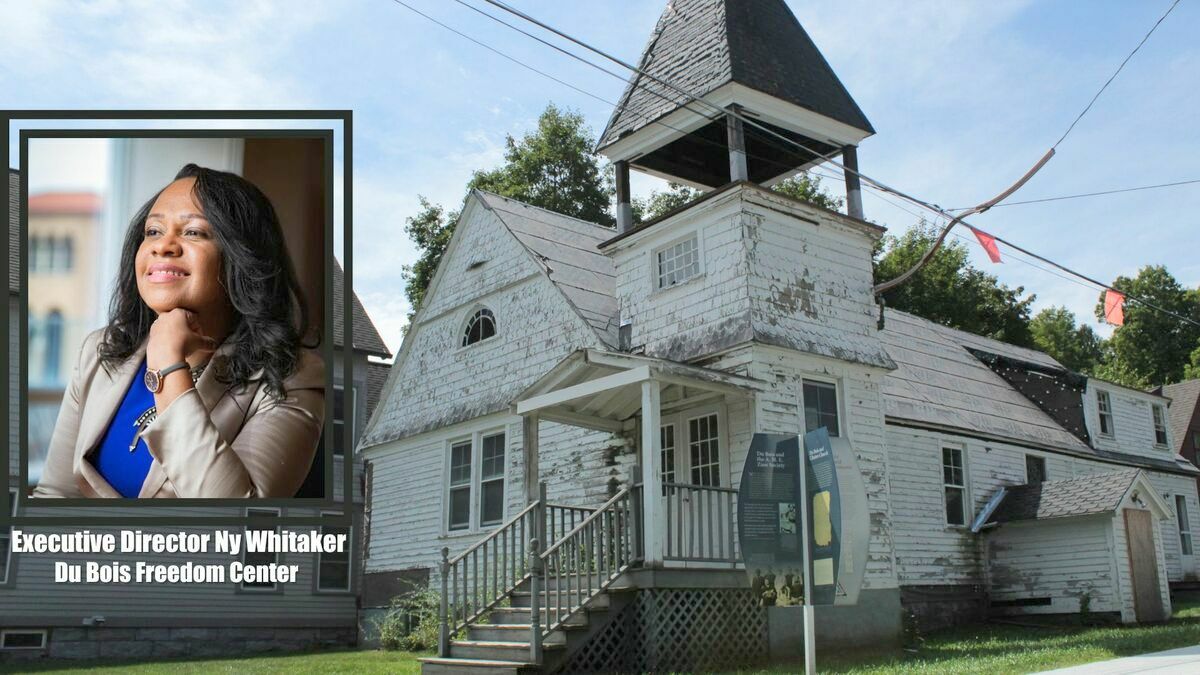
GREAT BARRINGTON, Mass. — The chance to educate people about the legacy of civil rights pioneer W.E.B Du Bois drew Ny Whitaker to become the first executive director of the Du Bois Freedom Center.
"I really think that there is just a new potential for the center to be a partner in the dialogue around W.E.B. Du Bois, around civil rights, around African American history and culture, and the contributions of African Americans to the overall discourse in America," Whitaker said.
"And I'm so looking forward to growing our partnership programs both locally in the Berkshires, regionally, and nationally."
It is important to recognize how forward-thinking Du Bois was because there are still so many things in his writings that are still relevant today, she said.
The project initially began with restoration of Clinton A.M.E. Zion Church in the Du Bois' hometown. The church, which he had attended, had become a hub for Du Bois-related events under the leadership of the late Rev. Esther Dozier starting with the first celebration of his birthday in 2001.
Clinton Church Restoration purchased the historic National Register property in 2017 with plans to restore and repurpose it as a heritage site and visitor center focused on Du Bois, local Black history and the Upper Housatonic Valley African American Heritage Trail. The project has a design and has been raising funding to complete the project that will become the W.E.B. Du Bois Freedom Center.
Du Bois was a sociologist, historian and author, earned his doctorate from Harvard, taught at Atlanta University and was a founder of the NAACP, the nation's oldest civil rights organization.
"I've always studied his work. It was always important to my family, to make sure that they elevated our African American history and culture," Whitaker said.
Du Bois is an inspiration and has been for every new generation, she said, adding that there has been a resurgence of untold stories that are not always depicted in history books.
Whitaker thinks this the year to share these stories, go into the archives and expose those people who had a hand in civil rights and activism movements to a whole new audience.
Whitaker was a professor at New York University for more than 20 years and is the founder of a charter school in New York State.
As an educator, she believes it is important to have an educational component in everything the center does and hopes to develop a curriculum and form partnerships with local schools and universities.
She also wants to ensure that the center is an inclusive communal space for students and families who want to celebrate civil rights and activism movements.
Growing up in Harlem, N.Y., she was surrounded by African American history and culture.
"I wanted to do legacy work. I wanted to be able to be part of something where for generations people can visit to celebrate African American history and culture, to celebrate the amazing civil rights pioneer and co-founder of the NAACP that is W.E.B. Du Bois," she said.
An added "bonus" to this opportunity is being able to transform the 1887 former African Methodist Episcopal church.
In the past, the center partnered with a variety of organizations to plan events but never had its own space. This renovation will not only allow the center to continue its partnerships in a "deeper" way but will also provide them a space to do things that have been successful in the past on a regular basis, Whitaker said.
The center received a $1 million from a grant through Andrew W. Mellon Foundation that will cover the cost of the renovations design, construction, and helps fund some community programs, which will be unveiled next month.
Its programming this year will surround the theme "Reflections on Democracy."
"Every year going forward, we will pick a theme. We will have a passage and allow the communities and all of our programming, to reflect on that writing, and I think that that will be a great way to tie the past to the present, and to explore the relevance of his work and again, how forward thinking he was," Whitaker said.
"That many of the things he talked about that day are still relevant for discussion and exploration today, and what we can do to bring that vision to reality, and to have that be an active part of our work as a community — an affirmation."
A community event in February will include updates on the project and there will be regular community meetings and engagement opportunities.
The center will also possibly have a survey that will include the designs so community members can provide their input "so that we can be partners fully in the development of the space," Whitaker said.
Whitaker has an extensive resume with more than 20 years experience in leadership for the corporate, nonprofit, and public sector. She was the former White House senior adviser.
In addition to that, she was a nonprofit executive and strategic consultant for a number of organizations to plan events and implement fundraising and awareness campaigns.
"That's what drew me to it, was the opportunity to really leverage all of those experiences that I've had and to be able to focus all of that in a way that allows us to bring the center to fruition," Whitaker said.
Tags: historic buildings, local history, W.E.B Du Bois Center,