Williams College Art Museum Debuts Emancipation Exhibit
 |
| Sadie Barnette's work |
WILLIAMSTOWN, Mass. — A new exhibit at the Williams College Museum of Art amplifies the voices of contemporary Black artists and their experiences of "freedom" 160 years after the Emancipation Proclamation was signed.
"One thing that people in the museum world think about about Williams is the incredible impact on arts leadership around the world and museums leadership around the world that Williams has had, and that is very much embodied in this exhibition," Director Pamela Franks said.
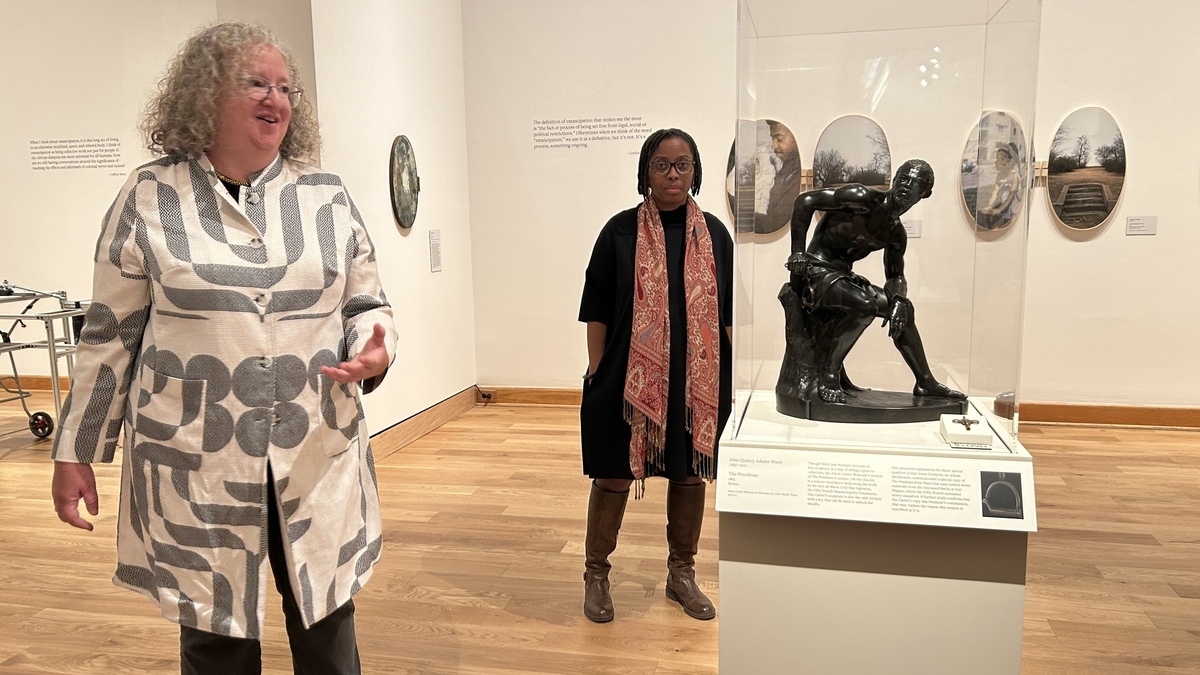
Emancipation: The Unfinished Project of Liberation debuted at the museum on Friday and will be on display through July 14. The show, which includes works from seven different artists, is inspired by John Quincy Adams Ward's sculpture "The Freedman". Created in 1863, this piece is one of the first American depictions of a Black subject cast in bronze and is dedicated to the 54th Massachusetts Regime, an all-Black infantry unit.
Artists Sadie Barnette, Alfred Conteh, Maya Freelon, Hugh Hayden, Letitia Huckaby, Jeffrey Meris, and Sable Elyse Smith reacted to the sculpture to depict their impressions of emancipation in the modern day with various mediums.
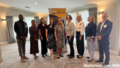
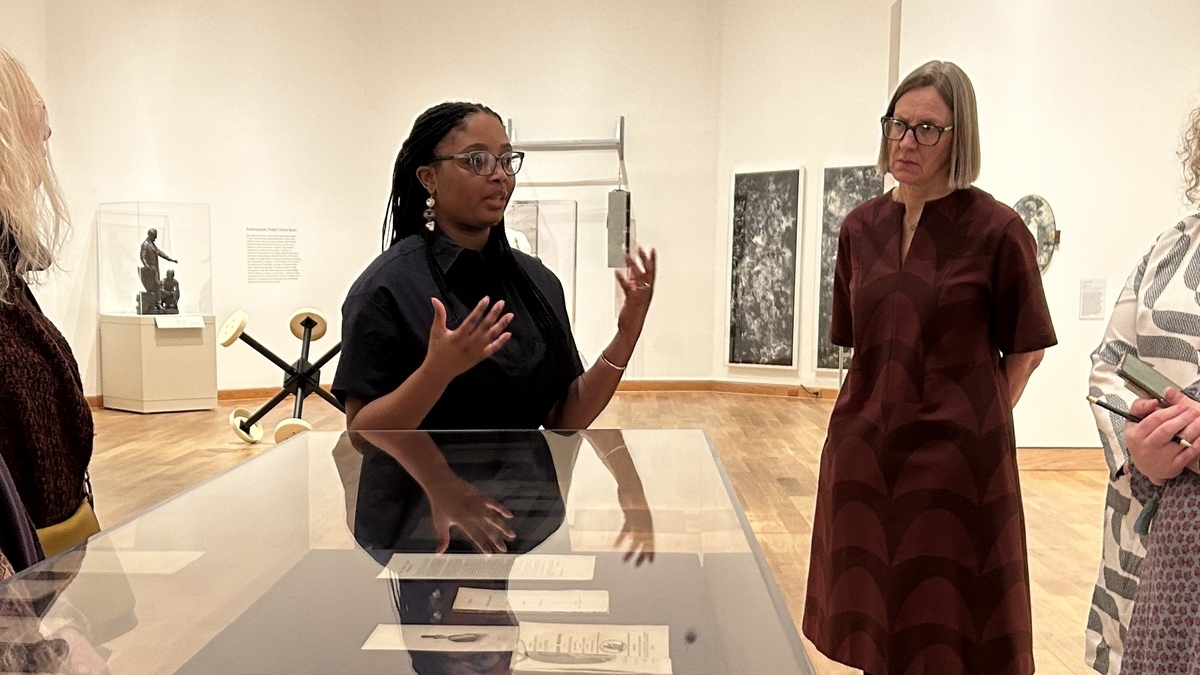
Curators Destinee Filmore, Maggie Adler, and Maurita N. Poole PhD gave a walkthrough of the works that ranged from somber and brutal to playful and colorful.
Adler, the curator of paintings, sculpture, and works on paper at the Amon Carter Museum, explained that the project started in 2018 and continued over Zoom after the onset of the COVID-19 pandemic.
Poole, the executive director of Newcomb Art Museum at Tulane University, explained that this only venue that is not in the south, making it a "very special" presentation that hopes to allow a variation of perspective and consider what the tension might mean historically.
"The methodology is different in terms of this as a traveling show because each venue is allowed to add additional materials to supplement the show to make it relevant for their audiences and we felt that that was particularly important because of the subject matter," she said.
"So it is grounded and inspired by a work of art from (the Amon Carter Museum of American Art's) permanent collection ‘The Freedman' which deals with a Black man liberating himself but then is also intended to be a broader conversation about what emancipation means within the context of the United States and the various lenses that people will have depending on their regions, their cities and towns. So for this version of it, you will see things that are very distinctive and kind of have an imprint of New England and Massachusetts in a way that has not been seen anywhere else and will not be."
Adler explained that the fact that it is a convergence of historical and contemporary work comes from the curators' backgrounds in both types of art.
"Artists understand precedent and they understand history and we think of them operating in a vacuum and in fact, that's not the case," she added. "There is a connectedness in terms of subject matter and in terms of artistic production that's on a continuum."
The artists were invited to reflect on their lives and emancipation, incarceration, surveillance, freedom, or lack thereof, in the 21st century. Works did not have to directly incorporate visual elements of the sculpture, as the idea behind it was the driving force.
Filmore, a WCMA Curatorial Mellon Fellow and assistant curator at the Metropolitan Museum of Art, said that having the opportunity to work on a traveling show is unique and being able to have the freedom to imagine the exhibition in the contest of Williams College and The Berkshires was "interesting and exciting."
"I learned so much about the history of enslavement here that differed greatly from the education I received as a seminar twice over throughout my primary school education and in college," she explained, adding that "lo and behold," the Berkshires are actually incredibly rich area for African American history.
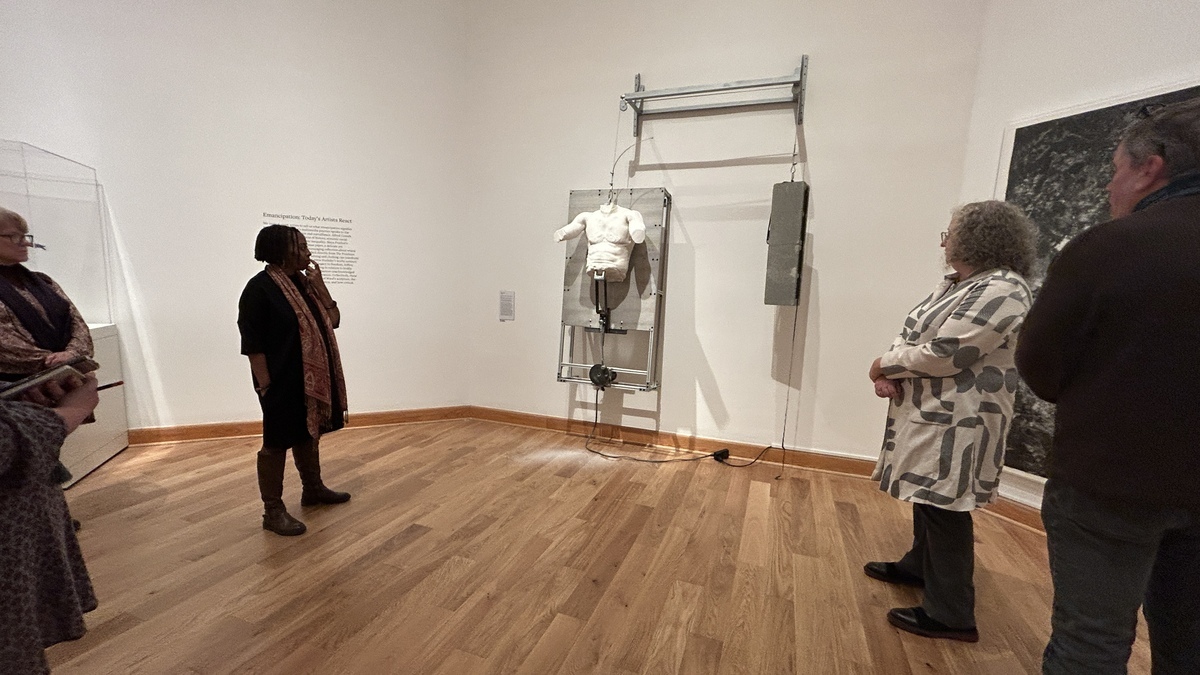
Meris uses plaster and mechanical elements to create a kinetic sculpture that uses his own body to represent systems of oppression that grind him down and are oppressive in today's society. His work "The Block is Hot" includes a cast of his torso mounted to a metal structure with a cinder block at the end of a pulley, lifting the cast of himself when activated.
He lives and works in New York but is from the Bahamas and of Haitian descent so this is said to give voice to the people to migrate to the country. Poole explained that over time, he was known to experience things like surveillance, policing, and racial categorization that he was not used to in the Bahamas.
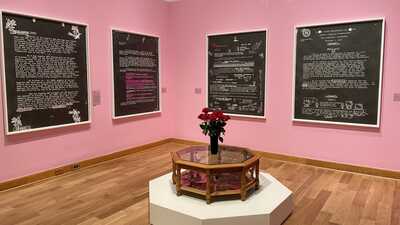
Barnette's work in the show is based on FBI files that document her father's surveillance because of his work for the Black Panther Party. The documents are blown up and adorned with glitter, Hello Kitty drawings, and other theming to juxtapose "abolition and decommodification" with "celebratory materials."
"This is a labor of love that Sadie has created these with graphite and the redactions are original to the file but what she has done is created this system of protection of symbols and iconography, such as Hello Kitty, such as glitter, pink, the color pink, you notice that she requires pink glitter for the walls," Adler explained.
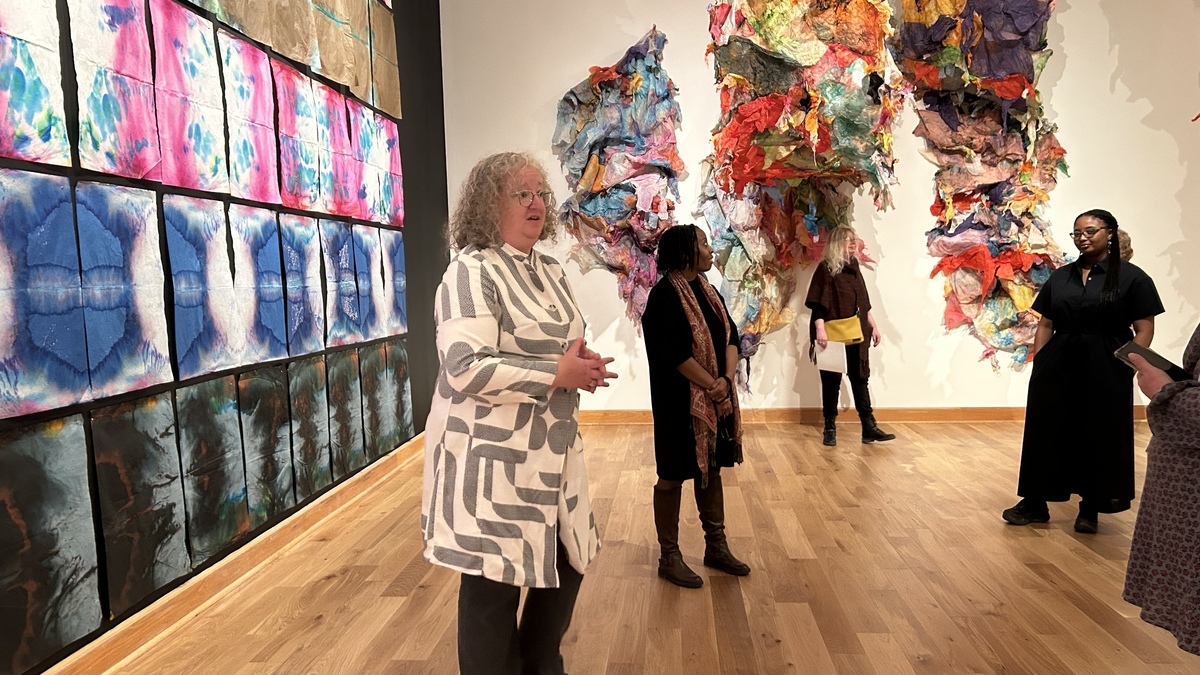
The tour ended in a burst of colors with Maya Freelon's large-scale colored tissue installations made of recycled material. Her art is influenced by her grandmother who provided the materials for the installations and her godmother, Dr. Maya Angelou.
The airy, flowing works are interactive in the way that they can be walked underneath and sway in a breeze.
After Freelon's grandmother's basement flooded, she was inspired by the bleeding ink on the fragile tissue paper and wanted to challenge museums to allow her to fill the space with a common material that is made into a transcendence, Adler explained.
Also included in the exhibit is an early copy of the Emancipation Proclamation and a pamphlet from Frederick Douglass' iconic 1852 speech "Oration" From the Williams College Chapin Library of Rare Books. The show is co-organized by the WCMA and the Carter Museum.
Tags: art exhibit, WCMA,