Gaza Resolution Proponents Again Make Their Case to Williamstown Select Board
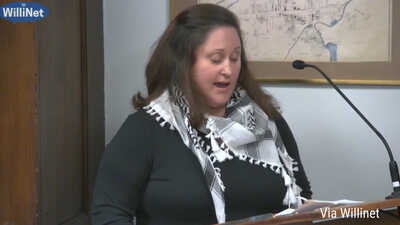 |
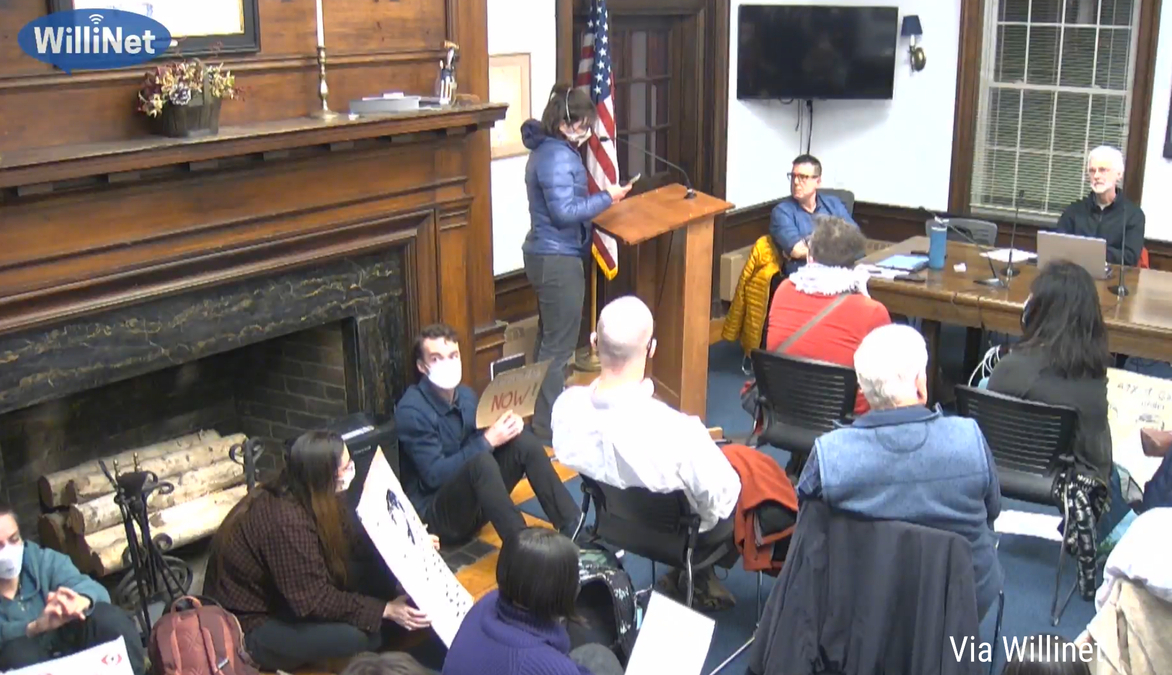
| Shaina Adams-El Guabli addresses the Williamstown Select Board Monday in this image from the town's community access television station, Willinet. |
The following story contains a reference to suicide.
WILLIAMSTOWN, Mass. — About a dozen people Monday pleaded with the Select Board to take a stand on behalf of the town in favor of an immediate cease fire in Gaza.
Several of the same activists who first brought a resolution to the board two weeks ago were back, filling the meeting room to capacity and sharing impassioned appeals to break with the board's practice of not voting on matters not directly under the board's purview.
"We, as members of Berkshire County, are committing this genocide," said a Lee resident who made the trip north to address the board. "We are funding it, and we have the power to stop funding it."
Most of those who spoke during the public comment portion of the Select Board's biweekly meeting were Williamstown residents, and all 13 who spoke either from the lectern in the meeting room or via Zoom spoke in favor of adopting the cease fire resolution.
At the start of the meeting and again, immediately before public comment began, Chair Jeffrey Johnson explained that since the resolution was not on the meeting's agenda, the three board members in attendance (Johnson, Randal Fippinger and Andrew Hogeland) would not hold a discussion on the question, let alone take a vote.
Johnson also indicated that there could be a change coming to the resolution's language that might broaden its appeal to residents.
"Many of our citizens have reached out in support of and in opposition [to the resolution] as well as to not be in favor of the Select Board getting involved generally in these types of issues," Johnson said.
"Continuing to be transparent, I've personally met and spoken to many people involved on both sides of this. I wanted to pass on, there's a bipartisan group, including the original author and local rabbis, that have been in communication with a plan to meet further to discuss potential edits."
No one on the Select Board has, to date, publicly questioned the intent or merits of the resolution. The stumbling block, as Johnson noted, has been the idea of "getting involved" in issues that do not directly relate to town government.
As board members noted at their Feb. 12 meeting, they were elected to do specific jobs, and making moral or political statements on behalf of the town's residents is not on that list. Instead, organizers supporting the cease fire resolution were encouraged to take the question to town meeting, where all registered voters in town are eligible to participate.
Many of the speakers on Monday night disputed both the idea that a Gaza resolution is "not in the purview" of the locally elected board and the notion that waiting until the May annual town meeting is an acceptable alternative.
"If this was solely an exercise in community building, bringing it to town meeting in three months might make sense," Katherine Lee Cohen told the board. "The status quo is simply ongoing violence. We invite you to do more."
Farah Momen, the chef and owner at New Ashford's Bondhu, asked the board whether Williamstown is so insulated that it is unaffected by events beyond the town line.
Momen was one of a couple of speakers on Monday to reference Sunday's protest in Washington, D.C., where a U.S. airman self-immolated in front of the Israeli embassy to protest its war in Gaza.
Momen noted that Bushnell went to school in Eastern Massachusetts and that the livestream of his suicide was widely available on the Internet and accessible on the phones in the Select Board members' pockets.
"Is that close enough yet?" Momen asked. "Is it local?"
Among the themes repeated at Monday's meeting was the need to send a message to Rep. Richard Neal, D-Springfield, that communities in his district, like Williamstown, do not support military aid to Israel while it continues to bomb civilian populations in retaliation for the Oct. 7 attack by the militant group Hamas.
Aliza Cotton, a student at Williams College, read a statement on behalf of the campus group Jews for Justice.
"We understand the pain and suffering from genocide," Cotton told the board. "It is precisely because of this fact that we condemn the genocide against the Palestinian people. We believe ‘never again' means never again for anyone.
"We know cynics will paint this call for justice as an act of anti-Semitism. … This violence will not be waged in our name. None of us are free until all of us are free."
Cotton was one of several people who self-identified as Jewish in prefacing their remarks in favor of a cease fire resolution.
"As a Jew, I've felt compelled to speak against the occupation of Palestine for the last 20 years," Shaina Adams-El Guabli said. "As a parent, I'm committed to our children knowing something different, knowing how to stand with Palestinians.
"I want to be clear that calling for a cease fire is a Jewish moral imperative. It is a human imperative."
Anna Moriarty Lev identified herself as, "a Jewish mom living in Williamstown," and addressed the board for a second straight meeting.
"I've heard people say the resolution is too one-sided," she said. "I'm not sure why. … I'm on the side that believes every human life has value.
"Saying nothing is as loud a statement as any resolution."
Johnson thanked all the people who advocated before the board on Monday night.
"You're heard, and I hope you feel valued," Johnson said.
Fippinger said, "It's so unfortunate that the issue of whether we should [generally vote on resolutions] as a Select Board is conflated with the [substance of] the resolution, because I think you can have two separate opinions."
Hogeland, the longest-tenured member of the board at Monday's meeting and long a proponent that the body, "stay in its lane" when it comes to requests to take stands on issues not directly under the control of town government, also thanked the proponents of the resolution.
"You made some excellent points," Hogeland said. "You made them with a lot of passion, which I really admire, and I'm glad you did it."
Tags: resolution,