WWII Veteran Reflects on D-Day at VFW Post Induction
.gif)
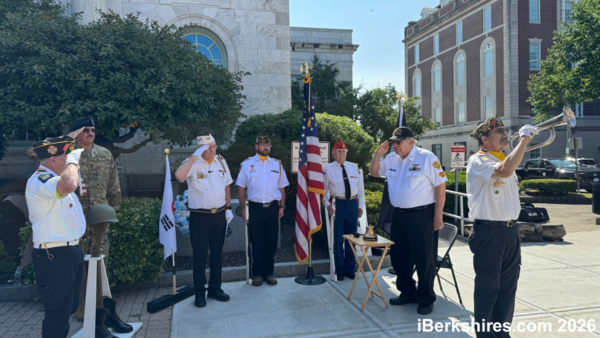
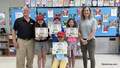
The members in the picture are Bret Miller, Coast Guard, Desert Storm; Hank Morris, Army, Vietnam; Brad Havill, Navy, Global War on Terror; VFW Post 448 Vice Cmdr. Mark Pompi, Army, Global War on Terrorism, Afghanistan; Post Cmdr. Arnold Perras, Korea; Joe Difillipo, Army, Vietnam; Teri Billington, Navy, Desert Storm; and Carmen Ostrander, Air Force, Afghanistan.
PITTSFIELD, Mass. — Anthony Salatino Jr. says his memory is getting a little foggy about his time in the Army.
But he remembers how terrible D-Day was, and feeling lucky he wasn't among those in the initial invasion force 82 years ago.
"One of the most horrible things was in Normandy. We went shortly after D-Day. I got lucky, very lucky on D-Day. We went to a staging area the night before … and at the very end, somebody called, I was in headquarters, they called all the headquarters personnel at the center," the 103-year-old said. "We did not go. There's about 30 of us. The rest of the battalion was gone, and the reason for that was because there was another battalion coming from the States, and they had no headquarters.
"We stayed back, but we did go to Normandy shortly after that, and when we went to Normandy, it was all over."
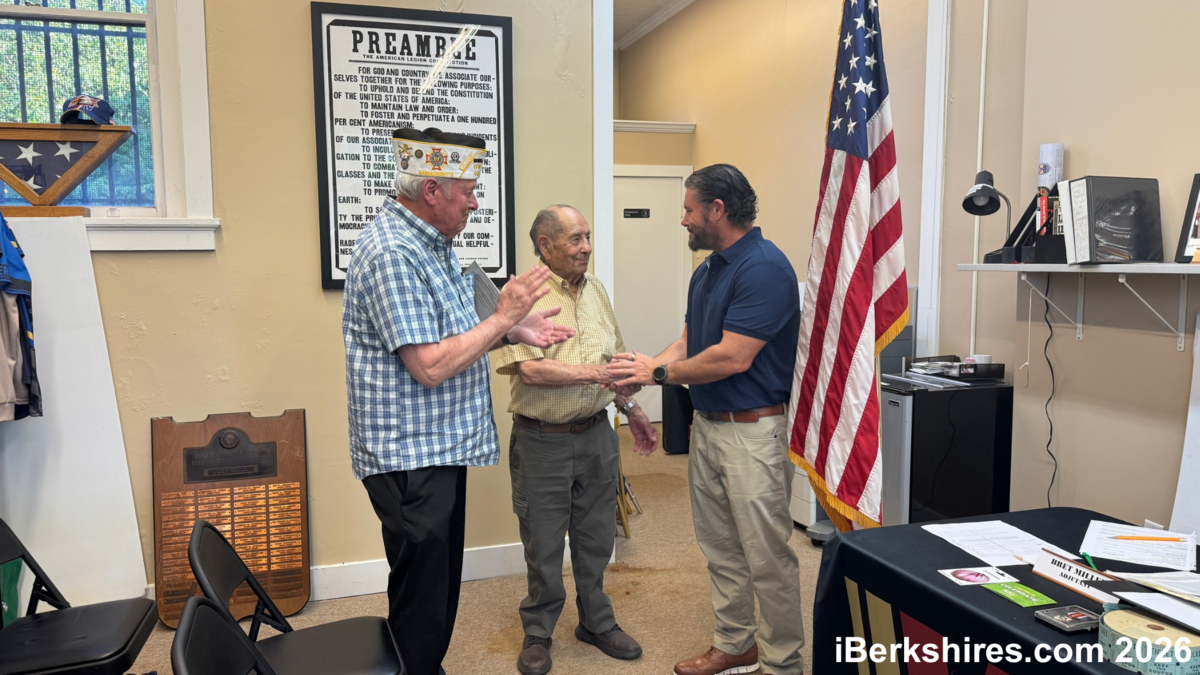
Salatino was attending an induction ceremony on Thursday at the Lt. John N. Truden VFW Post 448. Joseph Texidor, who served in the Army for 17 years with tours in Iraq and Afghanistan, was sworn in as the post's newest member.
Salatino served in the Medical Corps and wanted to follow in the footsteps of his father, a World War I veteran wounded at Verdun. Salatino was in the Army for about three years.
"The whole memory is what I just told you, very, very alive to me," he said. "That is, I can never forget, never forget that."
D-Day on June 6, 1944, was the start of Operation Overlord, and the largest invading force to cross the English Channel since 1066. Their goal: to liberate Europe from Nazi Germany.
The combined forces of the United States, the United Kingdom, Canada, Australia, New Zeland, and forces from occupied France, Norway, Belgium, the Netherlands, Poland, Greece and Czechoslovakia -- more than 150,000 men -- assaulted the Normandy coast of France by air, sea and land.
More than 4,400 men died on the first day of the invasion, more than half of them Americans.
Salatino came to the United States when he was 14 years old and did not want to go to Europe.
"When you're young, the only thing you know about war is you go and fight, either you get killed or you'll kill somebody, and I didn't want to go to Europe," he said.
But he ended up in England for a little over a year and then France for over a year as well. But his family was in Italy once the war started, he was not able to communicate with them.
"I didn't see my mother for 10 years, because once the war started, they started to censor, no communication," Salatino said. "OK, you can write letters to one another within the United States with the Army, with the Navy over there, but not outside the censor."
He almost became a casualty when some convoy trucks made a nighttime mistake with their turns, nearly driving over the sleeping Salatino and his sergeant, and crushing all of his belongings.
"I can never forget that I heard a little noise, and I touched it. I'm touching the tires, the tires of the truck," he said. "He was backing up, and he already stopped and shifting to go back forward, but the truck is moving very slowly. I could feel the tires with my hand. Boy, that woke me up."
After the war, he brought his family back from Italy and ended up in the Berkshires.
"So after the war, I got my mother, and the rest of the family here, and everything goes forward," he said. "It's a long story. It's just because of my age, it's a very long story, but I wound up being here was a miracle for me."
After bringing his family here, he started a family of his own with his wife, Bettina Mancuso, having two boys and two girls.
Salatino graduated from the New England School of Art in Boston in 1950 and received a degree in advartising design. He used this artistic talent to become General Electric Co.'s first graphic design artist in 1955 and he worked as a supervisor in the art department.
Salatino attended the VFW meeting to help swear in Texidor, who said he also joined the Army to follow in his father's footsteps. He remembers his time as being great with great people. He wanted to join the VFW to help veterans.
"They just do a lot for the veterans. It's nice to see. He told me Tony was coming down, he's 103, and I was like, that's great. I mean, that's kind of what I wanted to do," Texidor said. "A lot of veterans are just either bad times or there's a lot of programs, they just don't use them or they don't know about them, so it's just nice to help some of these guys and girls out."
Tags: veterans, VFW, world war,