Mount Greylock School Committee 'Struggles' with High-Stakes MCAS Question
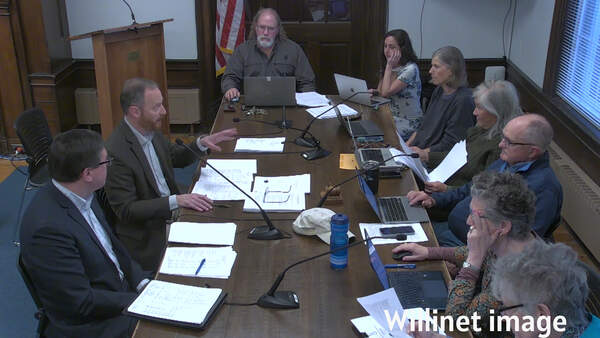
WILLIAMSTOWN, Mass. — The Mount Greylock Regional School Committee last week had a microcosm of the debate with which voters around the commonwealth will grapple when they go to the polls over the next few weeks: whether to continue using the MCAS test as a requirement for a high school diploma.
Question 2 on the Nov. 5 ballot, if passed, would eliminate the current practice requiring high school students to pass the 10th grade Massachusetts Comprehensive Assessment System test in order to graduate from school.
The issue arose at the October meeting of the regional school committee in the context of advising the body's delegate to this fall's Massachusetts Association of School Committee's convention on a proposal before that statewide body. One of the resolutions on the MASC agenda would go even further, calling on the Department of Elementary and Secondary Education to institute a "moratorium" on all MCAS testing while a replacement to the current standardized test is developed.
The committee agreed to authorize its delegate, Julia Bowen, to submit an amendment to the MCAS resolution that would strike the moratorium language but continue to push for alternatives.
But the regional panel also waded into the more pressing issue: Question 2, which will be decided the day before the MASC conference in Hyannis on Nov. 6.
Carolyn Greene noted that the MASC's executive committee already voted a position on Question 2, encouraging its passage and the replacement of the "high-stakes MCAS" with a, "more reasonable and equitable requirement for a high school diploma."
But the local elected officials were more conflicted — both as a group and as individuals — on the issue.
"I know the Massachusetts Teachers Association is supporting Question 2," Greene said. "I know the Massachusetts Association of School Superintendents is not supporting it. There are folks coming out on either side of this in lots of different places, and there are valid concerns all around.
"The main gist of what I've heard from the MASC board is there is a lot of frustration with DESE [the state agency] about not listening to what teachers are saying."
Greene said she also has heard that teachers spend too much time "teaching to the test" and that the state imposes other curricular standards that would ensure the validity of a high school diploma.
Curtis Elfenbein backed up that point.
"I can't claim to represent the Massachusetts Teachers Association," he said. "I can tell you as a classroom teacher and a member of a union of teachers, anecdotally, in the three districts in which I communicate with classroom teachers, there is overwhelming support for Question 2.
"I have seen students and families harmed by this as a graduation requirement."
Elfenbein indicated it is not enough that students can retake the test after underperforming in their sophomore year.
"The more they encounter this barrier, the further away from success they feel," he said. "And these are students with honor roll grades. For whatever reason, they're not able to bridge the gap between their mastery of material and the expression of that mastery [on the standardized test]."
That said, Elfenbein, who said he believes in "data-driven instruction," supported the idea of continuing to administer the MCAS as a way to measure progress across time and across school districts — just not, perhaps, as a requirement for graduation.
Interim Superintendent Joe Bergeron offered the counterpoint from the school superintendents' group.
"The MASS, while it agrees that the MCAS is not an ideal gate for graduation, in the absence of something else that will be used statewide, eliminating it will put local school districts in a difficult spot as far as determining who will graduate and who will not," Bergeron said. "The response from others will be, 'Was it really that bad prior to 2003, 2004 [when MCAS became a requirement a diploma]?'
"The response to that is that it used to be the case that some school districts had fairly stringent requirements for whether you could graduate, and others made it relatively simple. So the concept of a high school diploma was not as meaningful as it was before MCAS became a standard."
Coincidentally, last week's meeting also saw Bergeron's annual presentation of the district's report from last spring's MCAS tests and a discussion from him about how the preK-12 district uses that data as a diagnostic to inform its strategies in the classroom.
Bowen thanked Elfenbein for providing the perspective of teachers and the students he has seen harmed by the test. But the former school administrator argued that a standardized test provides consistency across school districts.
"My gut instinct is, 'What will happen to the validity of the data if students know the test scores don't matter?' " said Bowen, the former and founding executive director at Berkshire Arts and Technology Charter Public School. "How can we maintain the integrity of the results of that assessment if it's not a requirement for students to pass? That's a totally open question. I don't know the answer.
"We are spending a tremendous amount of Massachusetts taxpayers' money, and taxpayers are owed, to [Bergeron's] point, a good bar in terms of a high school education … a good, consistent bar."
At one point, Greene noted that she and Steven Miller were representing opposing points of view in an upcoming election forum sponsored by Williamstown's chapter of the League of Women Voters.
"I agreed to go on the discussion because they needed someone on the 'No' side [on Question 2]," Miller said, quipping, "I'd cede my place to Julia."
Miller said that he actually is torn on the issue.
"To me, one of the big reasons to have a test like this is to ensure school districts are providing a basic level," he said.
But the math professor at Williams College said he specifically has concerns about whether the MCAS math exams were testing the right skills. He had a student who did not do well on the graduate school's version of a standardized test but was one of the top 500 people in the country in a mathematics competition.
"I know I'm flip-flopping on this," Miller said.
The committee did not take a vote to recommend either passage or defeat of Question 2. Bowen's thoughts summed up the advise the panel might give.
"I personally come down as a 'no' on Question 2, but I recognize a lot of different perspectives to take into account," she said. "I hope everyone struggles with this question as much as we are as a group."
Tags: MCAS,