Dedication Set for Jordan, First Woman to Vote
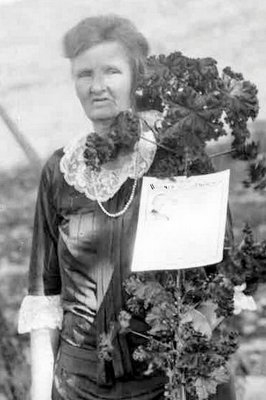
A photo of Phoebe Jordan, acquired by Rachel Branch, shows her with a 'tribute' from President Calvin Coolidge.
But her splash in the newspapers in the early part of the 20th century gave way to fewer and fewer mentions, and while she's remembered on anniversaries, anyone visiting her grave would have no idea of her importance.
A group spearheaded by Rachel Branch and Jordan's relatives have rectified that with a new inscription on her gravestone that will be dedicated at 11 a.m. on Saturday in the town cemetery, on Cemetery Road off Route 7.
Family members and town officials are expected to attend with a reception to follow at Town Hall with coffee from Jake's Java and cookies made from a recipe of Jordan's.
Branch, a former North Adams resident now living in Dalton, said the project had started from a chance conversation with one of Jordan's great-great-great-nephews.
"I don't know how we got talking about women's rights or anything, and he said, 'Do you know who Phoebe Jordan is?' And I said, 'no.' He said, she's the first woman that voted," said Branch.
The nephew, Chad Cornwell, told Branch that Jordan was buried in New Ashford with no inscription on her grave. That didn't sit well with Branch, a longtime activist and advocate.
"So I said, 'well, we have to do something, but that's how it started," she said. "Let's do a dedication."
Branch said she turned to Cindy Grosso, town historian, and other officials to get the ball rolling. Berkshire Monumental Works did the engraving on the back of the stone, signifying Jordan's legacy as the first woman to vote legally in 1920.
For years afterward, she would be the first in the nation to vote as New Ashford in those early years of the 20th century raced to report the choices of its several dozen or so voters — beating out challengers like Mount Washington and Peru by minutes — with the help of the local newspapers and the invention of the telephone.
Jordan was no newbie to politics — she was active in the community, had advocated for women's suffrage and was chair of the Republican Town Committee (so very likely gave her first vote to Warren J. Harding, who swept all but the deepest south on his way to the presidency.) She switched in 1930 and was chair of the Democratic Town Committee for a time.
By 1936, she was being described as the "oldest woman voter" in New Ashford at 72 as she cast the first ballot for the presidency. It would be the year that New Ashford lost its four-time "first in the nation" voting record as towns in New Hampshire and Vermont sought to grab the title. They were able to open their polls before 5:45 a.m., the earliest by state law that Massachusetts could start voting.
(The apocryphal saying "so goes New Ashford, so goes the country" also went to the wayside as Alf Landon beat Franklin Roosevelt 26-19 there; FDR would go on to win 46 out of the 48 states.)
It would also be Jordan's last presidential election. She was fittingly born in the presidential election year of 1864 and died at age 75 in 1940, also a presidential election year. Born in town of Washington, she went to live with an aunt in New Ashford when she was 7. She never married and ran her grandfather's 400-acre with a couple hired help.
Her will ordered her property sold and the proceeds donated to Shriner's Home for Crippled Children in Springfield and that a marble monument be set in New Ashford Cemetery with the names of herself, her uncle Martin D. Jordan and farmhand Edward Welden.
This Saturday, the more descriptive inscription will be unveiled. All those who wish to honor Jordan are welcome to attend.
Tags: historical figure, voting, womens history,