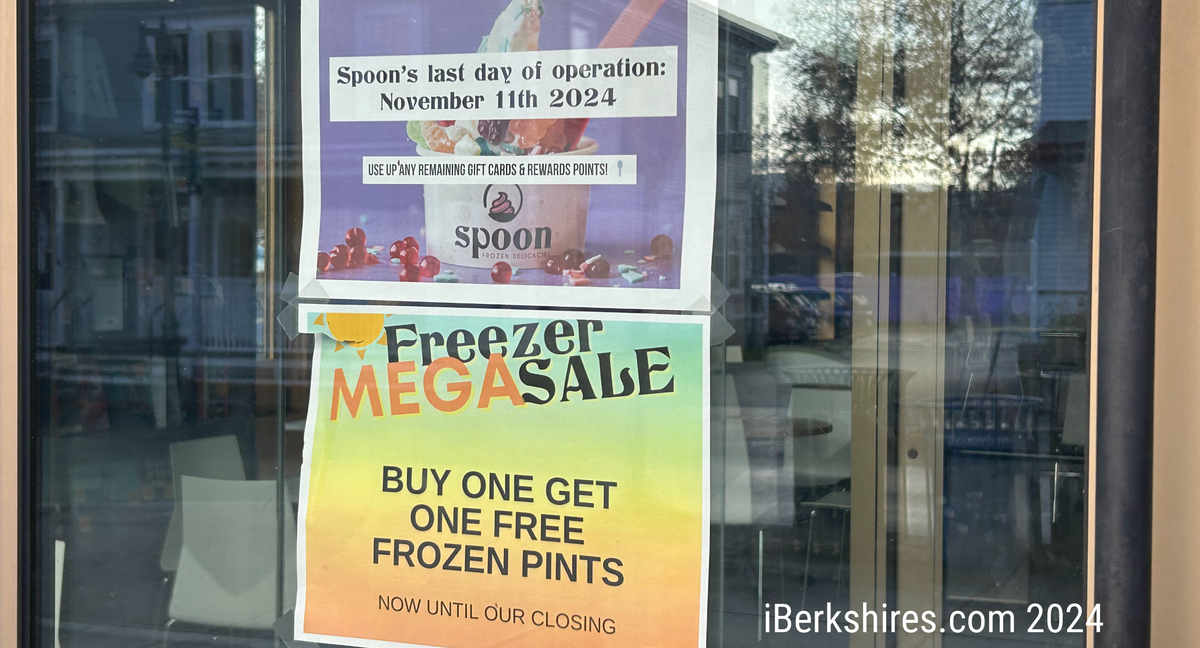
A sign on the front door of the Williams College Bookstore promotes Spoon's going-out-of-business sale. The college is seeking another entity to complement the bookstore.
Williams College Looking to Fill Commercial Space on Spring Street
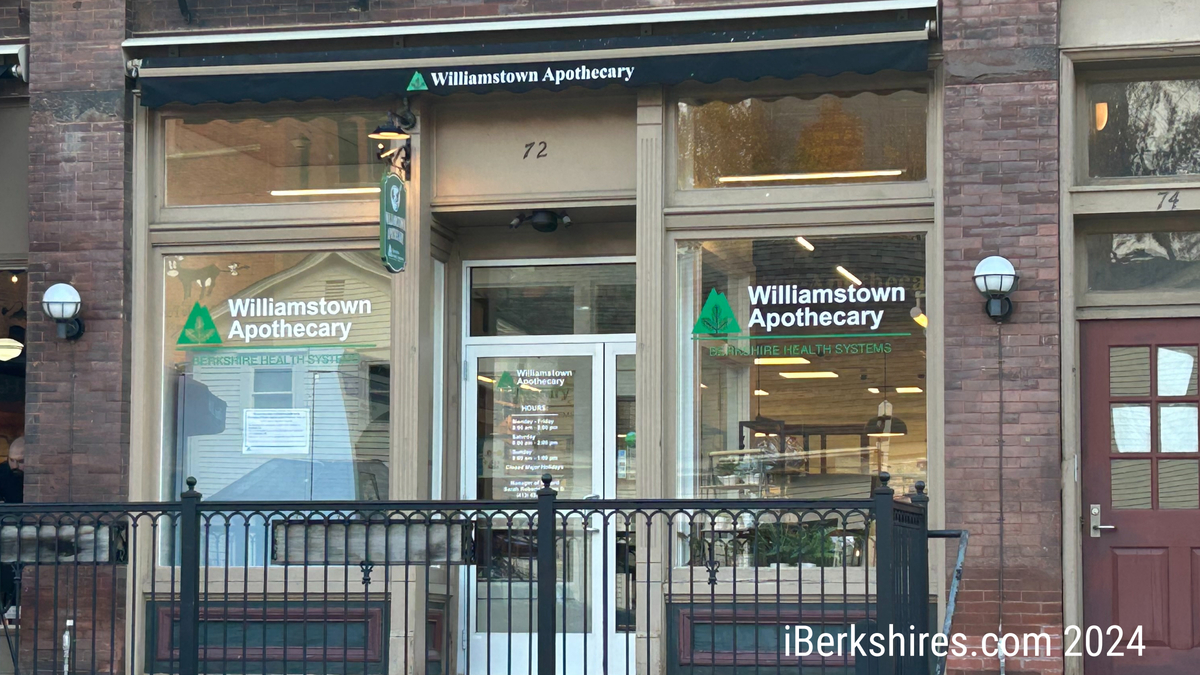
The pharmacy opened by Berkshire Health Systems four years ago is closing because of 'low utilization.' Another college-owned property, the former Purple Dragon, will undergo a facelift to make the space more attractive to potential tenants.
WILLIAMSTOWN, Mass. — A Williams College official who handles the school's commercial spaces on Spring Street said this week the school already has received interest in the space currently occupied by a frozen yogurt shop.
And another soon-to-be-vacant Spring Street storefront is ideally suited to host something similar to the drug store that is pulling out, the school's associate provost said.
Earlier this fall, two businesses located across the street from one another in the town's main commercial district announced their closure in rapid succession.
Spoon, a popular froyo shop on the first floor of the college's bookstore, plans to cease operations on Nov. 11. The Williamstown Apothecary will close on Nov. 14.
Both businesses operate in space rented from the college, which has extensive commercial holdings on Spring Street, which runs through the middle of campus.
Spoon owner David Little told The Record, the college's student newspaper, that he was giving up the business he ran since 2020 in order to spend more time with his loved ones.
Berkshire Health Systems, which opened a pharmacy in the heart of downtown and campus in August 2020 during the COVID-19 pandemic, announced earlier this month that, "low utilization and pharmaceutical reimbursement rates" drove its decision to cease operations at 72 Spring St.
Williams' Chris Winters said the college is actively trying to fill the holes left by the coincidental closures.
"Spoon, obviously, is a key component of the first floor of the bookstore experience," he said. "It's important to put a new entrepreneur in that space to maintain the vibrancy of that store and that corner of Spring Street.
"At this time, we're considering what will go in there. Obviously, it's set up as a food service location. That's likely what will go in there. The question is who and what."
Winters said a couple of entrepreneurs have approached the college about the location. One consideration is what sort of eatery is compatible with the building's main purpose as a college bookstore.
He agreed that frozen yogurt might not be the first thing that comes to mind, but the marriage made sense.
"It's not the normal association, but when I say compatible, I mean it doesn't conflict," Winters said. "It is not an operation that has negative externalities. It's not loud, it's not smelly, it does not spill into the space where the bookstore operates."
Although Spoon was set up to also operate outside of the book store's hours of operation, the college saw them as complementary businesses.
"It's even better when they operated together," Winters said. "The students would study there and hang out in the eating area. It would attract people to hang out in the bookstore, hang out [at Spoon], read a book, have a beverage or food, whatever is being served there."
Winters said the terms of Little's lease did not require a long notice period, and the school found out about the coming closure about the time it was made public.
He said it will take some time to find the right replacement and for an entrepreneur to put together a business plan. But he does not anticipate the space being vacant for long.
"For sure," Winters said when asked if he expected the space to be filled by summer 2025. We're highly motivated to put in something exciting and of use to the community.
"I would hope [by the spring] even if it's a pop-up opportunity to give another entrepreneur time to get their business plan together."
As for the Williamstown Apothecary space, Winters said he thinks "everyone's first choice" is that another pharmacy goes into the storefront.
"It is well equipped for a pharmacy," he said. "The security, the counter, the back office. It is turn-key pharmacy.
"I think it would be a win-win for everyone if there was a pharmacy operator that would like to operate on Spring Street in an already outfitted pharmacy. Lacking that, it would be set up for retail, and it's a nice retail location for an entrepreneur."
Winters declined to say if the college already is having conversations with prospective tenants for the apothecary space.
Meanwhile, another currently vacant commercial property on Spring Street is getting a facelift.
"The former Purple Dragon Games location is being renovated," Winters said. "We're taking the opportunity, as it's empty, to do substantial renovations. We're bringing back the tin ceiling, the 1950s/40s-era tin ceiling.
"We're removed a lot of the clutter. We will be adding accessible bathrooms. It will be ready for a new century. The building hasn't been touched since, probably, the 1980s."
Winters said there is not yet a tenant lined up for the spot where Purple Dragon closed last year.
"We're fixing it up so it will be ready for anything," he said.
If you would like to contribute information on this article, contact us at info@iberkshires.com.
Your Comments
iBerkshires.com welcomes critical, respectful dialogue. Name-calling, personal attacks, libel, slander or foul language is not allowed. All comments are reviewed before posting and will be deleted or edited as necessary.
No Comments
Students Show Effects of Climate Change in Art Show
By Breanna SteeleiBerkshires Staff
Students from 10 area high schools are showing works that reflect on climate change at the Clark Art this week. The exhibit will move to Pittsfield and Sheffield later.
WILLIAMSTOWN, Mass. — Students got to showcase their art at the Clark Art Institute depicting their relationship with the Earth in the time of climate change.
"How Shall We Live," a juried art exhibit, was on display Saturday in the Clark's Hunter Studio at Stone Hill. Students from 10 high schools participated.
Climate educational organization Cooler Communities has hosted this show for the past couple of years at different venues across the Berkshires. This year, it was approached by the Clark to host the show and is co-organizing with Living the Change Berkshires.
This was the first year Cooler Communities, a program of the Harold Grinspoon Charitable Foundation, changed its prompt to make it more personal for the students in hopes to start a conversation in the classrooms on climate change.
"In our work with Cooler Communities, we want to really make conversations about climate change normal, so it doesn't just happen in high school science or in activist circles, but for everyone to feel like they have a role to play, and for everyone to explore what it means for them," said Executive Director Uli Nagel.
"And so that's why the work of classrooms rather than after-school programs, but actually have it in the classroom and then bring it to the community and connect it to solutions. That's why the community is here, and so we always try to actually make it real, but also give kids the opportunity to explore their own emotions and interior experiences through art."
The Clark wanted to expand on its Sensing Nature Program and give students a higher impact experience instead of just the program tour that could help fit the criteria for the students’ portrait of a graduate.
The show had 74 displays as well as an iPad that showed other students’ art that was not showcased in the show, which was around 180 submissions.
Students were asked to respond to one or more elements in the following prompt:
What does nature provide?
What are the Earth's needs?
What matters most?
What is resilience?
Where do you find guidance and inspiration?
Pittsfield High student Stella Carnevale, 16, made her artwork out of newspaper, Mod Podge, chalk, and watercolors. She drew three sardines showing the effect polluted water had on them and wrote in her artist's note that she wants people to pause and feel empathy while also recognizing their role in protecting the natural world.
"Fish are vital to our world. They balance ecosystems, feed communities, and remind us how deeply connected life on Earth is. When our waters are polluted, fish are often the first to suffer, and their disappearance signals a greater loss that affects us all," she wrote. "Pollution doesn't just damage rivers and oceans; it threatens food sources, cultures, and the health of the planet itself. I make art to bring attention to what is quietly being taken away."
She said it was really cool to see her art hanging in the Clark and never thought it would happen.
Wahconah Regional High student, Alexandra Rougeau, 18, painted a jellyfish in acrylics.
"I started off making a different painting that was very depressing, obviously, because it's climate change, and I got really annoyed because everything was so negative," she said. "And although climate change is a really negative part of the world right now, I want to try to show that there is some hope in it. And that we do have some hope in saving our environment. So the jellyfish is meant to depict fire, global warming, but it's in the ocean and it's rising up, and there is some hope, hopefully at the top, in the surface."
Rougeau said it is an honor to be chosen to have her art here and to see all the other depictions from other students.
Monument Mountain High sophomore Siddy Culbreth painted a landscape in oil pastels and said he was inspired by his grandfather who is a landscaper and wanted to depict "what we should save."
"I was picturing this as a quintessential, it's kind of like epitome of what a nice landscape should be like," he said. "And so in terms of climate change, like how that is kind of shifting, or what our idea of like the world is shifting. And I feel like it's really important to preserve what, like, almost not a perfect world, but, what the world should be like."
Some students from Pittsfield High in Colleen Quinn's ceramics class created a microscopic look of what they thought PCBs looked like and wanted to depict how the polychlorinated biphenyls might have affected them at Allendale Elementary, near disposal site Hill 37.
Quinn said she is very proud of all her students.
The show is at the Clark until April 26 and is free and open to the public. It will be moved to Pittsfield City Hall to run from May 1 through June 8, and then to Sheffield's Dewey Hall from June 12 through 21.
It is made possible with support from the Feigenbaum Foundation, Lee Bank, and Greylock Federal Credit Union.
Students got to showcase their art at the Clark Art Institute depicting their relationship with the Earth in the time of climate change. click for more
The 100th annual meeting will be held on March 10, 2027, the Community Chest's birthday (there will be cake, he promised) and a gala will be held at the Clark Art Institute on Sept. 25, 2027.
click for more
Bergeron answered that officials in both member towns told the district they did not want Mount Greylock using taxpayers' money to build their reserves. click for more