Williamstown Health Board Considers Local Rule on 'Flavored' Tobacco
WILLIAMSTOWN, Mass. — The Board of Health on Monday heard a suggestion that the town code be updated to allow the local authority to bar the sale of items that run afoul of the commonwealth's prohibition of flavored tobacco products.
Jim Wilusz of the Lee-based Tri-Town Health Department met with the board via Zoom during its monthly meeting.
Wilusz runs a Tobacco Awareness Program that serves 12 Berkshire County towns plus the cities of North Adams and Pittsfield.
He explained that in June, the Massachusetts Department of Public Health determined that five products labeled "non-menthol" in order to make them salable in the commonwealth in fact met the state's definition of "flavored." And the state agency instituted a ban.
The problem, Wilusz said, is that the state likely will not be able to keep up with the ever-evolving marketing efforts of the tobacco industry as it tries to market its products to new users.
"DPH is not going to keep coming out with these letters next year and the year after and the year after that," Wilusz said.
"[Big tobacco] spends billions in marketing and developing new products."
The solution, Wilusz suggested, is to incorporate into local bylaws the criteria outlined in the June 6, 2024, DPH letter.
Specifically, the memo from DPH Commissioner Robert Goldstein lays out six factors that can be used to determine whether a tobacco product meets the definition of "flavored" under Massachusetts General Law, Chapter 270, Section 28.
Those factors include:
• "whether a constituent in the tobacco product produces a distinguishable taste or aroma;
• "testimony or consumer reviews about the taste or aroma of a tobacco product;
• "product packaging or labeling;
• "public statements, claims, or indicia made by a manufacturer or an authorized agent of
the manufacture
• "scientific articles; and
• "sworn testimony from persons familiar with tobacco industry or regulation."
"I like the DPH protocol because it's very general and not super specific but it gives you broad ways to make a determination," Wilusz said.
He advised the Williamstown BOH that it could insert the DPH language into the local bylaw, "so if a product comes in that is questionable, you can put a protocol in place and make a determination at a board meeting if the product is flavored."
"Our job is not to bring piles of product to every board meeting," Wilusz said. "But if a product does come on the market and we see it when we're out and about or [Williamstown Health Inspector Ruth Russell] sees a product that is questionable, it at least gives the board a way to set up these protocols in advance."
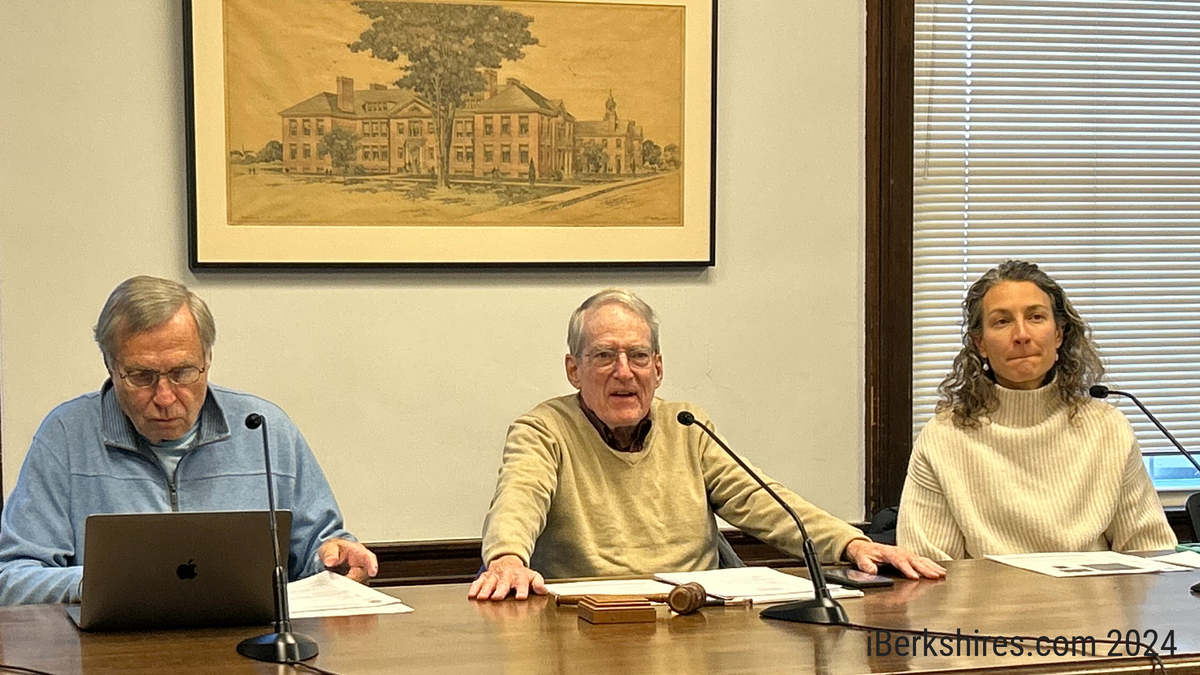
Board of Health Chair Dr. Erwin Stuebner said the panel should take up the idea at its January meeting.
In other tobacco related news on Monday, Wilusz shared with the board an annual report from the 14-municipality Tobacco Awareness Program.
A bright spot for Williamstown was that 8.9 percent of its adults smoke cigarettes, according to the latest figures from the commonwealth. That compares favorably with the 13.81 percent statewide average.
However, most of the communities served by the program continue to run ahead of the state average with its two largest — North Adams and Pittsfield — standing at 32.57 percent and 20.84 percent, respectively.
"Despite reductions in smoking prevalence due to strong comprehensive local and state laws, there is still a lot of work to do," the program's annual report reads. "We are still seeing prevalent tobacco use … in the Berkshires, and there are strategies we can work on as a collaborative to reduce those trends. Vaping is an epidemic in our schools, and our young people are getting access to them. Families and friends in some cases aren't even aware of what a vape looks like."
Stuebner asked Russell to try to seek out survey data on the use of tobacco among local youth.
In other business, the Board of Health heard about a couple of enforcement actions to address conditions at two residences and got an update on the long-standing issues at the 6 House Pub and 1896 House inn on Cold Spring Road.
Russell reported that a homeowner on North Hoosac Road appears to have addressed a concern related to "numerous haphazardly stored containers of waste cooking oil" that neighbors said were attracting rodents and bears. Russell said her inspection from the street showed that the issue was addressed; the board recommended she check in with the neighbors who reported the problem to see if they have continuing issues.
A correction order on Longview Terrace continues to be on the health agent's plate. She told the board that a property there is in violation of the state's sanitary code because of rubbish blocking the back exit, an extreme refuse and rubbish in the yard and standing water in various containers on the property. Russell said she is working with the Brian O'Grady from the Council on Aging to communicate with the resident about possible solutions.
At the 1896 House on Routes 2 and 7, the town is waiting on a plan of action to fix a number of electrical issues, including, potentially, overloaded circuits, improper clearance for electrical panels and improper wiring in the basement, Russell told the board.
She shared a Nov. 26 letter that asks the inn's owner to submit a plan of action to the building inspector, wiring inspector, health inspector and fire chief by Dec. 6.
Board member James Parkinson expressed frustration with the lack of a plan from the property owner.
"It seems like you're doing all the work, and they are not," Parkinson said. "Right from the beginning, I sensed this dragging of feet.
"I think we're at the point where we need to have a deadline. If these things are not done, the course of action may be to close them down."
The board agreed that Russell should consult with the town's wiring inspector to determine an appropriate deadline to complete all the work — taking into account the availability of licensed electricians — and set a parameter to address the safety issues.
As for the restaurant on the same property, Russell said the 6 House Pub is coming up on a one-year anniversary of a boiled water order after its former well failed. The owner is working toward getting a new well online; it has a February deadline to submit pressure test results to the Department of Environmental Protection, she said.
Tags: board of health, tobacco regulations,