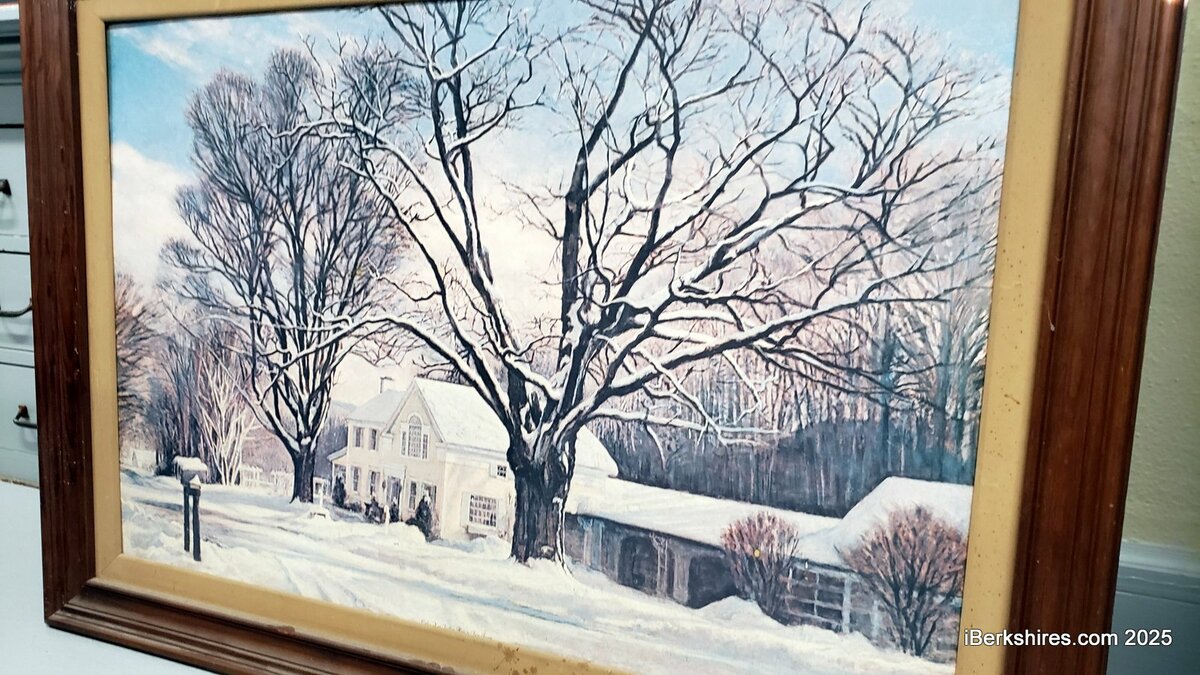
Clarksburg Gifting Historic Print to Dorset Historical Society
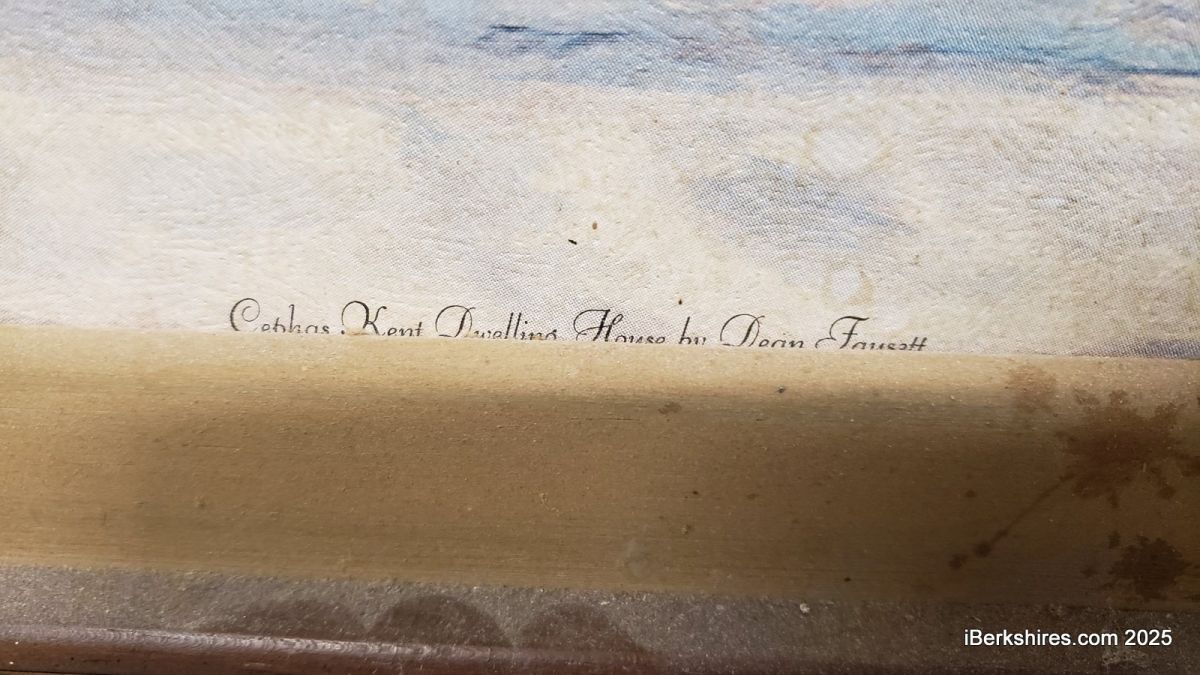
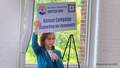
The caption on the print was partially obstructed but clearly says 'Cephus Kent Dwelling House,' a historic site in Dorset, Vt.
CLARKSBURG, Mass. — A large framed print of a yellow home on a snowy road has hung in Town Hall for years. The assumption had been that it was of a historic house that had been lost to demolition.
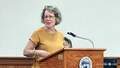
"It's been hanging and was hanging here for years. We thought it was somewhere in Clarksburg ... I remember looking at it, going, 'where is that?'" said Jeanne Moulthrop of the Historical Commission.
The print was moved upstairs to the commission's room with other items when the Town Hall flooded in 2023. And there it sat until Moulthrop decided to solve the mystery by looking up the artist, William Dean Fausett, and the nearly hidden caption "Cephas Kent Dwelling House by Dean Fausett."
It turned out the house was historic — to Vermont and particularly the town of Dorset.
[Update: after this story was published Sunday morning, the mystery of how it came to Town Hall was solved. Marybeth Kennedy of North Adams purchased the print from Pownal View Barn in 1977; she emailed iBerkshires and her son texted John Fosser in Clarksburg with the information. Kennedy says it hung in her home until she gave it to her son and daughter-in-law, Nate and Amy Cariddi, in 2006. Amy worked in Town Hall and her husband brought in the picture to fill an empty wall in her office. The print was left behind.
"They are not interested in us returning it, so it's a nice story and the print will go to a good home," wrote Moulthrop.]
Cephas Kent's inn and tavern in Dorset had been the site of four conventions that would result in the state declaring its independence as a nation from Great Britain in 1776.
Prior to that, the Vermont territory had been in the middle of a land tussle between New York State and New Hampshire. New Hampshire's Gov. Benning Wentworth had sold off town lots to Connecticut settlers and then the New York Supreme Court invalidated the grants in favor of its state's land patents.
(The first grant would result in Bennington, named for the New Hampshire governor.)
A militia, the Green Mountain Boys, was raised to fight off the New Yorkers and any redcoats attempting to oust the settlers. Once the American Revolution began, delegates from around the state gathered at Kent's Tavern to declare their independence. The Republic of Vermont would exist from 1777 until joining the union in 1791.
It's not known where the print came from and why it was in Town Hall, said Moulthrop. "All this time, we thought it was a Clarksburg home, and maybe one of the Clark houses."
The Vermont Historical Society had plenty of information on the inn and Fausett so they pointed her toward the Dorset Historical Society.
Jon Mathewson, curator at the time, responded immediately. "He got right back to me. It was this day off!" she said.
Mathewson, who just resigned to take on some research projects, explained the "interesting" relationship between Fausett and the tavern, Moulthrop said. The late artist, who had painted presidents, royalty and Grandma Moses, bought his house in 1945 and believed it's core had been part of Kent's home that had been altered and moved.
Historians have not been fully convinced but Dorset was very interested in obtaining Fausett's print of the tavern.
"They will be commemorating the 250th anniversary of the first [meeting] on July 26," Moulthrop said. "I'd be nice to have a copy of this print for their commemoration."
Moulthrop said the Select Board members and then Town Administrator Carl McKinney had approved the town gifting the print to Dorset. Commissioners will make the trip to the Vermont town later in the month to deliver it.
"That's where it belongs," she said.
Tags: historical,