Trees, Tall Grass Will Delineate Williamstown Dog Park
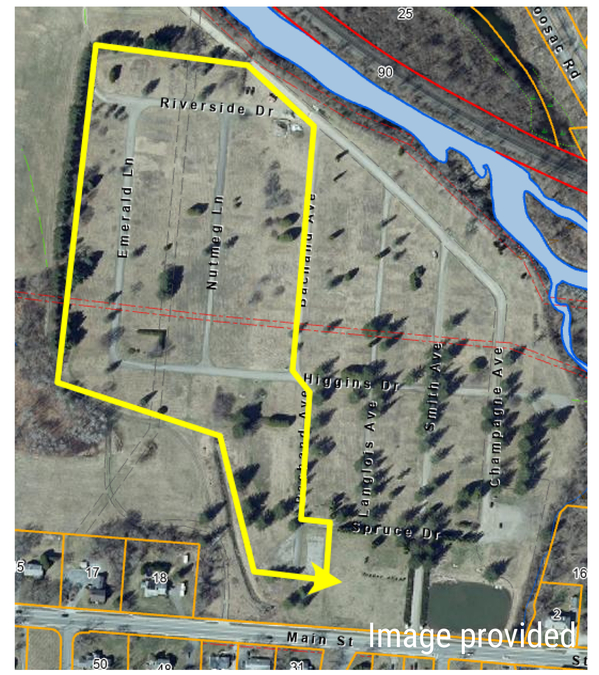
The town plans to designate an 18-acre area, outlined in yellow, for off-leash dogs at the Spruces Park.
Use of the 114-acre former mobile home park on Main Street has been on the table for the Select Board for more than two years, after a failed attempt by citizens petition to amend the town's leash bylaw at the 2023 annual town meeting.
Last September, the board agreed in principle to a plan to designate a section of the park for dog owners to bring their pets off leash.
At Monday's meeting, Town Manager Robert Menicocci brought the board a set of regulations that he proposes to post for an 18-acre portion of the park that will be delineated by natural boundaries and colorful "stakes" that the town hopes will keep the animals confined and alleviate the concerns of park users who do not want to be around unleashed dogs.
The Spruces Park, which was obtained by the town under the terms of a Federal Emergency Management Hazard Mitigation Grant following Tropical Storm Irene, is subject to FEMA prohibitions regarding the installation of objects — like fences — that could impede the property's function as a regulatory floodway.
Menicocci on Monday showed the board a set of rules for a "Dog Area … delineated by a vegetative buffer … open for off leash dogs seasonally after the buffer has established in the spring."
Select Board member Matthew Neely asked if the plan is to plant a hedge row or some type of vegetative border that will help define the off-leash area.
"Initially, when folks were scoping out the area, they thought it might be possible [to delineate] just by how you cut the grass," Menicocci said. "You might leave some of it natural, and what's cut would be the off-leash area. What wasn't — the tall grass, once that came around … We're still looking at the nuance of whether that's possible.
"It might just end up being the tree line. The tree line will be the border if that makes the most sense. If not, if we need a buffer, let's say, more toward the multi-use path, it might be where we don't cut the grass, and that's going to [demarcate] it. But the stakes will reinforce that."
Menicocci said he plans to have a "buffer zone" of undetermined size between the unleashed area and the Mohican Trail multi-use path, where signs are posted specifying that leashes are required for all dogs.
"I forget what [depth] was said in the conversation in our walks out there," Menicocci said. "I know it is somewhere in the ballpark of 25 to 50 yards, something of that nature."
The two pages of rules that Menicocci showed the board on Monday — including a requirement that dogs "MUST be within view and voice control of owner at all times" — came from an "amalgamation of all the language we could find from other places," he told the Select Board.
That language included at least one detail in the draft regulations Menicocci showed on Monday that appears to have been borrowed from a fenced dog park. Bullet point No. 6 on the draft regulations for the "Spruces Park Dog Area" specified that dogs "MUST be leashed when outside the gated enclosure."
On Monday, Menicocci clarified that he had intended that bullet point to state that dogs need to be leashed when outside the "designated area."
In response to a question from iBerkshires.com about whether he had found examples of other unfenced dog parks, Menicocci wrote on Tuesday, "many communities … have off leash areas that range from parks, beaches and wild land areas that exist throughout the state and country."
In September, the Select Board voted unanimously to have Menicocci create a better map for the off-leash area and develop "draft regulations." On Monday, he advised the board, which also functions as the town's parks commission, that the implementation of the dog area plan can be handled administratively without requiring another board action.
"It's draft, but it's also — there are different layers of regulation," Menicocci said. "There are town regulations we have under the purview of the town, which I would consider something of this nature. I could understand you just saying, 'Hey, we're the parks commissioners, and we want to have a formal vote,' that kind of thing. That would be your prerogative.
"Having it function under the town as a town regulation, I think, is more than sufficient. I don't have any problem with that. If you feel the need to put your stamp on it, we could do that. Obviously, we'll tighten this up, and we can talk more about anything else. It really just depends on your preference."
He also indicated that the rules for the off-leash area could be amended over time as the town sees how the rules are working.
Menicocci said successful implementation will depend on an education and public information campaign.
"I think part of this comes down to … how can we help out around creating good conversation of, ‘What kind of dog obedience community training opportunities are there?' " he said. "People share how they can best train their companions. In the end, it really comes down to … there are some good solutions for controlling dogs and such. And, in the end, it's a safety thing for them.
"I would say 99 percent of all dogs are pretty trainable in terms of being responsive to a boundary."
Education of a different kind was the focus of residents Polly McPherson and Jennifer Howlett, who spoke to the board to publicize the inaugural Williamstown Citizens Academy, which begins on Wednesday, May 7, at 6:30 at the David and Joyce Milne Public Library.
"Pittsfield has had a citizens academy for a couple of years, and Williamstown is going to have one starting this May," McPherson said. "What the citizens academy is is a series of seminars or Civics 101, if you will. Free, open to the public. They'll be happening at the library. And they will start out with learning about local government. Here in Massachusetts, we have the town meeting form of government, which, if you've moved into town, might be different from where you came from. But if you've lived here a long time, you understand that town meeting in May is where it all happens.
"So the first two sessions for the first seminar of the Citizens Academy, the first one will be with Bob Menicocci as our teacher and lecturer and professor. The second one, just in time for town meeting, will be from Elisabeth Goodman, who is our town moderator and is the person who makes town meeting run so smoothly and manages to get all the financial stuff very quickly and then we get into the real meat of town meeting."
In other business on Monday, the Select Board:
• Reminded residents that the annual town election is May 13.
• Voted to approve a change in the names on the liquor license of the Taconic Golf Club.
• Reopened the warrant for the May 22 annual town meeting that the board voted to close at its April 14 meeting to include a final article, a home rule petition that would adjust the terms of the library trustees to create more staggered terms. The board recommended town meeting approve what is labeled Article 32 and finalized the warrant.
• Heard a presentation from the Berkshire Regional Planning Commission about the town's Open Space and Recreation Plan that BRPC is finalizing for submission to state regulators on behalf of the town. Seth Jenkins told the board that an approved plan would make the town eligible for grants from the commonwealth, including the Parkland Acquisitions and Renovations for Communities {PARC] Grant.
• Discussed how the town can recognize the decades of service of recently retired Fire Chief Craig Pedercini.
• And heard a proposal from resident Leslie Gura about a proposed local ordinance to ban the use of second-generation anticoagulant rodenticides or SGARs on municipal properties in town.
Gura explained that SGARs can take up to 10 days to kill rodents and pose a threat to the wider environment because poisoned rodents in turn poison predators who kill and eat those rodents before the rodenticide does its job.
"[Raptors, owls and pets] don't die right away, but when they've had a few [rodents with SGARs], it builds up in their system," Gura explained.
Ironically, the SGARs end up killing the rodents' natural predators, thus allowing the rodent population to flourish.
Gura said some states, including California, have banned SGARs, and there is legislation on Beacon Hill to do the same in Massachusetts. In addition, some municipalities have voted to send home-rule petitions to Boston enabling those towns and cities to implement local bans on the rodenticides.
Gura is proposing, as a first step, that the Select Board approve a bylaw banning SGARs use on municipal properties.
Chair Jane Patton said that with only three board members in attendance on Monday (Stephanie Boyd, Neely and Patton), she would rather hold off on approving the bylaw until the full five-member body was present. In the meantime, Patton said she will reach out to the Mount Greylock Regional School District to see what its rodenticide protocol is at the elementary school, which is owned by the town and leased to the district, and middle-high school.
Tags: dog park, Spruces,