Adams Gets 'Clean' Audit for FY2024
ADAMS, Mass. — The town received an essentially "clean report" last week from its independent auditor, Adelson & Co., for fiscal year 2024, which ended last June 30.
"We have issued a clean opinion on your fund financial statements, so all of the accounting is accurate," David M. Irwin Jr. told the Board of Selectmen at its regular meeting. "We have good, clean opinion on general funds, special revenue funds, trust funds, fiduciary funds, everything that is fine. But at the governmentwide statement level, the town is required to report certain liabilities on its balance sheet in accordance with the Governmental Accounting Standards Board. One of those is that pension liability."
That forecasted liability is an actuary calculation by the state Public Employee Retirement Administration Commission. GASB requires that the proportionate share of that unfunded liability be put on the balance sheet, which for Adams is $9.8 million.
"For us to issue a clean opinion that that estimate that is put on your balance sheet is accurate, the Adams retirement system really has to be audited," Irwin said. That did not lie within Adelson's purview so the firm had to disclaim any opinion.
"Outside of disclaiming that opinion, all the accounting was fine, no material weaknesses, no significant deficiencies of any sort," he said. "The town did a good job with its accounting for fiscal year 2024."
Chair John Duval asked if there was any risk to the town if the retirement fund was not audited. When GASB began requiring the other post-employment benefits, or OPEB, to be included on balance sheets, rather than "buried" in audit notes, Irwin said he thought it could have had some affect.
"But there was no impact on the bond rating at that point, so that would have been the only negative that I could have seen," he said. "It has an impact with the town's ability to go after debt or go after grants."
The audit looked at financial reporting, that bank accounts are reconciled on a timely basis, that revenue deposits are going into the correct accounts, and test expenses for money coming out of the accounts. The town had about $7 million in its accounts. It also spent about $750,000 in federal funds that had to be carefully reviewed for compliance.
"We didn't notice anything unusual. So all the cash is fairly stated, all of it was confirmed, and everything that ran in and out of it was connected with the operations of the town," Irwin said. "The taxes receivable is about $700,000, that your real estate, personal property and motor vehicle taxes. ... It's a very positive comment for the collection of the taxes."
Tax liens brought in more than $800,000 in revenue last year, so the tax collector "has been really good being busy and making sure that you collect on your old tax receivables that are in the liening process."
Intergovernmental revenues were about $1.7 million because of the construction projects going on, such as the wastewater treatment facility, the Greylock Glen. Capital assets were pegged at $40.5 million with about $9.5 million in infrastructure. The town is holding just over $8 million in total debt and has met its debt obligations.
Irwin did have two recommendations: purchase fixed asset software which would allow for easier review of expense accounts and capital assets and to identify the levy year of the funds collected for the Adams Fire District for better tracking. He also recommended tagging federal dollars to assure compliance with federal auditing rules.
Selectman Joseph Nowak brought up his concerns about keeping the same audit firm for years, noting the town had just signed another three year agreement with Adelson.
Irwin said the annual audit takes about 400 hours and costs $38,000; the associates with Adelson must hold a bachelor's degree in accounting and are expected to obtain their master's and be licensed in the state.
He acknowledged he's been the town's auditor for 20 years and that his field auditors generally stay with their towns.
Selectwoman Christine Hoyt said she believed there were only a couple certified public accounting firms in Western Massachusetts and asked if the field audit teams were rotated.
"Usually we try and keep the staff consistent with the towns, because they know the findings of the towns and they know what to look for," Irwin said. "There is only a couple of CPA firms. We're the only one that I know of in Berkshire County that performs single audits, and this town is a single audit."
He said auditing firms are held to a very high standards and that they, in turn, are audited.
"These audits that I conduct here, the work that I do, to make sure that I'm doing my job the right, we are required to contract with a peer reviewer," he said. "They come in and they audit my work, and then they report that information to the review board for the Commonwealth of Massachusetts in order for me to hold my license."
In other business, the board:
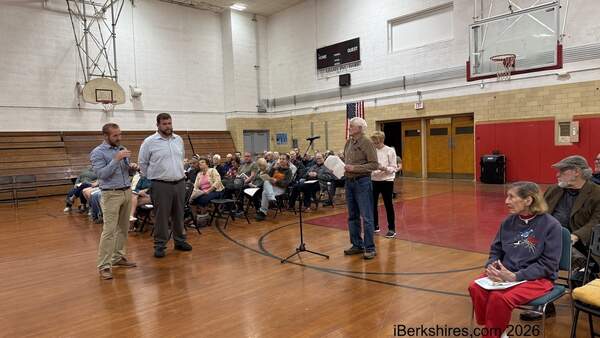
• Referred an Open Meeting Law complaint dated April 8 from Patrick Higgins of Alabama, a frequent filer of OML complaints in Massachusetts, to town counsel.
• Closed the town meeting warrant. One of three citizens' petitions received enough signatures to be included: It would require one or more selectmen to hold 60 to 90-minute community forums on the Greylock Glen project.
• Designated interim Town Administrator Kenneth Walto as the acting Department of Public Works director. That post has been empty for some time and the past town administrator had also stepped in as acting director. Duval said the position will be the subject of one or more future workshops.
Tags: audit,