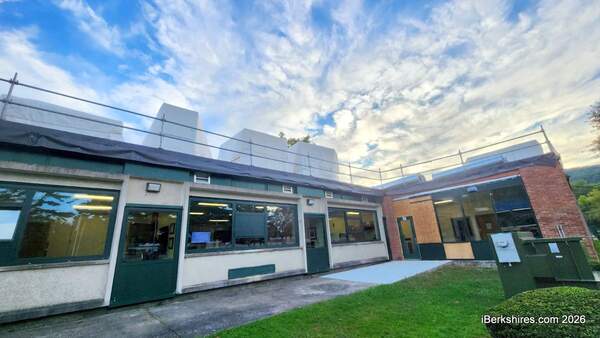
The Lenox Housing Authority voted at its Wednesday, Oct. 2 meeting not to go forward with a proposal to put cellular antennas on the chimneys of the Curtis Building and cell equipment in the basement, according to Chairman Edward J. Roche Jr.
Roche declined to say why the LHA made this decision, but said the board reserves the right to revisit the issue in the future. Abutters and residents in the Curtis had met and circulated a petition against the project, that week and the week before.
AT&T Wireless originally proposed the installation to give coverage to downtown Lenox. The Curtis would link up with a proposed extension of the cell tower at the Lenox Fitness Center. The Zoning Board of Appeals asked, at the Sept. 10 hearing on the proposal, that the LHA request the special permit for the antennas at the Curtis. Robert McNinch explained that the the LHA planned to put the project out to bid, and AT&T might not win the bid. The LHA, as the owner of the building, should make the proposal.
Roche simply said the LHA did not wish to make the request for proposal (RFP) for this project. AT&T will withdraw this petition if the LHA does not go forward. Marty Nee, a spokesman for AT&T Wireless, said A&T would look at alternative sites in the Lenox downtown area. AT&T has not entered into any formal negotiations yet; it was too soon for him to say what sites might be considered.
AT&T will go forward with the proposal to extend the fitness center tower by 20 feet, from 120 to 140 feet. This tower will cover Route 7 & 20 north and south of the fitness center, but will not cover the downtown area well, Nee said. Antennas typically cover 1 to 3 miles, but the distance varies dramatically depending on the character of the landscape. AT&T came before the ZBA Oct. 8.
Sept. 25 Edward Acker, who lives next to the Curtis, held a meeting in the Town Hall to address the proposed cell antennas on the Curtis roof. He hoped to hold the meeting at the Curtis, but the Curtis is a private residence; public meetings are not allowed there.
Of the 25 people who came to this meeting, 12 were Curtis residents. Many Curtis residents did not know about AT&TÕs proposal, Acker said; it had been in the newspapers, but they had not been individually notified. He added that the LHA effectively provides the building for events like fire drills.
Bill Curry, a physicist from Chicago, came to the meeting to discuss microwave radiation Ñ the kind emitted by cell antennas. Curry is an expert on microradiation who travels and lectures on the effects of cell towers. Acker said he brought a meter and took the participants out to the Lenox Fitness Center tower, to monitor its activity. They took readings a the fitness club and at the Arcadian Shop across the street.
The tower was very active, Acker said. Curry told Acker he would not want to live nearby. Residents of the LHA were chiefly worried, not about radiationÕs possible long-term effect on the brain, but about its possible short term effect on health devices: hearing aids, electric wheelchairs, and pacemakers. Many residents of the LHA are elderly or disabled, and use these things. Microwave radiation demonstrably interferes with all of them, Acker said; cell phones are not allowed in hospitals.
Acker and several LHA residents began circulating a petition opposing the Curtis cell tower proposal. Acker said he asked to put up posters at the Curtis, and pass out flyers; this is not allowed either. As of the following Wednesday, the petition had nevertheless gathered 100 signatures. 40 were LHA residents Ñ out of approximately 60 apartments in the building.
Acker said he also had help from June MacFarland. The MacFarlands brought Sarah Clarke, a health activist, to the Sept. 10 ZBA hearing, to discuss the possible dangers of living or working near a source of cellular radiation. Clarke in turn helped Acker to get in touch with Curry. Acker added that a woman called him to say she had moved out of her house in Boston after three cell towers went up in the area; she began having headaches and memory problems.
Nee said if the LHA had chosen to go forward with its proposal, AT&T would have addressed any concerns the residents had about the radiation.
AT&T has never had any problems at any of its tower sites, he said. ÒWe have them on the roofs of most hospitals in the greater Boston area.Ó
Hospitals are high buildings, and they use their own radio frequencies to communicate over radio.
AT&T is licensed to offer coverage throughout the Berkshires, Nee said. They are expanding their coverage throughout the county.
If you would like to contribute information on this article, contact us at info@iberkshires.com.
Your Comments
iBerkshires.com welcomes critical, respectful dialogue. Name-calling, personal attacks, libel, slander or foul language is not allowed. All comments are reviewed before posting and will be deleted or edited as necessary.
No Comments
Veteran Spotlight: Coast Guard Capt. Thurman 'Tom' Maine
By Wayne SoaresSpecial to iBerkshires
MASHPEE, Mass. — If I were to describe the best attributes of this week's veteran, they would be an infectious personality, role model, leader, wonderful family man and a person that leads by example in the very best way.
The aforementioned, are the primary reasons why Thurman "Tom" Maine enjoyed a successful and distinguished military career in the Coast Guard from 1983 to 2014.
Born in North Stonington, Conn., Maine entered the Coast Guard at the age of 21 and was sent to boot camp in Cape May, N.J. His first assignment was at Coast Guard Station in Provincetown, R.I. From 1994 to 1997, he was a helicopter pilot for Coast Guard Air Station at Otis Air National Guard Base and was elevated to operations officer, chief pilot at the base from 2004 to 2007.
During his 31-year career, Maine flew some of the Coast Guard's most elite helicopters; the Sikorsky H-3 (the Coast Guard's last amphibious aircraft), the Sikorsky H-60 (the most widely flown military helicopter in the world) and the H-65 (a smaller, faster helicopter that deploys on ships).
Maine continued to rapidly climb the ranks and in 2009 was promoted as the Coast Guard's liason to the Chairman of The Joint Chiefs of Staff at the Pentagon, a position he held until 2011. Following that assignment, he was promoted to captain and rose to be the commanding officer at the Coast Guard's prestigious Aviation Training Center in Mobile, Ala.
During his tenure as commanding officer, he suffered a devastating blow when four Guardsman were killed during a night training exercise. He conveyed that his greatest achievement in his entire military career, was the leadership he provided
to his 600-member unit and the families of the fallen Guardsmen, by always being accessible, communicating constantly and holding vitally important family nights.
He said this tragedy, "gave him the ultimate opportunity to live out his faith." He also lobbied intensely for the student pilot who was killed to be awarded his designation posthumously, which he did.
If I were to describe the best attributes of this week's veteran, they would be an infectious personality, role model, leader, wonderful family man and a person that leads by example in the very best way. click for more
Northern Berkshire United Way entered the 1990s with big goals — and met almost all of them. It ended the decade with the largest campaign in its history.
click for more