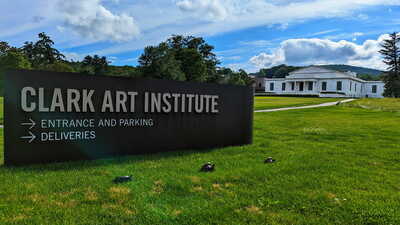
WILLIAMSTOWN, Mass.— On Sunday, June 22 at 11:15 am, the Clark Art Institute presents "In Focus: Field and Flowers," a free thematic tour of the Clark's permanent collection exploring how artists celebrate the beauty of food and flowers in their art.
Free with gallery admission. Capacity is limited. Pick up a ticket at the Clark Center admissions desk, available on a first-come, first-served basis. Meet in the Museum Pavilion.

If you would like to contribute information on this article, contact us at info@iberkshires.com.
Your Comments
iBerkshires.com welcomes critical, respectful dialogue. Name-calling, personal attacks, libel, slander or foul language is not allowed. All comments are reviewed before posting and will be deleted or edited as necessary.
No Comments
Theater Review: 'Driving Miss Daisy' Is a 'Wondrous' Production
By Alan PetrucelliSpecial to iBerkshires
PITTSFIELD, Mass. — Alfred Uhry's "Driving Miss Daisy" rolled into the St. Germain Stage in late May, marking the opening of Barrington Stage Company's 2026 season.
And what a wondrous, welcoming production it is. Uhry won a Pulitzer Prize for his work; he won an Oscar for the 1989 film adaptation of the play, which also won the Best Picture Oscar. Yes, that's how good it is.
Daisy Werthan is a 72-year-old white Jewish widow in Atlanta whose car accident destroyed her Packard — and her chance to ever drive herself again.
"Mama, we are just going to have to hire someone to drive you," her adult son Boolie tells her.
She is adamant: "What I do not want — and absolutely will not have — is some chauffeur sitting in my kitchen, gobbling my food and running up my phone bill."
Enter Hoke Colburn, an unemployed African-American illiterate who grew up in rural Georgia during the Jim Crow-era South. Boolie hires him at $20 a week, and in a span of 85 minutes and a decade or so, this odd couple develop a tight bond that overcomes their cultural, gender and class differences.
Though she's living in a racially explosive time in the South, the irascible Miss Daisy doesn't consider herself racist, nor does she fully accept the realities of the racist culture that has even resulted in a bombing at her own synagogue (a true event in Atlanta, in 1958).
Uhry won a Pulitzer Prize for his work; he won an Oscar for the 1989 film adaptation of the play, which also won the Best Picture Oscar. Yes, that's how good it is. click for more
A granite installation in Bloedel Park next to the town's new traffic rotary honors the area's first residents and caps an effort that began five years ago. click for more
The Select Board on Monday decided to enter into negotiations with Williams College on the sale of the vacant town-owned lot at 59 Water St.
click for more