At their Oct. 9 meeting, the Lenox Select Board reviewed the Lenox residents’ options for reducing their tax burdens. Lenox offers tax exemptions for blind residents, veterans and their survivors. The town offers two different exemptions (Clauses 18 and 41C) for senior citizens. Residents who meet the qualifications may apply for these exemptions, to lower their property tax bill by a given amount.
In a meeting Sept. 23, Chair of the Select Board William “Smitty†Pignatelli, Selectman Timothy Doherty and Selectman Terrence Field asked for information on various options. At this meeting, they opened a public hearing on tax classifications. They approved a single tax rate for the town and set a tax rate of $11.84 for fiscal year 2003.
Assessor James Kincaid said estimated receipts for FY 2003 were approximately $600,000 less than the town’s actual receipts from 2002. Town Manager Gregory Federspiel added that the town could see further drains on its resources mid-year: state aid could drop. Rooms tax could decrease when the Canyon Ranch case is settled; Canyon Ranch has appealed before the state, because the rooms tax now applies to a package deal covering all of their services, and they would like it to be confined to rooms. If the town does lose revenue, Federspiel said, it could take some out of its fund balance, or cut back on operations, or get a short-term loan.
The Selectmen agreed that they would not raise the tax rate further, because they had committed to it at the Special Town Meeting in September.
Lenox Property Taxes
For senior citizens:
*Under Clause 41C, residents age 70 or older can qualify for a $500 reduction in their taxes. The financial guidelines are: $13,000 income for a single person, with a social security deduction of $3,361; for a married couple, income $15,000 with a social security deduction of $5,042 and a $30,000 limit on savings. The social security deduction is an amount of social security that does not count toward the $13,000 or $15,000 total. It is, in fact, subtracted. T. Christena Roberts, administrative assessor, explained: if a single person had an income of $16,000, they could subtract the $3,361 and still qualify for the exemption.
A property owner may not have cannot have assets of more than $28,000 or a married couple more than $30,000, to qualify for the exemption. If someone co-owns a property but is not a spouse, each co-owner also cannot have assets of more than $28,000 if single or $30,000 if married. These assets do not include the value of the property owner’s house and land. The property owner or owners may deduct up to a three family house.
The state passed this exemption, Clause 41, in the 1960s. Lenox adopted Clause 41C, a more liberal version, over ten years ago. According to an Informational Guideline Release from the Property Tax Bureau, legislation signed in 2002 can provide even more help for people with heavy tax burdens. Towns may opt to relax the limits on who may apply for a tax break, or increase the amount of the tax break.
Assessor James Kincaid said Lenox could lower the age limit from 70 to 65. The town could increase minimum income from $13,000 to $20,000 for a single person, and from $15,000 to $30,000 for a married couple, and increase assets from $28,000 to $40,000 for a single person, or from $30,000 to $50,000 for a married couple. The town could also increase the allowed deduction from a three family to a four family house, or increase the reduction from $500 to $1000. Kincaid believed the town could opt for some, but not all of these changes, under state law.
Any of these changes must be approved by a town meeting before the tax rate is set for the fiscal year, so the town cannot take advantage of them in 2003.
Federspiel said these restrictions are strict. The select board was interested in looking into options for relaxing them further. The board has asked for information on seniors who do not qualify under the 41C restrictions now, but could qualify under the more liberal restrictions.
The Senior Citizen Property Tax Work-off Abatement
This is another option Lenox could choose to adopt. The state approved the Senior Citizen Property Tax Work-off Abatement as a local option in July 1999. Under Property Tax Bureau rules, this measure also must be accepted during a town meeting, for a specific fiscal year. It may be revoked later, but the town must wait until three years after accepting the statute in order to revoke it. The town must also vote to revoke it.
The work-off abatement would allow taxpayers over 60 to receive an abatement of up to $500 in exchange for volunteer work in the community. A volunteer would earn the abatement at an hourly rate no higher than minimum wage ($6 per hour, as of January 2000).
Reimbursement to the town
The state reimburses the town for some of these exemptions. The town pays out all of these exemptions from the overlay account, Kincaid explained. The overlay is the amount allocated each year to cover exemptions or abatements. The assessors keep funds in an overlay account each year to cover these expenses. An abatement is a reimbursement the town pays to someone who successfully contends that their tax bill is too high. A resident who contests their tax bill pays the bill in full first. Then the town reviews their request for an abatement. If the town grants the abatement, the town repays the tax payer the requested amount from the overlay account. If the town does not grant the abatement, the resident may appeal the decision in the appellate court.
The changes to Clause 41C and the Senior Citizen Property Tax Work-Off Abatement are local options. The state would not reimburse the town for these reductions. The state reimburses the town at the same rate as it reimbursed the town in the last year the town was running of Clause 41 — the same lump sum. Lenox adopted 41C in 1991. The state reimbursement is capped at approximately $15,500.
Hardship, Clause 18
Residents age 65 or older may apply for one more exemption if they are medically infirm. They would need a doctor’s certificate proving their infirmity, Kincaid said. Roberts said that the amount of this exemption is at the discretion of the Board of Assessors; they can exempt the full tax payment if they believe it is appropriate.
Blind residents
The town offers an exemption to blind residents with a minimum ownership interest of $5000. They need a doctor’s certificate also. They are eligible for a $437 reduction.
Veterans and their survivors
Veterans and their parents, spouses and children may apply for varying reductions, depending on the veterans’ service and injuries. Clause 22 veterans — veterans with a minimum of 10 percent war service disability, or veterans of certain WWI conflicts, or veterans awarded Purple Hearts, or survivors and spouses of any of these, Gold star parents, or surviving spouses of WWI veterans qualify for an exemption of $250.
Veterans who lost one hand, foot or eye or received certain service medals (22A) receive $425; veterans who lost two feet, hands or eyes (22B) get $775; Veterans with 100 percent disability and specially adapted houses (22C) $950; veterans with 100 percent disability who are unable to work (22E) $600; and paraplegics full exemptions. They all must have been living in Massachusetts for six consecutive months before entering the service or for five consecutive years before applying for the exemption.
Surviving spouses of veterans killed during Quemoy and Matsu mission (22D) receive $250, and must have been living in Massachusetts for five consecutive years before applying. Spouses may apply for any of the applicable reductions until or unless they remarry.
Clause 22 veterans must have a minimum ownership interest of $2000 to apply. The minimum ownership interest for 22A veterans is$4000; for 22B veterans, $8000; for 22C veterans, $10,000; for 22E veterans, $6,000; for 22D veterans, $6000; and for paraplegic veterans, $6,000.
State income taxes
Circuit Breaker tax credit for Mass. residents age 65 or older came into effect Jan. 1, 2001. A taxpayer who rents his house is eligible for the credit if his income does not exceed $41,000 for a single individual who is not the head of the household, $51,000 for the head of the household, or $61,000 for a husband and wife filing jointly. A resident who owns his house and occupies it is eligible under the same restrictions. The Department of Revenue has more information at www.dor.state.ma.us/rul-reg/tir/tir01-19.html.
If you would like to contribute information on this article, contact us at info@iberkshires.com.
Your Comments
iBerkshires.com welcomes critical, respectful dialogue. Name-calling, personal attacks, libel, slander or foul language is not allowed. All comments are reviewed before posting and will be deleted or edited as necessary.
No Comments
Berkshire County Homes Celebrating Holiday Cheer
By Breanna SteeleiBerkshires Staff
There's holiday cheer throughout the Berkshires this winter.
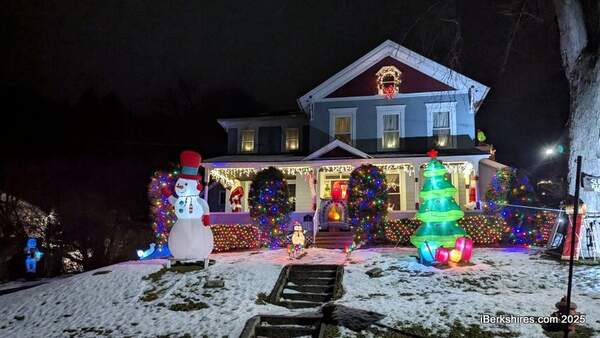
Many homeowners are showing their holiday spirit by decorating their houses. We asked for submissions so those in the community can check out these fanciful lights and decor when they're out.
We asked the homeowners questions on their decorations and why they like to light up their houses.
In Great Barrington, Matt Pevzner has decorated his house with many lights and even has a Facebook page dedicated to making sure others can see the holiday joy.
Located at 93 Brush Hill Road, there's more than 61,000 lights strewn across the yard decorating trees and reindeer and even a polar bear.
The Pevzner family started decorating in September by testing their hundreds of boxes of lights. He builds all of his own decorations like the star 10-foot star that shines done from 80-feet up, 10 10-foot trees, nine 5-foot trees, and even the sleigh, and more that he also uses a lift to make sure are perfect each year.
"I always decorated but I went big during COVID. I felt that people needed something positive and to bring joy and happiness to everyone," he wrote. "I strive to bring as much joy and happiness as I can during the holidays. I love it when I get a message about how much people enjoy it. I've received cards thanking me how much they enjoyed it and made them smile. That means a lot."
Pevzner starts thinking about next year's display immediately after they take it down after New Year's. He gets his ideas by asking on his Facebook page for people's favorite decorations. The Pevzner family encourages you to take a drive and see their decorations, which are lighted every night from 5 to 10.
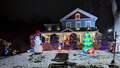
In North Adams, the Wilson family decorates their house with fun inflatables and even a big Santa waving to those who pass by.
The Wilsons start decorating before Thanksgiving and started decorating once their daughter was born and have grown their decorations each year as she has grown. They love to decorate as they used to drive around to look at decorations when they were younger and hope to spread the same joy.
"I have always loved driving around looking at Christmas lights and decorations. It's incredible what people can achieve these days with their displays," they wrote.
The Wilsons' invite you to come and look at their display at 432 Church St. that's lit from 4:30 to 10:30 every night, though if it's really windy, the inflatables might not be up as the weather will be too harsh.
In Pittsfield, Travis and Shannon Dozier decorated their house for the first time this Christmas as they recently purchased their home on Faucett Lane. The two started decorating in November, and hope to bring joy to the community.
"If we put a smile on one child's face driving by, then our mission was accomplished," they said.
Many homeowners are showing their holiday spirit by decorating their houses. We asked for submissions so those in the community can check out these fanciful lights and decor when they're out.
click for more