Williamstown Select Board Talks Trash
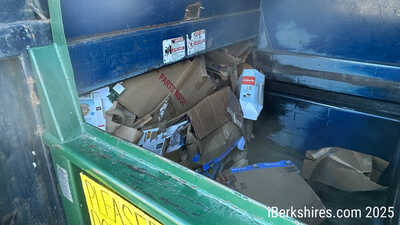 |
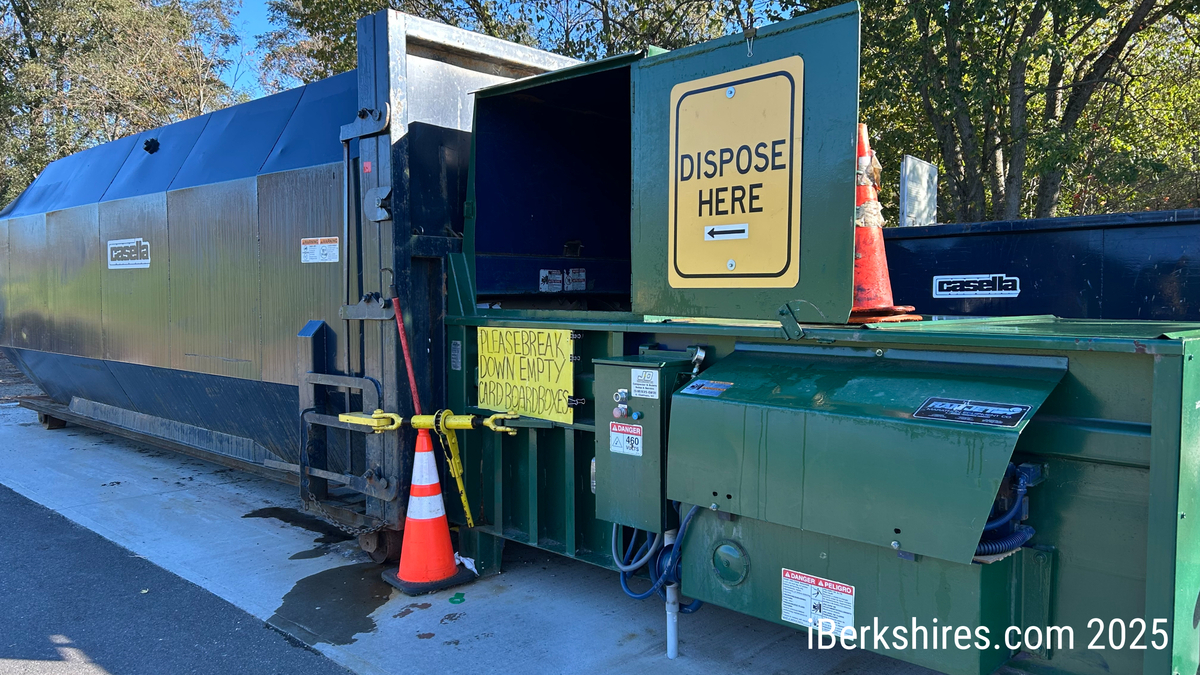
WILLIAMSTOWN, Mass. — A paper and cardboard compactor at the transfer station installed a couple of years ago is saving the town tens of thousands of dollars each year, the Select Board learned recently.
Nancy Nylen, who represents the town on the 14-town Northern Berkshire Solid Waste Management District, was before the board at its late September meeting to talk about the district's activities and the operations at the town transfer station.
The large green compactor is the most prominent modification to the town facility since a large solar field was installed on the capped landfill in 2017.
Like the 19 1.9-megawatt photovoltaic array that helps power town and public school infrastructure, the compactor is paying dividends for local taxpayers.
"There used to be a big rolloff container that you'd walk into with your paper and cardboard recycling," Nylen said. "We could fit about 1-plus tons in that container before it was hauled away, and it's expensive to haul away.
"Recently, we put in a compactor. Now, in one haul, we fit 6 to 7 tons of paper. We've been saving $20,000 a year just in hauling fees."
The compactor itself was paid for largely through grants, she added.
"It's really a win-win-win for the town," Nylen said. "Thanks to [DPW Director Craig Clough] and Justin [Maynard Olansky] and the crew for getting this all together and hooked up."
In addition to paper and cardboard, residents who pay a $120 per year fee can use the station to recycle glass, metal and plastic and, more recently, food waste.
"We started composting food waste as a pilot project," Nylen said. "People purchased green buckets. We had 100-plus households do that. … We still encourage people to compost in the back yard, but composting at the commercial level allows you to do dairy, meat and bones.
"Right now, we have a contract with Tommy's [Compost Service], which picks up composting once or twice per week. To date, we have diverted 43,000 pounds of food waste from going to landfills."
In addition to the local service at the transfer station, where household waste can be disposed of in bags ($2 for a 15-gallon bag, $4 for larger bags) residents also have access to special waste disposal events held by the NBSWMD like paper shredding, household hazardous waste and bulky waste collection dates.
In addition to the report from Nylen, which she called "Trash 101," the Select Board received a report from Finance Committee member Suzanne Stinson, who served on that body's debt study committee.
Stinson explained the group's intent and some of the data it has collected in hopes of helping the town take a long-term approach to taking on new debt.
"We specifically wanted to provide a view of our borrowing and assets that took into account more than one year," Stinson said. "Rather than the annual budget process with one thing coming up in a given year that you look at in isolation, this was an attempt to see what it looks like five years out and, maybe, five years back.
"The entire effort is designed to support town decision processes and, ultimately, the residents who make their decisions at town meeting. It's in support of that decision-making process, not a separate layer on top of it."
The reports from Nylen and Stinson were in keeping with a priority by board chair Stephanie Boyd to keep the panel in touch with other town activities and give a platform for other volunteers to reach viewers of Select Board meetings on the town's community access television station, WilliNet. On Monday, the board is scheduled to hear from the chair of the town's Agricultural Commission and its representatives to the board of the Hoosac Water Quality District, which was the center of much discussion last spring over its practice of producing compost from sewage.
Also on the agenda for Monday's meeting is a discussion of how to fill a vacancy on the five-person board. At its last meeting on Sept. 29, Jeffrey Johnson said that his resignation, which he first announced in August, would take effect on Sept. 30.
"I'd like to thank the citizens and my colleagues," Johnson said. "It's been the honor and the privilege of a lifetime to be entrusted by the people of Williamstown to serve on our board."
Among his final acts on the board were participating in a couple of holiday-related discussions.
The executive director of the Williamstown Chamber of Commerce was before the body to ask the town to contribute $10,000 toward a $35,000 project to replace the lighted snowflake decorations that are hung on street lamp poles on Spring Street each November. Susan Briggs told the board that the current decorations were purchased in 1999 and, after decades of display through the winter months,are in need of replacement.
The board asked Briggs to come back after considering a smaller-scale installation rather than the Chamber's proposal to install the decorations the length of Spring Street, west on Latham Street and up Water Street.
Finally, the board, as it does each year, designated the "official trick-or-treat hours" for Williamstown neighborhoods as 5:30 p.m. to 7:30 p.m. on Friday, Oct. 31. Briggs told the board that Spring Street businesses would host trick-or-treating from 4 to 5.
Tags: recycling,